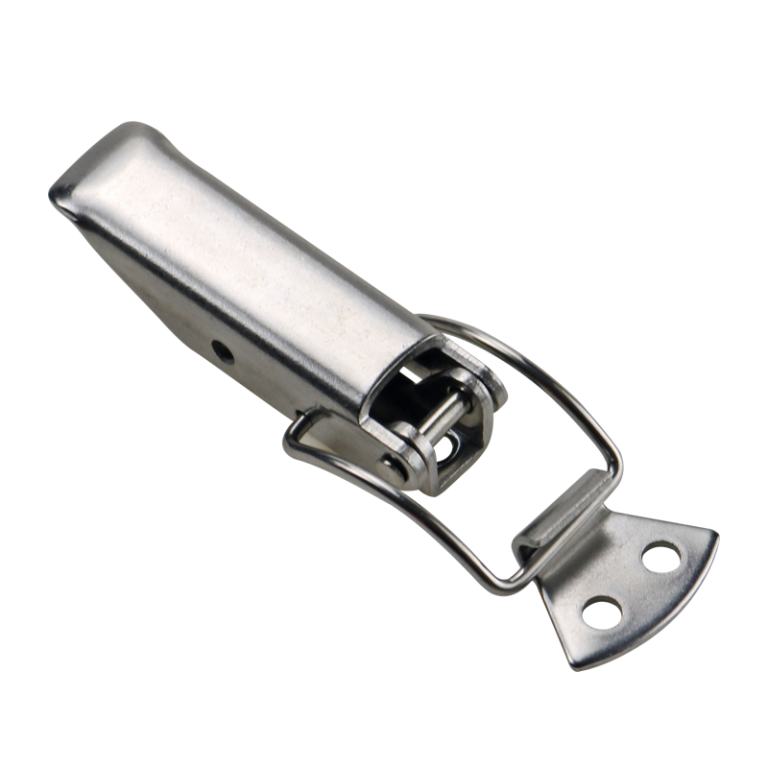
HTAN ist einer der führenden Hersteller von industriellen Scharnieren, Griffen und Verschlüssen in China.


The handle on an electrical cabinet door does two jobs that pull in different directions: it has to let an authorized technician open the door quickly, and it has to keep everyone else out. A standard pull handle does the first job well and ignores the second. A locking handle does both, at the cost of more hardware and an extra step every time the door is opened. Choosing between them is not about which handle is “better” — it is about whether the cabinet needs controlled access or just a way to open the door.
This guide compares locking and standard pull handles for electrical cabinet doors across access control, safety, sealing, and cost, so you can match the handle to what the cabinet actually needs. It focuses on the locking-versus-standard decision rather than handle materials or mounting methods, which are covered separately.
Quick Answer: Which Handle Does Your Cabinet Need?
| If the cabinet… | Better choice | Warum |
|---|---|---|
| Contains live equipment in a public area | Locking handle | Restricts unqualified access |
| Sits inside a locked electrical room | Standard pull handle | Access is already controlled |
| Needs multi-point gasket compression | Locking swing handle | Can drive rod closure |
| Is opened many times per shift | Standard pull handle | Faster operation |
| Requires lockout/tagout support | Locking or padlockable handle | Supports maintenance control |
In short, the cabinet’s location and who can reach it decide the handle. A cabinet behind a locked door in a controlled facility may only need a standard pull handle, while a cabinet in a public corridor, outdoors, or on a factory floor with mixed traffic usually needs a locking handle to keep unqualified people out.
What Each Handle Type Actually Does
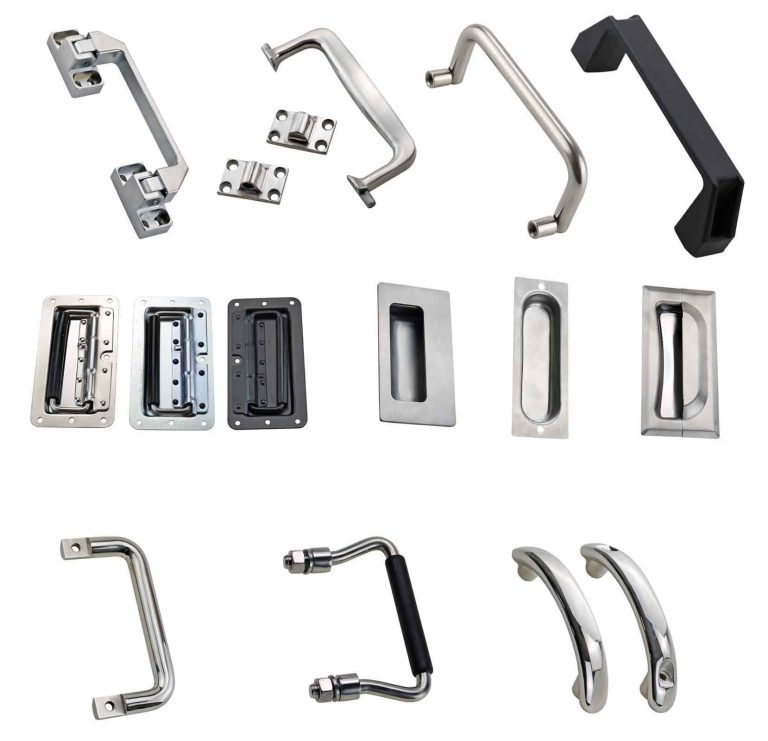
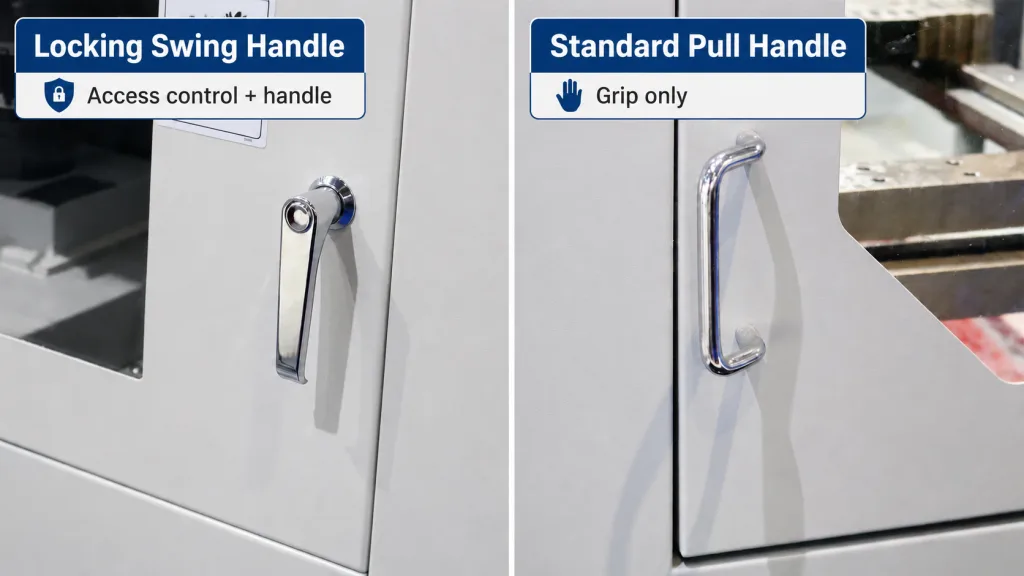
A standard pull handle is a fixed grip mounted on the door. It lets a person grip and pull the door open, and that is all it does — the door’s closure depends entirely on a separate latch or catch. The handle itself adds no security. Standard pull handles are simple, low-cost, and fast to operate, which makes them the right choice when access does not need to be restricted.
A locking handle integrates the gripping function with a locking mechanism, often a swing handle that folds into a recess and turns to drive a latch or multi-point rod system. To open the door, the user unlocks the handle — with a key, tool, or code — then turns it to release the latch. This combines access control and door operation in a single component, so the door cannot be opened without first defeating the lock. Locking handles are standard on electrical enclosures where unqualified access is a safety hazard.
Access Control: The Core Difference
The defining difference is access control. Electrical cabinets often contain live components that are dangerous to anyone who is not trained to work on them, which is why many installations require that the enclosure restrict access to authorized personnel. A locking handle is how that requirement is usually met at the door.
Locking handles come with several access options. A keyed cylinder limits opening to whoever holds the key. A standardized tool key — such as a double-bit or triangular key — lets any authorized technician open the cabinet with a common tool while still excluding the general public. Padlockable handles accept a padlock or lockout device, which matters for lockout/tagout procedures during maintenance. The right option depends on how tightly access must be controlled and who needs to get in.
A standard pull handle offers none of this. Anyone who can reach the door can open it, so it is only appropriate where access is already controlled by other means — a locked room, a fenced area, or a restricted zone. For ergonomics and grip comfort across both handle types, the principles in the guide to ergonomische Industriegriffe still apply, since a locking handle must still be comfortable to operate.
The Practical Rule: Control the Room or Control the Door
The decision starts with one field question: who can physically reach the cabinet door? Everything else follows from the answer. Access to live equipment has to be controlled somewhere — the only question is whether it is controlled at the room or at the door.
If the cabinet is already inside a locked electrical room, a standard pull handle may be enough, because access is controlled at the room level. Adding a lock at the door would just be a second barrier behind a door that is already secured. But if the cabinet sits in a public corridor, an outdoor area, a production floor, or a shared maintenance zone, access must be controlled at the door — which usually means a locking handle. There is no controlled room boundary doing the job for you, so the handle has to do it.
This is why two identical cabinets can correctly use different handles: it is not the cabinet that decides, it is where the cabinet sits. Before specifying the handle, look at the surroundings, not just the enclosure.
Sealing and Multi-Point Closure
Locking handles do more than control access — many also improve how the door seals. A swing-handle locking system can drive a multi-point rod mechanism that pulls the door tight against its gasket at several points along the edge, rather than relying on a single latch. For large electrical cabinet doors, this even compression helps maintain the enclosure’s ingress protection by keeping the gasket evenly loaded across the full door.
A standard pull handle does not contribute to sealing at all, because the door’s closure and compression come entirely from a separate latch. That can be perfectly adequate for a small door with a single latch, but on a large door it is harder to achieve even gasket pressure without a multi-point system. So the choice of handle can be tied to the sealing strategy: where a tight, even seal on a large door matters, a locking handle that drives multi-point closure offers an advantage a standard pull handle cannot.
Cost, Speed, and Daily Operation
Standard pull handles win on cost and speed. They are cheaper, simpler to install, and faster to use because there is no lock to operate. For a cabinet that authorized operators open dozens of times a shift in an already-secure area, a locking handle adds friction to every single operation with no security benefit, since access is controlled elsewhere. In that situation the standard pull handle is the better engineering choice.
Locking handles cost more and add a step, but that step is the point: it is what keeps unqualified people out. The question is whether that access control is needed. If it is — for safety, compliance, or security — the extra cost and the extra second to unlock are worth it. If it is not, they are pure overhead. The mounting and installation differences between handle styles are covered in the guide to choosing the right handle installation method.
How to Decide
Work through these questions in order to land on the right handle:
| Frage | If yes → Locking | If no → Standard may be enough |
|---|---|---|
| Can unqualified people physically reach the cabinet? | Locking handle | Standard possible |
| Does a standard or regulation require restricted access? | Locking handle | Standard possible |
| Is the door large and dependent on even multi-point sealing? | Locking (multi-point) handle | Standard possible |
| Is the cabinet already inside a secured, access-controlled area? | Standard pull handle | - |
| Is the door opened very frequently by trained operators only? | Standard pull handle | - |
For electrical cabinets specifically, the requirements that come with live equipment mean a locking handle is the default in most exposed or public-facing installations. The detailed requirements for handles on these enclosures are covered in the guide to handles for electrical cabinet doors. You can also browse the full range of industrial pull handles to compare locking and standard options.
FAQ
Do electrical cabinets legally require locking handles?
Requirements vary by region, industry, and where the cabinet is installed, but many installations require that enclosures with live equipment restrict access to authorized personnel, and a locking handle is the usual way to meet that at the door. Always confirm the specific standards that apply to your installation rather than assuming a standard pull handle is acceptable.
Can a locking handle improve the door seal?
Yes, when it drives a multi-point rod system. A swing-handle locking mechanism can pull a large door tight against its gasket at several points along the edge, giving more even compression than a single latch. This helps maintain the enclosure’s ingress protection on large doors where even sealing is hard to achieve otherwise.
When is a standard pull handle the better choice?
A standard pull handle is the better choice when access is already controlled by other means, such as a locked room or fenced area, and the door is opened frequently by trained operators. In that case a locking handle adds cost and an extra step on every operation without adding any security, so the simpler handle is the right engineering decision.
What is the difference between a swing handle and a standard pull handle?
A standard pull handle is a fixed grip that only lets you pull the door open, with closure handled by a separate latch. A swing handle folds into a recess and turns to drive a latch or multi-point rod system, and it usually includes a lock. The swing handle combines access control, operation, and often multi-point sealing in one component.
Are locking handles worth the extra cost?
They are worth it whenever access control is genuinely needed for safety, compliance, or security, because that is exactly what the lock provides. They are not worth it when the cabinet already sits in a secured area and only trained operators reach it, since then the lock adds cost and operating time without any benefit. The deciding factor is who can physically reach the door.
Unterm Strich
The locking-versus-standard decision comes down to one question: can someone who should not open this cabinet physically reach it? If yes, a locking handle is how you keep them out, and on large doors it can improve sealing through multi-point closure as a bonus. If access is already controlled and only trained operators reach the door, a standard pull handle is cheaper, faster, and entirely sufficient. Match the handle to the cabinet’s exposure, not to a default, and the choice is straightforward.
If you can describe where the cabinet sits and who needs access, HTAN can recommend a locking or standard handle to match — including swing handles with multi-point sealing for large electrical doors. Browse the Griffsortiment aus Edelstahl or send your cabinet details for a recommendation.