HTAN ist einer der führenden Hersteller von industriellen Scharnieren, Griffen und Verschlüssen in China.


When an electrical cabinet door needs a single latching point, a quarter-turn cam latch and a swing handle can both do the job — but they solve different problems. A quarter-turn cam latch is compact, fast, and closes a door at one point with a 90-degree turn. A swing handle is larger, folds into a recess, and can drive a multi-point rod system that pulls a big door tight along several points at once. On a small door either works; as the door grows or has to seal, the difference between a single latching point and multi-point closure decides which one belongs there.
This guide compares quarter-turn cam latches and swing handles for electrical cabinets across sealing, multi-point locking, door size, grip, and access speed. It focuses on the mechanism choice, not on locking versus non-locking — both types come in locking and non-locking versions, so that is a separate decision covered elsewhere.
Core question
Does the door need one latching point, or multi-point closure along its edge?
Main difference
Cam latch = one point, compact. Swing handle = multi-point sealing on large doors.
Next step
Check the door size and whether it must seal evenly before choosing.
Wichtigste Erkenntnisse
- A quarter-turn cam latch closes a door at one point with a fast 90-degree turn, and is compact and low-cost.
- A swing handle can drive a multi-point rod system that seals a large door evenly along several points, with a bigger, easier-to-grip handle.
- Choose the cam latch for small or medium doors where one latching point is enough; choose the swing handle for large doors that must seal evenly or need multi-point security.
- The deciding factor is door size and sealing, not the latch alone — a single point cannot pull a large door tight the way multi-point closure can.
Quick Answer: Cam Latch or Swing Handle?
| If the cabinet door… | Die bessere Wahl | Warum |
|---|---|---|
| Is small or medium with one latching point | Quarter-turn cam latch | Compact, fast, low-cost |
| Is large and must seal evenly along the edge | Swing handle | Drives multi-point rod closure |
| Needs the fastest possible open and close | Quarter-turn cam latch | One 90-degree turn |
| Is heavy and opened by gloved hands | Swing handle | Larger grip, more leverage |
| Has very little panel depth behind it | Quarter-turn cam latch | Smallest footprint |
In short, quarter-turn cam latches win on small doors, speed, and tight spaces, while swing handles win on large doors that need even multi-point sealing and a better grip. Door size and sealing usually decide it before anything else.
What Each Mechanism Is
Quarter-turn cam latch
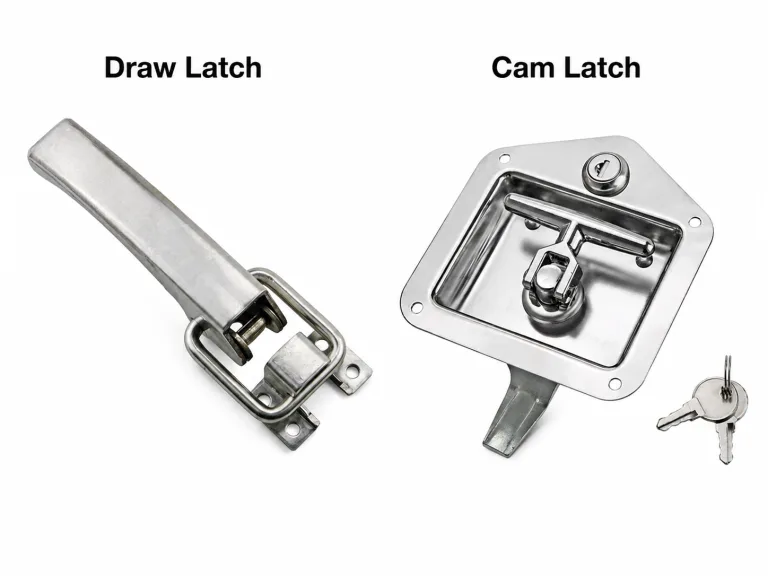
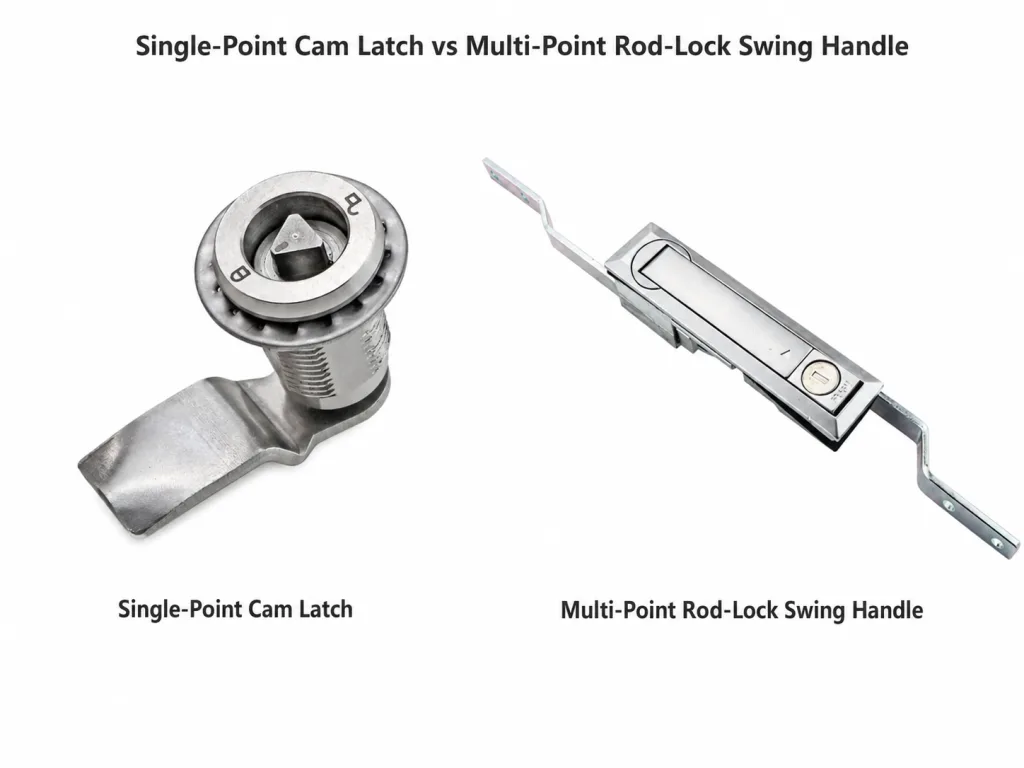
Secures a door by rotating a cam behind the frame with a 90-degree turn of a tool, knob, or wing. It latches at a single point, is compact, and mounts in a small cut-out. Its strengths are speed, low cost, and a small footprint, which make it the default for small and medium cabinet doors that only need one latching point.
Swing handle
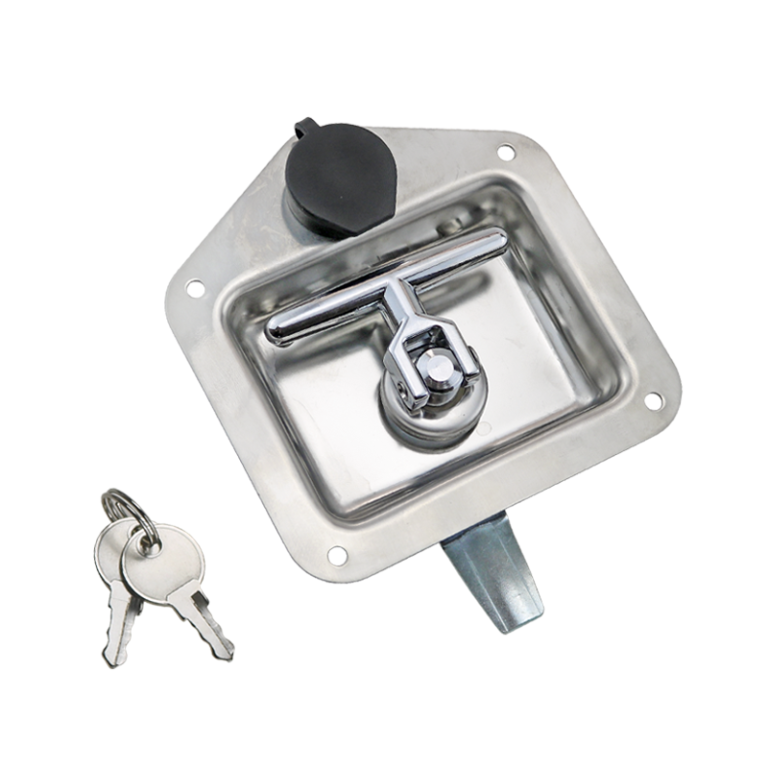
A larger handle that folds into a recessed cup and swings out to operate. Turning it can drive a multi-point rod system that latches the door at the top, bottom, and sides at once, and the handle is big enough for a firm or gloved grip. It takes more space and costs more, but brings multi-point closure and better ergonomics a single cam latch cannot.
The full range of cam mechanisms and where each fits is covered in the guide to Riegelverschlüsse und wo man sie einsetzt.
Multi-Point Sealing: The Core Difference
The defining difference is how the door is pulled shut. A quarter-turn cam latch holds the door at one point, so on a large door the corners and edges away from that point can lift slightly, and the gasket is compressed unevenly. That is fine on a small door, but on a large one it makes an even seal hard to achieve with a single latch.
A swing handle that drives a multi-point rod system pulls the door tight at several points along the edge at once, compressing the gasket evenly across a large door. For big electrical cabinet doors that must maintain an ingress-protection seal, this even, multi-point closure is the main reason to choose a swing handle. A large door can also be sealed with several cam latches spaced along the edge, but a single swing handle driving a rod system does it in one operation rather than several. Where sealing is the priority rather than the handle mechanism itself, the comparison of Druckverschlüsse für die Abdichtung des Gehäuses covers that angle in more depth.
Size, Grip, and Speed
Quarter-turn cam latches win on footprint and speed. They fit in a small cut-out, take almost no depth behind the panel, and open with a single quick turn — ideal where space is tight or a door is opened many times a shift. On a compact instrument or control cabinet, that small size and quick action are exactly what is needed.
Swing handles win on grip and leverage. The larger folding handle is easier to operate with gloves and gives more leverage for a heavy door or a stiff multi-point system, at the cost of a bigger cut-out and more depth behind the panel. For large or heavy doors opened by hand, that grip and leverage matter more than a small footprint.
Wie man sich entscheidet
Start with door size and sealing, then weigh space and grip:
| Frage | Verweist auf… |
|---|---|
| Is the door large and does it need even sealing? | Swing handle (multi-point) |
| Is it a small or medium door with one latch point? | Quarter-turn cam latch |
| Is panel space or depth very limited? | Quarter-turn cam latch |
| Is the door heavy or opened with gloves? | Swing handle |
| Is fast, frequent access the priority? | Quarter-turn cam latch |
The choice is really about whether the door needs closure spread along its edge or held at a single point. If access control also matters — whether either one should lock — that is a separate decision, covered in the comparison of locking versus non-locking cam latches.
FAQ
What is the main difference between a quarter-turn cam latch and a swing handle?
A quarter-turn cam latch latches a door at a single point with a fast 90-degree turn and is compact and low-cost. A swing handle is larger, folds into a recess, and can drive a multi-point rod system that seals a big door evenly along several points. The core difference is single-point closure versus multi-point closure, which mainly matters as the door gets larger and has to seal.
When should I use a swing handle instead of a cam latch?
Use a swing handle when the door is large and must seal evenly, when multi-point locking is needed for security or gasket compression, or when a bigger grip helps operate a heavy door or a stiff rod system. On large electrical cabinet doors that must maintain an ingress-protection seal, the even multi-point closure of a swing handle is the main reason to choose it over a single cam latch.
Are quarter-turn cam latches faster to use?
Yes. A quarter-turn cam latch opens or closes in a single 90-degree turn, which is quick and simple, and its compact size suits doors opened frequently in tight spaces. A swing handle takes an extra motion to fold out and turn, and drives more hardware, so it is a little slower — the trade for its multi-point closure and larger grip. For fast, frequent access on small doors, the cam latch is quicker.
Can a quarter-turn cam latch seal a large door?
A single quarter-turn cam latch holds a door at one point, so on a large door the edges away from that point can lift and the gasket compresses unevenly, which makes an even seal hard to achieve. For a large door that must seal, a swing handle driving a multi-point rod system, or multiple latches, is more reliable. On small doors, a single cam latch can seal adequately.
Which takes less space, a cam latch or a swing handle?
A quarter-turn cam latch takes less space. It fits in a small cut-out and needs very little depth behind the panel, which suits compact or densely packed cabinets. A swing handle needs a larger recess and more depth for the handle and its rod mechanism. Where panel space or depth is limited, the cam latch is the more practical choice.
Unterm Strich
Quarter-turn cam latch versus swing handle comes down to single-point versus multi-point closure. Choose the quarter-turn cam latch for small and medium doors where one latching point is enough and speed and compactness matter. Choose the swing handle for large doors that must seal evenly, need multi-point locking, or benefit from a bigger grip. Match the mechanism to the door’s size and sealing needs, and the choice is usually clear before you compare models.
Hinweis zur Auswahl: On large doors, the number and spacing of latching points affect the seal as much as the mechanism itself. Where an even ingress-protection seal is required, confirm the multi-point layout and gasket compression before ordering rather than relying on a single latch.
If you can describe the door size, whether it must seal, and the space behind the panel, HTAN can recommend a quarter-turn cam latch or a swing handle with the right multi-point layout. As a manufacturer, we can supply samples for fit testing and build to your panel cut-out and access needs. Browse the Bereich der Nockenverriegelung, or send your cabinet details for a recommendation.