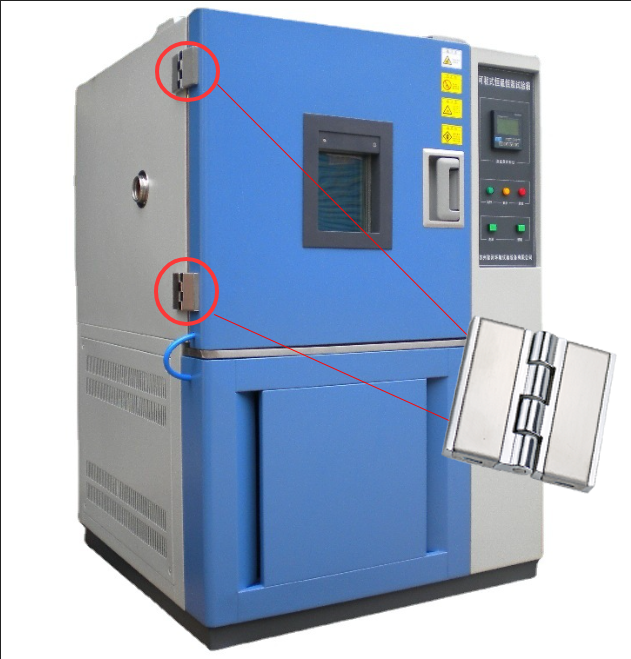
HTAN ist einer der führenden Hersteller von industriellen Scharnieren, Griffen und Verschlüssen in China.


A neglected hinge can doom an expensive server cabinet. If the hinge sags, the door warps, sealing fails and safety drops. In harsh plants, every detail counts – a hinge is the joint between door and frame, critical far beyond its size. Verdeckte Scharniere sit entirely inside the cabinet. They hide all hardware when the door is closed, delivering a smooth, unbroken exterior. In modern industry this hidden hinge is core to sleek design, plus high security and robust protection. Yet the market is flooded with options: dozens of materials, ratings and features. How do engineers or buyers make a sure choice? This guide lays out a systematic, seven-point selection method. We will cover each key factor in detail, with real-case examples, so you can pick the exact concealed hinge to secure your industrial cabinet or chassis.
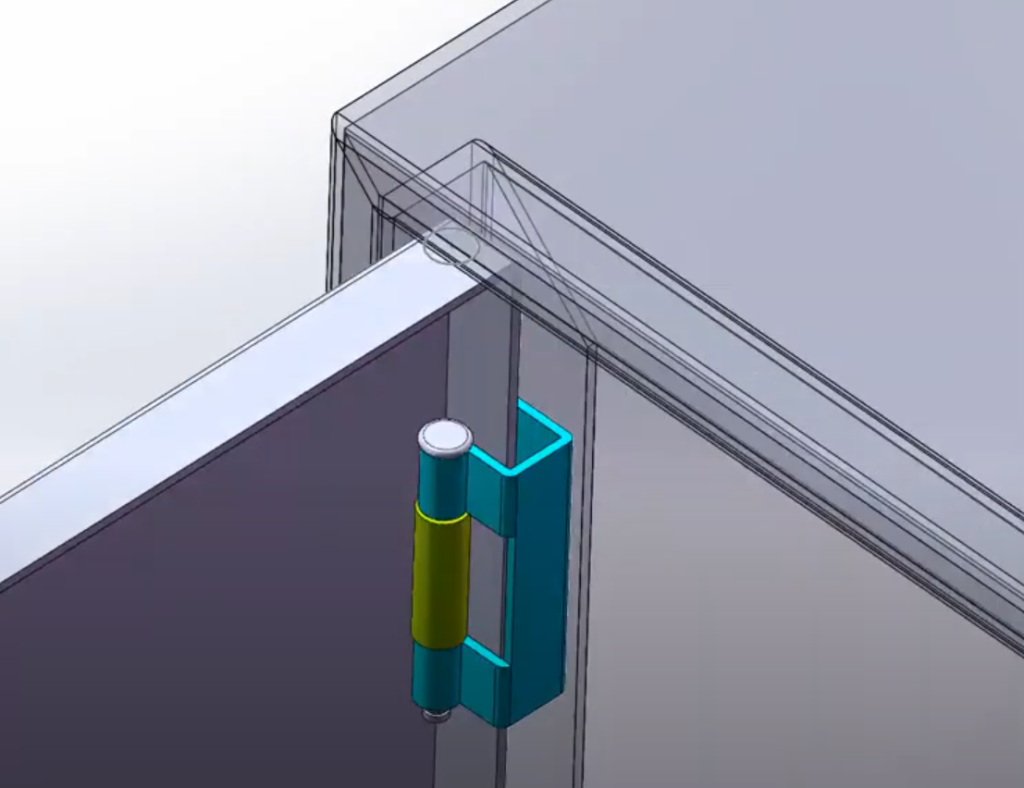
Verdecktes Scharnier im Inneren eines Industrieschranks
Was ist ein verdecktes Scharnier und warum wird es in der Industrie bevorzugt?
Bevor Sie sich für ein Scharnier entscheiden, sollten Sie wissen, was es ist und was es bewirkt. Ein verdecktes Scharnier ist ein Scharnier, das nicht sichtbar ist, wenn die Schranktür geschlossen wird. Sein Mechanismus - Platten, Stifte und Glieder - ist im Inneren der Tür und des Rahmens angebracht. Diese unsichtbare Konstruktion steht in krassem Gegensatz zu den altmodischen offenen Scharnieren (Stoß- oder Bandscharniere), bei denen die Stifte und Flügel immer sichtbar sind. Ein verdecktes Scharnier hält die Außenflächen flach und sauber. Die Technik, die dahinter steckt, verwendet oft mehrere Gelenkpunkte oder Arme. Diese Mehrgelenkmechanismen ermöglichen eine sehr sanfte, kontrollierte Bewegung auch bei schweren Türen.
Definition:
A concealed hinge is fully hidden by the door in its closed position. The pivot mechanism is buried inside the cabinet wall. When you open the door, arms or links extend in a precise path, then retract again on closing. Many designs feature two or more pivot points. This allows the door to swing smoothly without scraping any seals or frames, even up to 180°. High-security enclosures often use heavy-duty concealed hinges with weld-on or screw-on mounts – every part is engineered to bear weight and motion in tough conditions. In short, a concealed hinge is not just a pivot; it’s a multi-part system built for strength and smooth action.
Das verdeckte Design bietet in industriellen Umgebungen zahlreiche Vorteile:
Schlankes Erscheinungsbild:
Da keine Beschläge sichtbar sind, sehen die Schränke modern und nahtlos aus. Die verdeckten Scharniere decken den Rahmen vollständig ab und lassen nur einen kleinen Spalt zwischen den Türen. Zwei Schränke nebeneinander können bündig sitzen. Das Ergebnis ist ein sauberes, monolithisches Äußeres, das zu High-Tech-Umgebungen passt. Bei modernen Schalttafeln und Racks werden häufig verdeckte Scharniere verwendet, die für diesen polierten Look sorgen.
Hohe Sicherheit und Schutz vor Manipulationen:
A hinge hidden inside means no external screws or exposed pins to pry. Intruders cannot easily remove or force the door by attacking the hinge from outside. Engineers cite concealed hinges as ideal for security cabinets and outdoor telecom boxes, since “they prevent tampering from the outside”. In other words, any attempt to force the door must break the outer shell first, not just pop the hinge off.
Raumeffizienz:
Verdeckte Scharniere lassen Türen näher aneinander und an die Wände heranrücken. Eine Tür, die den gesamten Rahmen überdeckt, kann ohne Spalt an eine benachbarte Einheit stoßen. In Rechenzentren oder Kontrollräumen, wo die Racks sehr eng sind, spart dies wertvollen Platz und macht die Installation kompakt. Außerdem gibt es weniger hervorstehende Teile, an denen man sich stoßen kann.
Verbesserte Versiegelung und Schutz:
Concealed hinges integrate well with seals and gaskets. Because they often allow the door to rise or move out slightly before swinging open, they avoid scrubbing against frame seals. This protects any rubber gasket from wear. Also, the hinge itself can be designed as part of the enclosure’s IP seal. Properly aligned concealed hinges help the cabinet meet dust/water protection ratings. (In fact, technicians stress that correct hinge alignment is critical to maintain any gasket’s seal and IP rating.)
Jeder dieser Punkte ist in der Industrie von entscheidender Bedeutung. Ein verdecktes Scharnier verbessert die Ästhetik, dichtet besser ab und schreckt Einbrecher ab. Die Komplexität im Inneren ist der Preis für diese Vorteile. Auf dieser Grundlage werden in den folgenden Abschnitten die sieben Schlüsselfaktoren erläutert, die jeder Ingenieur oder Käufer bei der Auswahl eines verdeckten Scharniers berücksichtigen muss.
Sieben Hauptfaktoren bei der Scharnierauswahl
Jetzt kommen wir zum Kern der Auswahl: ein schrittweiser Blick auf sieben kritische Faktoren. Betrachten Sie dies als eine Checkliste, die von den grundlegenden bis zu den erweiterten Anforderungen reicht. Wenn Sie einen Faktor auslassen, tun Sie dies auf eigenes Risiko - jeder Faktor spielt eine Rolle für den Erfolg.
Tragfähigkeit - Die Grundlage der Sicherheit
In erster Linie muss ein Scharnier in der Lage sein, das Gewicht der Tür zuverlässig zu tragen. Ein Scharnierversagen ist ein großes Sicherheitsrisiko: Stellen Sie sich vor, eine 200 Pfund schwere Stahltür fällt auf Geräte oder Personen. Beginnen Sie mit der Gewichtsberechnung. Berechnen Sie das Türgewicht als Dicke × Breite × Höhe × Materialdichte. Wenn Ihre Tür zum Beispiel 2 m × 0,5 m × 0,01 m groß ist und aus Baustahl (Dichte ~7850 kg/m³) besteht, beträgt ihr Gewicht 2×0,5×0,01×7850 ≈ 78,5 kg. Tipp: Verwenden Sie immer konsequent metrische Einheiten, um Fehler zu vermeiden.
Next, account for lever arm effect. A wider door exerts more torque on its hinges even if weight is equal. A double-door or very wide panel can sag faster than a narrow one of the same weight. So, always check the hinge spec not just for total weight but for indicated door width or offset. Manufacturers often list something like “holds 80 kg per pair (for 1.2 m door)” which already factors in size.
Now interpret manufacturer ratings correctly. If a hinge pair is rated “100 kg (2 hinges)”, it means those two can carry 100 kg total at the tested door dimensions. If your door is heavier or larger, step up a model. Best practice: Choose a hinge rated at least 20–30% above your calculated need. This safety margin covers dynamic loads (bouncing open/close, minor impacts) and long-term wear. For example, if your calculation shows 50 kg, pick a hinge (or hinge pair) rated for ~65 kg. Over-engineering a bit here prevents future surprises.
Material und Oberflächenbeschaffenheit - Haltbarkeitsgarantien
Wählen Sie ein starkes, widerstandsfähiges Material, um das Gewicht zu sortieren. Scharniere gibt es in verschiedenen Metallen und Legierungen:
Rostfreier Stahl (z.B.. SS304 oder SS316):
Äußerst korrosionsbeständig und robust. Ideal für raue Umgebungen - im Freien, an der Küste (Salzsprühnebel), in der chemischen Verarbeitung, in der Lebensmittel- und Medizintechnik oder überall dort, wo Feuchtigkeit ein Problem darstellt. SS316 hat eine noch bessere Rostbeständigkeit als 304. Verwenden Sie rostfreie Scharniere, wenn Langlebigkeit gegen Korrosion ist unerlässlich.
Zink-Legierung:
Wird häufig im Druckgussverfahren für Scharniere der unteren Preisklasse verwendet. Die Zinklegierung bietet eine gute Festigkeit und ermöglicht komplizierte Formen. Viele Innengeräte und elektronische Schrankscharniere use zinc alloy because it’s cost-effective and still rust-resistant after plating. It also takes paint and plating well.
Stahl (Kohlenstoffstahl, z. B. Q235):
Sehr hohe Zugfestigkeit, gut für schwere Lasten und Stöße. Schwerer und kostengünstiger. Üblich bei großen Maschinen und Schwerlastschränken (z. B. Schaltanlagen, große Generatorgehäuse). Da blanker Stahl rosten kann, werden diese Scharniere zum Schutz normalerweise verzinkt, verchromt oder pulverbeschichtet.
Aluminium:
Geringes Gewicht und gute Korrosionsbeständigkeit (insbesondere eloxiert). Wird verwendet, wenn eine Gewichtsreduzierung wichtig ist (z. B. bei Flugzeugen und Schienenfahrzeugen) und die Belastungen moderat sind. Nicht so stabil wie Stahl, aber seine geringe Dichte kann bei großen Türen von Bedeutung sein.
Don’t overlook surface finish. Even the right material can fail if not treated. Typical finishes include zinc plating or chrome plating (for indoor/mild environments), powder coating (baked-on paint for color and corrosion resistance), and electrophoretic E-coat (thin, uniform seal used in automotive and high-end electronics). In short, match the hinge material and coating to your environment and always confirm the material spec with the supplier.
Eröffnungswinkel - Erfüllung operativer Bedürfnisse
Consider how far the door must open. 90°–120° hinges are common for cabinets in tight spaces — they open enough for most access tasks while preventing collision with walls or adjacent racks. 180° (or greater) hinges allow the door to swing fully back — use these where full clearance is needed for mounting equipment or full component access. Choose the angle by imagining the real workspace and confirming the hinge spec sheet states the correct maximum angle.
Zusätzliche Funktionen - mehr Komfort und Sicherheit
Modern hinges often add features beyond mere pivoting. Damping (Soft-Close): A built-in damper slows the door at end of closing — prevents slamming, reduces noise and wear in control rooms and data centers. Offenhalten oder Selbstverriegelung: Locks at certain angles so engineers can open a heavy panel hands-free. Schnellspanner / werkzeuglose Demontage: A pop-out pin lets you lift the door from the frame without unscrewing — useful for heavy door transport or field panel swaps.
Dreidimensionale (3D) Einstellbarkeit:
This is a big one for heavy industrial doors. A 3D adjustable hinge means once installed, you can fine-tune the door’s position along three axes (up/down, left/right, and in/out) with simple screws. This precision is key for heavy steel doors with seals: even a millimeter off can cause a seal to bulge. With 3D adjustment, installers align the door perfectly so it mates cleanly with the frame. Industry experts emphasize that this adjustability is essential to ensure a perfect fit on heavy precision doors. Always look for this if alignment is critical. For a detailed guide on specifying 3D adjustable concealed hinges for electrical cabinets, see: Auswahl von 3D-verstellbaren, verdeckten Scharnieren für Schaltschränke.
Einbau und Türauflage - Strukturelle Kompatibilität
The hinge must match how your door is built and how it mounts. Consider the door overlay style: Vollständige Überlagerung — door completely covers the cabinet side panel, popular in high-tech equipment for a sleek look. Halbes Overlay — two doors share a central partition, each covering half. Inset Door — door sits entirely inside the frame flush with the face, requires an inset hinge that swings the door clear of the frame.
Choose the hinge style that matches your door type exactly. Most industrielle Scharniere come as pairs: the door-leaf and the frame-leaf. For fixing method: Screw-On is most common for metal cabinets — easy to install or replace. Aufgeschweißt forms a weld line as strong as the base metal — ideal for large security doors or containers where you don’t want removable fasteners. Choose based on whether you need future adjustability (screws) or ultimate sturdiness (weld).
Environmental Requirements – Don’t Forget Context
Think through where the cabinet will live. Key factors: IP-Bewertung — if the cabinet is rated IP65/67, the hinge must not compromise the seal; precise mounting is critical to maintain gasket contact. Corrosion and Weather — outdoor cabinets face rain, UV, temperature swings; indoor factories may have chemical spray or high humidity. Vibration und Schock — mobile installations (vehicles, ships, generators) require rugged hinges, possibly weld-on. Temperature Extremes — confirm dampers and lubricants function at your operating temperature range. EMC and Grounding — in electrical enclosures, look for earth-bonding hinges or add grounding straps to ensure the door stays electrically bonded to the cabinet frame.
Marke, Zertifizierungen und Gesamtkosten - die lange Sicht
Finally, weigh quality and cost. Look for certifications: ISO 9001 (Qualitätsmanagement), RoHS (lead-free), UL-Zulassungen (for electrical enclosures). A cheaper hinge might corrode or break — causing downtime, repairs, or safety incidents that easily exceed the hinge price. When evaluating suppliers, ask for technical support or 3D models early. The “best” hinge is the one that meets all your technical needs and makes sense economically over the equipment’s lifetime.
Fallstudien: Die Anwendung der Regeln
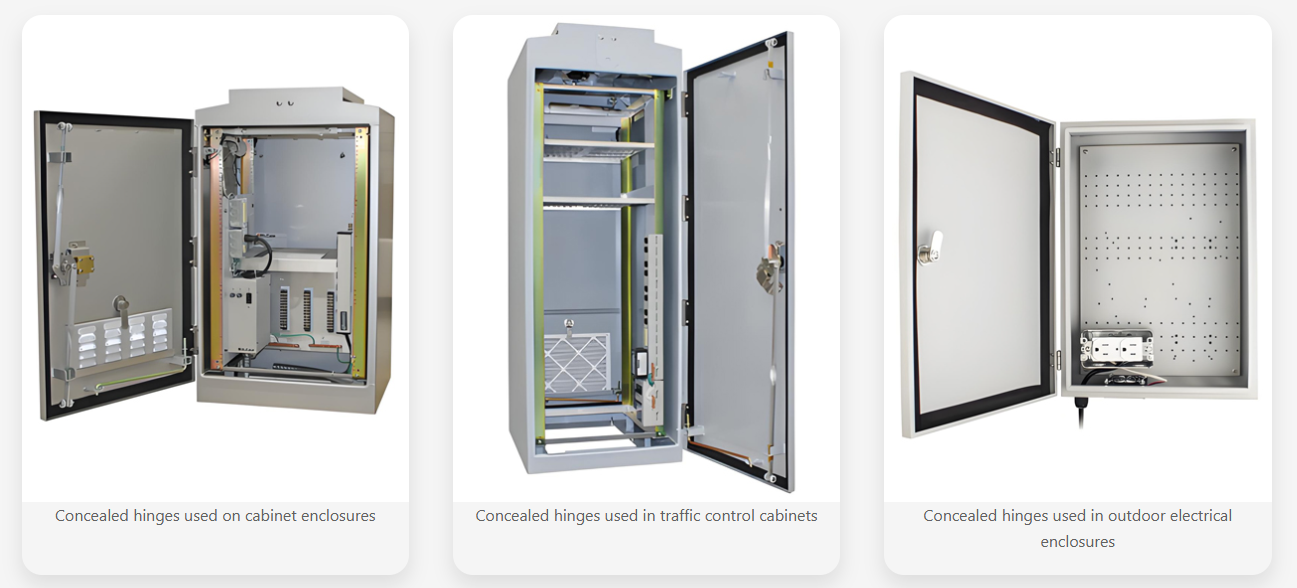
Industrielle Anwendungen von verdeckten Scharnieren (Beispiel Telekommunikationsschrank)
Fall 1: Outdoor-Telekom-Schrank.
Requirements: High weather resistance, vandal resistance, wide access for maintenance, IP54+ sealing, hinges not removable from outside.
Solution: 316 stainless-steel concealed hinges with heavy-gauge plates, 180° opening, weld-on mounting, no exposed fasteners. Add heavy-duty gasket around the door.
Fall 2: Innenraum-Rack für Rechenzentren.
Requirements: Very heavy door, frequent opening/closing, precise alignment to maintain airflow seals, tight space between racks.
Solution: Multi-link concealed hinge rated for 50+ kg, 180° opening, 3D adjustable model for perfect door alignment, zinc-coated steel for indoor environment, quick-release pin for server swaps. For common installation problems and fixes, see: Schließt die Tür eines Industrieschranks nicht? Verdecktes Scharnier - Anleitung zur Reparatur.
Fall 3: Schaltschrank für Präzisionsgeräte.
Requirements: Smooth quiet closing, perfect seal, prevent dust ingress, moderate weight door, indoor ambient conditions.
Solution: Concealed hinge with built-in soft-close damping, rubber gasket around door frame, zinc alloy or stainless steel material, full overlay style for flush exterior, 120° angle sufficient, metal hinge for ESD grounding if required.
Diese Beispiele veranschaulichen den gesamten Prozess: Anforderungen auflisten, dann Scharnierattribute zuordnen. Beachten Sie, dass Faktoren wie Material, Festigkeit und Funktionen so gewählt werden, dass sie genau zu jedem Anwendungsfall passen.
Ultimative Checkliste und häufige Fallstricke
- Habe ich das Türgewicht berechnet und Drehmoment? Don’t forget width.
- Does the hinge’s capacity exceed my needs by 20–30%?
- Ist das gewählte Material und die Oberfläche für Korrosions- und Verschleißbedingungen geeignet?
- Entspricht der Öffnungswinkel den Zugangsanforderungen?
- Do I need any extra features (soft-close, hold-open, quick-release, 3D adjustment)?
- Passt das Scharnier zum Stil der Tür (einliegend, halb/voll aufliegend) und zur Befestigungsart?
- Habe ich Vibrationen, Temperatur, IP-Schutz, Erdung usw. berücksichtigt?
Common mistakes to avoid: Choosing by price alone; ignoring door width (lever arm effect); using the same hinge model everywhere regardless of conditions; skipping the final 3D adjustment after installation — a misaligned adjustable hinge ruins the seal and wears the hinge prematurely.
Schlussfolgerung
Selecting a concealed hinge for an industrial cabinet is a comprehensive decision. It influences the cabinet’s appearance, its security, and even the safety of your operation. The right hinge is not just a part; it’s a key element of the entire system’s reliability.
By methodically working through these seven factors, you ensure your cabinet will function smoothly for years. Don’t just stop at the datasheet – talk to hinge experts and test-fit if possible. That attention to detail is what separates ordinary equipment from truly exceptional, reliable gear. Browse HTAN’s full range of concealed hinges for industrial cabinets oder Kontakt zu unserem Ingenieurteam for selection support.

Anson Li
文章: 576VERBUNDENE POSTEN
Drehmoment-Scharniere: Der wesentliche Leitfaden für die Beschaffung - Funktionalität, Auswahl und Lieferantenmanagement
Die Auswahl der richtigen Paddelverschlüsse für Industriegehäuse: Ein vollständiger Leitfaden

Schrankgriffe für Dampf- und Backofentüren
Anwendung von versenkten Türschlössern in Krankenwagen
So wählen Sie das richtige Nockenschloss: Expertentipps und Kaufberatung