HTAN est l'un des principaux fabricants de charnières, de poignées et de loquets industriels en Chine.


On a wide or heavy metal door, the hinge choice comes down to how the load is carried along the door edge. A butt hinge carries the door at two or three separate points. A continuous hinge — also called a piano hinge — runs the full length of the door and carries the load along the entire edge. For a narrow, light door either works, but as the door gets wider, heavier, or has to seal, the difference between point support and full-length support starts to decide whether the door hangs straight, closes evenly, and lasts.
This guide compares butt hinges and continuous hinges for wide metal doors across load distribution, sag resistance, sealing, cost, and installation. It focuses on the choice between point support and full-length support, not on hinge material, which is a separate decision.
Principaux enseignements
- A butt hinge carries a door at a few separate points; a continuous (piano) hinge supports the whole edge at once. This single structural difference drives every other trade-off.
- Continuous hinges resist sag, seal evenly, and resist prying better on wide or heavy doors, because load and closure are spread along the full edge.
- Butt hinges cost less, install more simply, and can be replaced one unit at a time, which makes them the practical choice on standard, moderate-weight doors.
- The deciding question is not “which hinge is better” but “does the door’s load and seal need to be spread along the whole edge, or is support at a few points enough.”
Quick Answer: Butt or Continuous?
| If the door… | Un meilleur choix | Pourquoi |
|---|---|---|
| Is wide, heavy, or prone to sagging | Charnière continue | Spreads load along the full edge |
| Needs an even, continuous seal along the edge | Charnière continue | No gaps between hinge points |
| Is standard-sized and moderate in weight | Charnière d'emboîtement | Point support is enough, at lower cost |
| May need a single hinge replaced later | Charnière d'emboîtement | Individual units swap out easily |
| Must resist prying along the hinge edge | Charnière continue | No gaps to lever the door open |
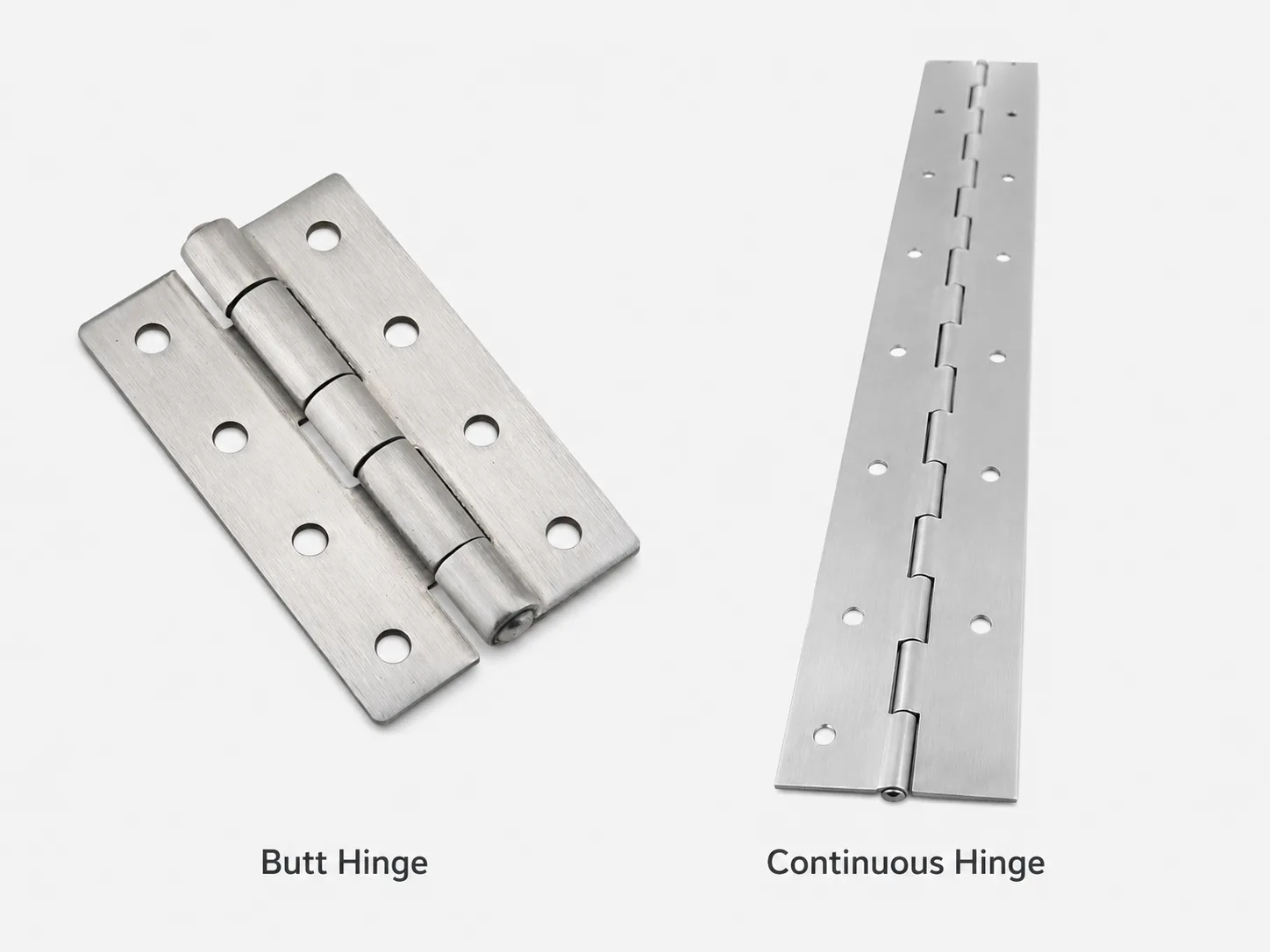
In short, continuous hinges win on wide, heavy, or sealed doors where load must be spread evenly, while butt hinges win on standard doors where their lower cost and easy individual replacement are the bigger advantages. Door width, weight, and whether it seals usually decide it.
What Each Hinge Type Is
A butt hinge is the familiar two-leaf hinge joined by a central pin, installed in pairs or sets along the door edge. Each hinge carries the door at its own point, and the door’s weight is shared between however many hinges are fitted — typically two or three, more for taller doors. Butt hinges are simple, widely available, and mounted only where they are placed, leaving the rest of the door edge open. The selection factors for heavy versions are covered in the guide to heavy-duty stainless steel butt hinges.
A continuous hinge, or piano hinge, is a single long hinge that runs the entire length of the door, joined by one continuous pin. Instead of carrying the door at a few points, it supports the whole edge at once. This is why it was originally used on piano lids, where even support along a long edge matters, and why it is now common on wide industrial doors, enclosures, and access panels that need support and sealing across their full height.
Load Distribution and Sag Resistance
This is the central difference. A butt hinge concentrates the door’s weight at each hinge point, which puts high local stress on those spots and on the fasteners there. On a wide or heavy door, that concentrated load is what causes sagging over time: the door slowly droops between or below the hinge points, and eventually stops closing squarely. Adding more butt hinges helps, but the load is still carried at discrete points.
A continuous hinge spreads the load along the entire edge, so no single point takes a heavy concentrated stress. This even distribution is why continuous hinges resist sag far better on wide and heavy doors, and why they are often specified precisely where a butt-hinged door would eventually droop. If sag is the risk — a wide door, a heavy door, or a door that must keep closing squarely for years — full-length support is the more reliable answer. The parameters that drive this, such as leaf thickness and load rating, are covered in the industrial hinge selection guide.
Sealing and Security
Continuous hinges have an edge on sealing. Because the hinge runs unbroken along the door, it presses the door evenly against its gasket for the full length of that edge, with no gaps between hinge points where the seal could be weaker. For enclosures that need to keep out dust or water along the hinge side, this continuous, even closure helps maintain the seal. A butt-hinged door, by contrast, is pulled tight only at its hinge points, and the sections between them rely entirely on the latch side and gasket to stay sealed.
Security follows a similar logic. A continuous hinge leaves no gap along the hinge edge for a tool to be inserted and used to lever the door, so the hinge side is harder to pry. Between butt hinges there are open sections of edge that can, in principle, be attacked. For enclosures where tamper resistance along the hinge side matters, the unbroken edge of a continuous hinge is an advantage.
Cost, Installation, and Replacement
Butt hinges usually win on cost and serviceability. They are inexpensive, widely stocked, and if one is damaged it can be replaced on its own without touching the others. Installation is a matter of aligning a few individual hinges, which is straightforward on a standard door. For a moderate door where point support is enough, butt hinges are the economical, practical choice.
Continuous hinges cost more and are installed as one long piece, which must be cut to length and aligned along the whole edge — more involved than fitting a few butt hinges, and if the hinge is damaged, a longer section or the whole length is replaced rather than a single unit. The trade is that you get full-length support and sealing in return. The practical side of fitting them is covered in the guide to cutting and installing continuous hinges.
Comment se décider
Start with width, weight, and sealing, then weigh cost and serviceability:
| Question | À propos de… |
|---|---|
| Is the door wide, heavy, or sag-prone? | Charnière continue |
| Must the hinge edge seal evenly? | Charnière continue |
| Does the hinge side need to resist prying? | Charnière continue |
| Is the door standard-sized and cost-sensitive? | Charnière d'emboîtement |
| Do you want to replace one hinge at a time? | Charnière d'emboîtement |
The choice is really about whether the door needs support and sealing spread along its whole edge, or whether support at a few points is enough. Once hinge type is settled, the material and load rating still need choosing — the guide to choisir la bonne charnière covers type, material, and load together.
FAQ
What is the difference between a butt hinge and a continuous hinge?
A butt hinge is a two-leaf hinge that carries a door at separate points, installed in pairs or sets along the edge. A continuous hinge, or piano hinge, runs the full length of the door and supports the whole edge at once. The core difference is point support versus full-length support, which affects load distribution, sag resistance, and sealing along the hinge edge.
Are continuous hinges better for heavy doors?
For wide or heavy doors, continuous hinges are usually better because they spread the load along the entire edge instead of concentrating it at a few points. This even distribution resists the sagging that eventually affects heavy butt-hinged doors, where concentrated stress at each hinge point causes the door to droop over time. For standard, moderate-weight doors, butt hinges remain a sound and more economical choice.
Is a piano hinge the same as a continuous hinge?
Yes. Piano hinge is another name for a continuous hinge — a single long hinge that runs the full length of a door or lid, joined by one continuous pin. The name comes from its original use on piano lids, where even support along a long edge is needed. In industrial use, the same design supports wide doors, enclosures, and access panels.
Which hinge seals better along the door edge?
A continuous hinge seals better along the hinge edge because it presses the door evenly against its gasket for the full length of that edge, with no gaps between hinge points. A butt-hinged door is pulled tight only at its hinge points, so the sections between them depend on the latch side and gasket. For enclosures that must seal along the hinge side, the continuous hinge is the stronger choice.
When is a butt hinge the better choice?
A butt hinge is the better choice for standard-sized, moderate-weight doors where point support is sufficient. It costs less, is widely stocked, and can be replaced one unit at a time without disturbing the others, which makes service simpler. Unless the door is wide, heavy, needs edge sealing, or needs pry resistance along the hinge side, a butt hinge is usually the more practical and economical option.
Résultat final
Butt versus continuous comes down to point support versus full-length support. Choose a continuous (piano) hinge when the door is wide, heavy, sag-prone, or has to seal or resist prying along the hinge edge — the full-length support spreads load and closes the edge evenly. Choose butt hinges when the door is standard-sized and moderate, where their lower cost and one-at-a-time replacement outweigh the need for continuous support. Match the hinge to the door’s width, weight, and sealing needs, and the choice is usually clear before you compare models.
There is a broader principle worth carrying into any door design: as a door gets wider or heavier, the cost of point support rises faster than most designers expect, because sag, seal failure, and pry vulnerability all trace back to the same root — load concentrated at gaps rather than spread along the edge. Continuous support is not simply “more hinge”; it changes how the whole door behaves over its service life. When a door is near the boundary between the two, that difference in behavior, not the unit price of the hinge, is the more reliable thing to decide on.
If you can describe the door’s width, weight, and whether it needs to seal, HTAN can recommend butt or continuous hinges to match. Browse the gamme de charnières robustes or send your door details for a recommendation.