식품 가공 장비 힌지 유지보수 가이드

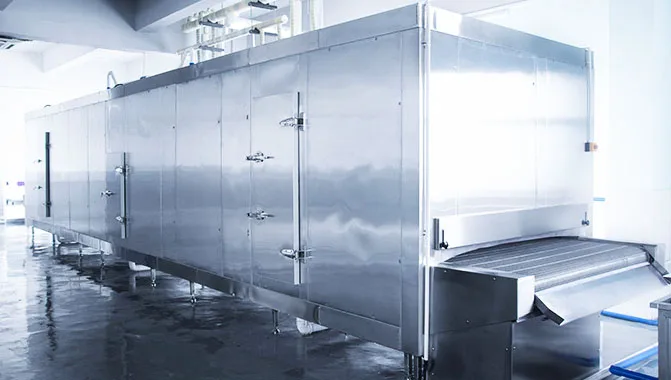
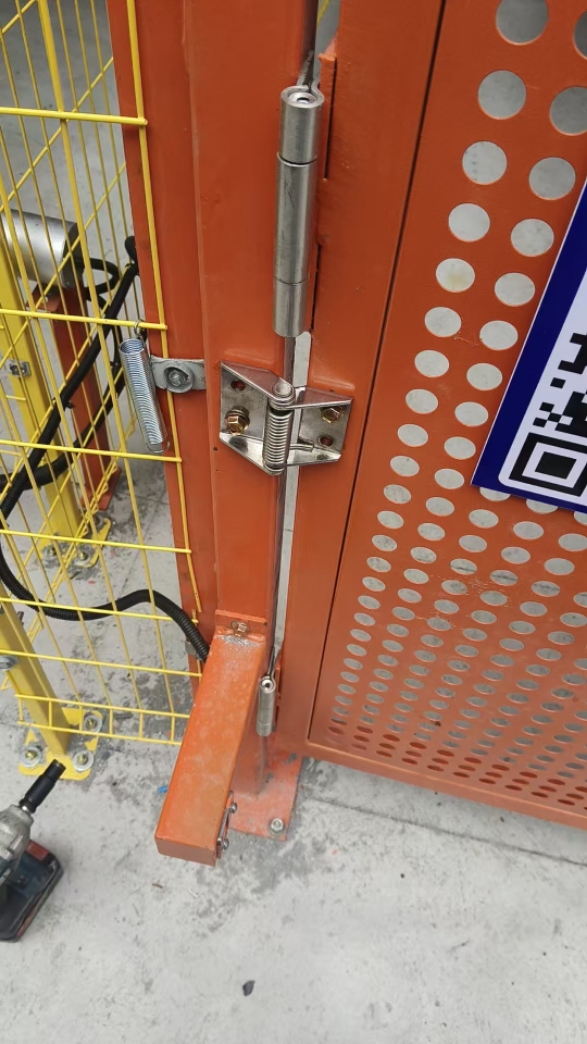
출입문 경첩이 있는 스테인리스 스틸 식품 가공 장비

Food processing equipment hinge maintenance is rarely on the maintenance manager’s dashboard — until a stuck pin, a misaligned door, or a missing fastener stops a sanitation cycle and pushes a shift behind schedule. In a food processing plant, every minute the door is open during CIP cleaning is a minute the line is not producing. This guide focuses specifically on the maintenance side of hinge selection: how hinge design affects daily cleaning time, scheduled disassembly, and operator safety, rather than which alloy resists corrosion best. For the material question, see our separate guide to 316 stainless steel hinges for washdown environments.

Why Hinge Design Belongs in the Maintenance Conversation

Food processing equipment doors are opened more often than most plant managers realize. A typical CIP (clean-in-place) access door on a dairy line is opened 3 to 6 times per shift for inspection and verification. A meat processing kill-floor enclosure may be opened more than 20 times per shift. Multiply that by the number of doors in a single processing line, and the hinge becomes one of the most-cycled mechanical components in the plant.

When a hinge slows down door operation by even 10 seconds — because it requires two hands, because the pin is stuck, because the door drops onto a misaligned frame — that delay compounds across every cycle. Over a year, a poorly performing hinge can cost a single production line 20 to 60 hours of avoidable downtime. That is the maintenance manager’s problem, not the procurement engineer’s.

What Changes When You Look at Hinges Through a Maintenance Lens

Through a procurement lens, hinges are specified by load, material, and finish. Through a maintenance lens, the priority order changes:

  • How fast can the door be opened, closed, and re-sealed during a routine cycle?
  • Can the door be removed without tools when full access is needed for cleaning?
  • Does the hinge stay aligned after thousands of cycles, or does gasket compression slowly drift?
  • If the door is removed, how easy is it to reinstall correctly under time pressure?
  • Does the hinge design support lockout/tagout (LOTO) procedures during major sanitation?

These are operational questions, not material questions. A 316 stainless hinge that requires two technicians and 15 minutes to reinstall is, from a maintenance perspective, less valuable than a properly designed lift-off hinge that one technician can handle in 30 seconds.

How Hinge Maintenance Affects CIP and Manual Cleaning Cycles

CIP and COP (clean-out-of-place) cycles are timed sequences. A dairy CIP cycle is typically pre-rinse, caustic wash, intermediate rinse, acid wash, and final rinse — each step has a fixed duration. If door access during inspection or partial disassembly adds 60 seconds per opening, those seconds extend the total sanitation window. Across a plant running three CIP cycles per day on six lines, an inefficient hinge can cost 1 to 2 hours of cleaning-window time daily. This is the operational reality that food processing equipment hinge maintenance has to solve.

Three Hinge Behaviors That Extend CIP Time

Doors that do not fully open against a wall. If a hinge limits the door swing to less than 110°, cleaning operators cannot insert a spray wand or visual inspection light without holding the door open with their body. The result is incomplete cleaning verification and repeated re-openings.

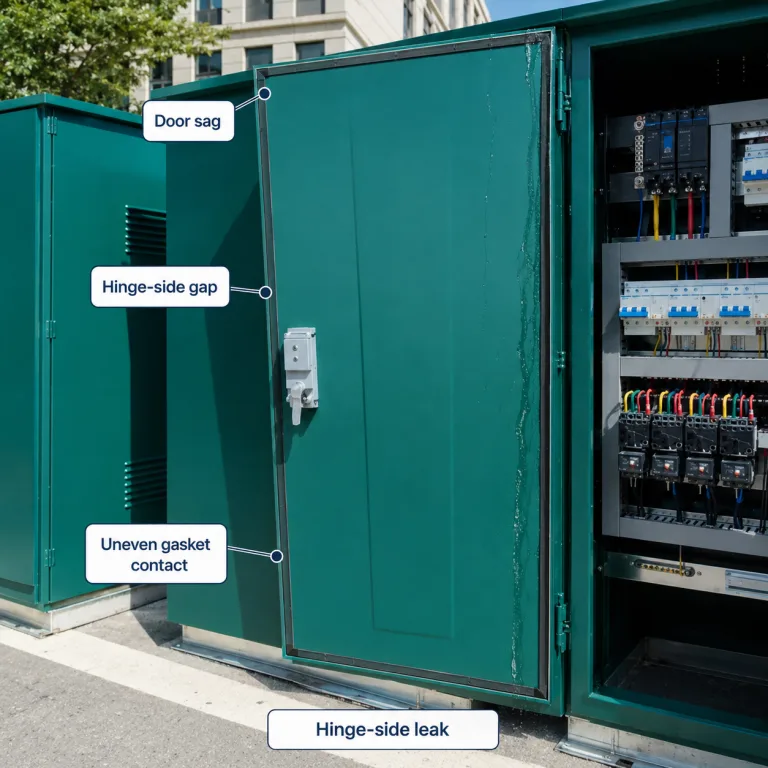
Doors that sag after repeated washdown. When a hinge cannot maintain alignment after high-temperature washdown cycles, the door begins to drag on the frame or compress the gasket unevenly. The technician now spends time fighting the door instead of cleaning the equipment. Over weeks, the gasket itself fails and becomes a contamination risk.

Doors that require special tools to remove. Many food plants standardize on 7/16″ or 1/2″ hex tools for routine maintenance. A hinge that requires a torx, allen, or proprietary fastener forces the cleaning team to walk back to the tool room, often skipping deep cleaning steps that should happen weekly. The resulting cleaning verification failures appear weeks later in ATP swab results or audit findings — long after the root cause (the hinge fastener) has been forgotten.

Tool-Free Access Design for Food Processing Doors

For weekly deep cleaning, monthly preventive maintenance, and quarterly equipment inspections, the door usually needs to come off entirely. The hinge type determines whether this takes 30 seconds or 30 minutes.

Lift-Off Hinges for Routine Removal

Lift-off hinges separate into two halves when the door is lifted vertically past the hinge pin height. There are no tools required, no fasteners to lose, and the door reseats by lowering it back onto the pins. For doors under 60 pounds that are removed routinely, this is usually the most efficient design — particularly for inspection panels, conveyor covers, and CIP access doors that are accessed on every shift. The trade-off is that the door is not secured against accidental lifting from below, so lift-off designs are best used on cabinets and enclosures where the door does not bear lateral forces during normal operation. For tight access situations where standard hinges cannot be reached for removal, the case for lift-off hinges in tight maintenance spaces covers the geometry and clearance considerations in detail.

Removable-Pin Hinges for Secured Routine Removal

Removable-pin hinges allow door removal by sliding out the pin, while still keeping the door secured during normal operation. The pin can be designed as a captive pin (tethered to prevent loss) or with a quick-release detent. For heavier doors (60 to 150 pounds) where lift-off is impractical but quick removal is still needed, removable-pin designs are the better choice. The risk to manage is pin loss — every removable-pin system needs a defined pin storage location during disassembly, otherwise the cleaning crew creates a missing-parts problem.

Continuous Hinges When Removal Is Rare

Continuous (piano) hinges distribute load evenly across the full door length and rarely sag, but they are not designed for routine removal. For doors that only come off during annual shutdowns — large filling-line covers, walk-in equipment doors — a sealed continuous hinge gives the longest alignment life. Maintenance teams should accept that scheduled removal will require two people and proper rigging, and plan the annual shutdown accordingly rather than fight the design weekly.

Hinge Maintenance and Lockout/Tagout Compatibility

OSHA-required lockout/tagout procedures complicate door access in unexpected ways. If a hinge is on a powered access door (motorized lid, automated guard, interlocked panel), the door cannot simply be opened during LOTO — the safety circuit must release. Maintenance teams should verify three points before specifying a hinge for any door that interlocks with a control system:

  • Does opening the door under LOTO require any additional tool or override key beyond the standard lockout device?
  • If the door is held open mechanically during cleaning, does the hinge include a defined hold-open position, or will the door drift closed onto a technician’s hand or wrist?
  • After LOTO is removed and the door is closed, does the interlock re-engage reliably, or does hinge wear allow misalignment that prevents the safety circuit from confirming closure?

Detent (position-control) hinges or torque hinges that hold a door at a defined angle without external support are particularly useful for LOTO-relevant doors. A door that stays open at 90° or 120° without being propped — but does not require force to close — reduces both safety risk and operator fatigue during long cleaning cycles.

Reducing Mean Time to Repair (MTTR) Through Correct Hinge Selection

For maintenance departments tracking equipment availability through MTBF (mean time between failures) and MTTR (mean time to repair) metrics, food processing equipment hinge maintenance affects MTTR more directly than most teams measure. When a door problem stops a production line, the time spent re-aligning, replacing fasteners, sourcing a missing pin, or scheduling a two-person door reinstallation all adds to MTTR.

Four Design Choices That Shorten MTTR

Captive fasteners on the hinge mounting. Tethered or retained fasteners ensure the bolt does not fall into the equipment or floor drain during disassembly. Time saved per incident: 5 to 20 minutes of searching, plus the contamination risk of an unfound fastener.

Visual alignment indicators. Hinges with a clearly marked alignment notch or witness mark let one technician confirm correct reinstallation without a second person verifying gasket compression. Time saved per door: 2 to 5 minutes of trial-and-error.

Standardized hinge models across the line. When a plant standardizes on two or three hinge models for all access doors, the maintenance team needs to stock fewer spare parts and trains technicians once instead of per-equipment. This is harder to measure but consistently reduces MTTR over the long term.

Pre-aligned mounting plates. For continuous hinges and heavy butt hinges, a pre-drilled mounting plate (with the hinge already attached) speeds replacement by removing field alignment work. This matters most during emergency replacement during a production day.

Common Food Processing Equipment Hinge Maintenance Mistakes

Mistake 1: Treating the Hinge as a Disposable Part

When a hinge fails, the typical response is to source a same-size replacement from the spare parts shelf and bolt it on. If the original hinge failed because the load was wrong, the replacement will fail in the same way. Each hinge failure should trigger a quick root-cause check: was the door over-loaded with product buildup, was the gasket compression too high, or did a cleaning chemical reach a non-rated component? Replacing the hinge without checking the cause guarantees a repeat failure within months.

Mistake 2: Using Non-Food-Grade Lubricant During Maintenance

When a hinge starts to bind, technicians sometimes reach for the closest lubricant — which in many plants is a general-purpose spray that is not NSF H1 rated. Even a small amount of non-food-grade lubricant on a hinge near a product zone is an audit finding and a contamination risk. Every maintenance cart in a food processing area should carry only NSF H1 or H2 lubricants, and the substitution rule should be in the standard operating procedure.

Mistake 3: Ignoring Progressive Misalignment

A door that closes slightly off-center is easy to ignore for weeks. By the time the misalignment is bad enough to fail an inspection, the gasket is permanently deformed, the latch mechanism is stressed, and the hinge mounting holes may be elongated. A simple monthly check — does the door close cleanly without operator force — catches this early. Document the check in the preventive maintenance log so the trend is visible across shifts.

Mistake 4: Removing Hinges During Production Windows

Hinge replacement during a production day, with the line still running adjacent, creates contamination risk and tool-handling pressure. Where possible, hinge replacement should be scheduled into planned downtime or sanitation windows, with the spare hinge pre-staged and the procedure pre-walked. Emergency hinge replacement during production should trigger a follow-up review: why was the hinge condition not caught during the previous PM cycle?

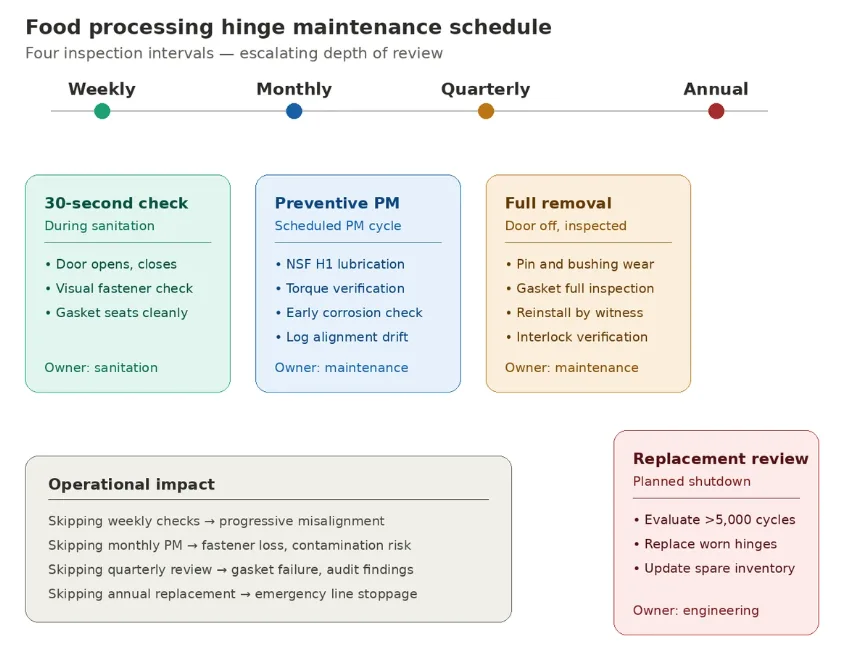
Standardized Procedure for Food Processing Equipment Hinge Maintenance

A repeatable food processing equipment hinge maintenance procedure reduces the variation between technicians and shifts. The following structure works for most food processing access doors and can be adapted to specific equipment. For step-by-step technique on the physical removal and reinstallation steps, see our guide to installing and removing hinges correctly.

Weekly: 30-Second Check

  • Open and close the door — note any binding, sag, or unusual resistance
  • Visually check for surface damage, fastener looseness, or pin walking
  • Confirm the gasket seats cleanly when the door is closed

Monthly: Preventive Maintenance

  • Apply NSF H1 lubricant to the hinge pin if the design allows
  • Check fastener torque against specification
  • Inspect for early signs of corrosion at the fastener heads or hinge knuckle
  • Document the check in the PM log; flag any door requiring force to close

Quarterly: Full Removal and Inspection

  • Remove the door according to the hinge type’s defined procedure
  • Inspect the hinge body, pin, washers, and bushings for wear
  • Inspect the gasket fully — easier with the door off
  • Reinstall, confirm alignment using the witness mark or visual indicator
  • Verify the door closes cleanly and the interlock (if any) engages

Annual: Replacement Evaluation

  • For doors cycled more than 5,000 times per year, evaluate hinge replacement during planned shutdown
  • For hinges with visible pin wear, fastener thread damage, or repeated alignment drift, replace rather than continue to service
  • Update spare parts inventory based on the year’s actual replacement rate
Hinge maintenance schedule for food processing equipment

Practical Checklist for Maintenance Managers

Question to Ask About Each Access DoorWhy It Matters for Maintenance
How often is this door opened per shift?Determines whether lift-off, removable-pin, or continuous is appropriate
How heavy is the door, and can one technician handle it?Drives one-person vs. two-person removal procedure and safety review
Does the door open against a wall, a piece of equipment, or into clear space?Determines required swing angle and whether a hold-open feature is needed
What tool, if any, is required to remove the hinge?Doors requiring non-standard tools delay cleaning and create non-compliance risk
Is the door part of an interlocked safety system?LOTO procedures and interlock alignment must be considered before specifying the hinge
How often does this door fail alignment in the current setup?Frequent misalignment indicates the wrong hinge type, not a maintenance problem
What is the spare parts availability for the current hinge model?Standardization across the plant reduces emergency replacement time

자주 묻는 질문

식품 가공 출입문의 경첩은 얼마나 자주 검사해야 하나요?

Visual checks during weekly sanitation, lubrication and fastener torque verification monthly, full removal and inspection quarterly, and replacement evaluation annually. High-cycle doors opened more than 20 times per shift may need more frequent attention.

What lubricant should be used on hinges in a food processing facility?

Only NSF H1 (incidental food contact) or NSF H2 (no food contact) rated lubricants should be used on hinges anywhere in a food processing environment. The lubricant choice should be defined in the plant’s sanitation SOP, and maintenance carts should be stocked accordingly. General-purpose lubricants are an audit finding and a contamination risk even at small amounts.

How do I choose between lift-off and removable-pin hinges for a food processing door?

Door weight and removal frequency are the deciding factors. Lift-off hinges suit doors under 60 pounds that need fast removal on every shift — inspection panels, conveyor covers, CIP access doors. Removable-pin hinges suit doors from 60 to 150 pounds that need secured operation but periodic removal for deep cleaning. Above 150 pounds, plan for two-person removal regardless of hinge type.

Why do food processing equipment doors lose alignment over time?

Repeated high-temperature washdown cycles, gasket compression, and fastener loosening all contribute. The hinge itself can develop pin wear or bushing wear, especially on doors opened thousands of times per year. Catching progressive misalignment during monthly PM — when the door first requires force to close — prevents the cascading failures of gasket deformation and elongated mounting holes that follow if it is ignored.

What documentation should the maintenance team keep for food processing hinges?

At minimum, a record of monthly PM checks (date, technician, condition noted), a record of any lubricant or fastener replacement (with NSF rating documented), and a record of any hinge replacement (with the original failure cause noted). For audited facilities, the documentation supports compliance reviews and helps identify repeat-failure equipment that warrants a design change rather than continued service.

Closing the Loop on Hinges and Downtime

A well-designed food processing equipment hinge maintenance program treats hinges as productivity components, not disposable hardware. Most food processing maintenance programs track downtime by equipment system — pumps, motors, sensors, conveyors. Hinges rarely appear on the dashboard, but they affect every one of those numbers by determining how fast and how reliably operators can access the equipment to clean, inspect, and repair. A 90-second hinge that should be a 15-second hinge is not a hardware problem; it is a recurring tax on plant productivity. Reviewing hinge design against the maintenance lens — not just the procurement lens — is one of the easier improvements a plant can make in the next sanitation cycle.

If your maintenance team is fighting recurring door problems on washdown equipment — slow access, misalignment after cleaning, missing fasteners, two-person removal that should be one-person — HTAN can review your specific door geometry, cycle frequency, and removal procedure to recommend a hinge specification matched to your operational reality. Share the door dimensions, cycle data, and current failure mode for a maintenance-focused recommendation.

앤슨 리
앤슨 리

안녕하세요, 저는 앤슨 리입니다. 저는 산업용 힌지 업계에서 10년 동안 일해 왔습니다! 그 과정에서 55개국 2,000개 이상의 고객사와 함께 일하며 모든 종류의 장비 도어용 경첩을 설계하고 생산할 수 있는 기회를 가졌습니다. 고객과 함께 성장하고 많은 것을 배웠으며 소중한 경험을 쌓았습니다. 오늘은 산업용 경첩에 대한 몇 가지 전문적인 팁과 지식을 여러분과 공유하고자 합니다.

기사: 516

뉴스레터 업데이트

아래에 이메일 주소를 입력하고 뉴스레터를 구독하세요.