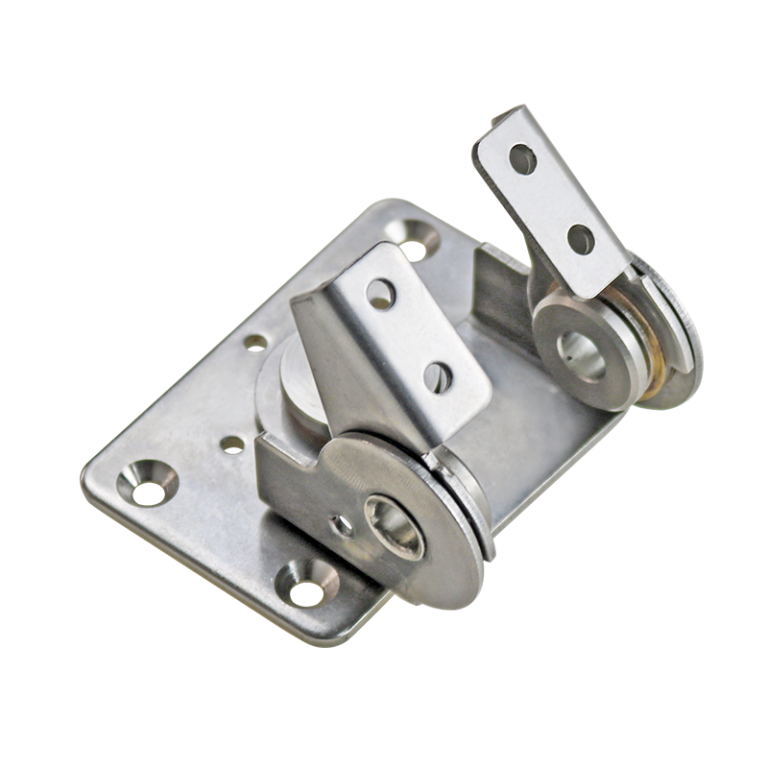
HTAN is one of the leading manufacturers of industrial hinges, handles and latches in China.


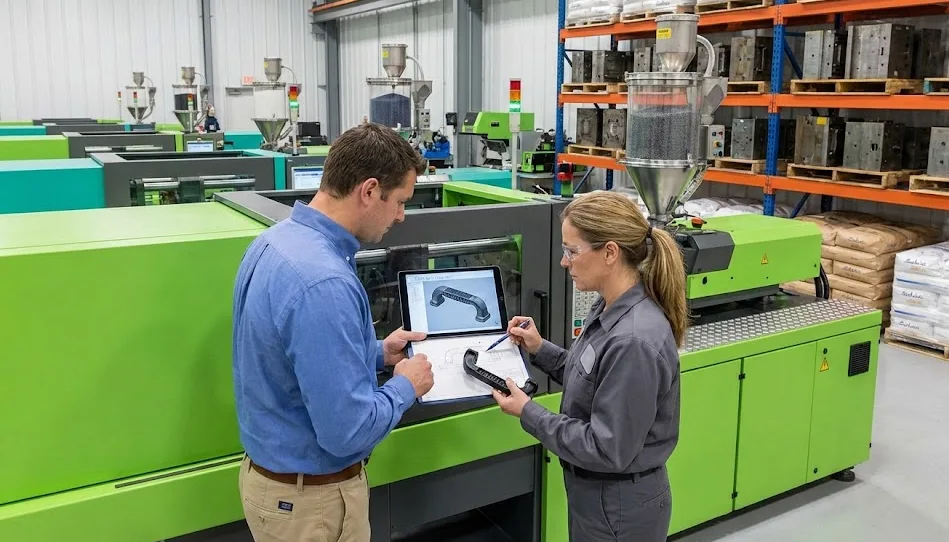
Supply chain redundancy is a primary driver of inflated procurement costs for industrial components. For plastic handles, many enterprises rely on convenient local distributors, but this convenience often sacrifices supply chain transparency and pricing power. A distributor’s pricing structure inevitably includes multiple layers of operational expenses, preventing the buyer from accessing true injection molding processing costs.
Only by establishing direct connections with production sources can procurement departments truly control lead times, quality standards, and pricing structures.
Why Choose Source Factories Over Distributors?
For companies with an annual procurement volume exceeding 1,000 units, working directly with a factory is the optimal strategy for cost control. Beyond pricing, supply chain transparency and technical response speed are critical considerations.
Eliminating Middle-Layer Cost Stacking
Distributors operate as sales agents; their profit margin relies on the difference between the buying and selling price. The pricing logic of a source factory is fundamentally different and transparent:
- Material Cost: Market price of plastic resin (e.g., PA6 or ABS).
- Processing Cost: Injection molding machine runtime, electricity consumption, and labor.
- Mold Amortization: Allocation of tooling development expenses.
When sourcing directly, you pay only these production costs plus a reasonable manufacturing margin. You avoid funding the distributor’s inventory risk premiums or sales commissions.
Accuracy and Efficiency in Technical Communication
When developing new products or customizing specific specifications (such as non-standard hole spacing), the accuracy of information transfer is vital.
- Distributor Model: Your Requirement -> Distributor Sales -> Distributor Purchasing -> Factory Order Clerk -> Factory Engineer. This chain is too long and frequently results in the loss or distortion of technical parameters.
- Factory Direct Model: Your Engineer -> Factory Mold Designer. This point-to-point communication allows for the rapid resolution of technical issues, such as insufficient draft angles or reinforcement rib conflicts.
Customization Flexibility for Material Formulas
Distributors typically sell only standard inventory products. However, industrial applications often demand specific material properties. A genuine injection molding factory can adjust raw material formulas to meet your requirements:
- Environmental Adaptability: Adding UV stabilizers for equipment used outdoors to prevent fading and brittleness.
- Enhanced Durability: Modifying the resin mixture with glass fibers to increase structural rigidity for heavy-duty lifting.
- Safety Compliance: Adjusting the formula to meet specific flame-retardant requirements for electrical environments.
How to Identify Real Manufacturers vs. Trading Companies
On the internet, many trading companies present themselves as factories. To ensure you are vetting a genuine source manufacturer, perform the following due diligence steps.
Review Business Licenses and Scope of Operations
In major manufacturing hubs, a company’s legal registration documents clearly define its permitted scope of operations.
- Manufacturer Characteristics: The scope must include terms such as “Production,” “Manufacturing,” “Processing,” or “Mold Design.”
- Trader Characteristics: The scope typically lists only “Sales,” “Wholesale,” or “Import/Export Business.” If a company is licensed only to sell but not produce, they cannot legally conduct manufacturing activities.
Request ISO 9001:2015 Certification
Legitimate factories typically hold ISO 9001:2015 certification. Do not rely solely on a scanned image; verify the “Scope of Certification” on the document.
- Valid Scope: “Production and Sales of Plastic Products.”
- Invalid Scope: “Sales of Plastic Products.” If the scope mentions only sales, the certification applies to their trading process, not a manufacturing process.
Conduct Remote Video Audits or Request Equipment Lists
If an on-site visit is not feasible, require a real-time video call with the supplier. Focus on the following areas:
- Injection Workshop: Observe if the injection molding machines are currently operating.
- Mold Room: Are there shelves storing molds? Real factories typically store existing molds for numerous clients.
- Raw Material Warehouse: Look for stacked bags of plastic resin (branded raw materials like Sabic or BASF).
Ask Deep Technical Questions About Molds
During initial communication, asking professional technical questions can quickly filter out traders. Sales staff at trading companies generally cannot answer specific parameters, whereas factory representatives often possess engineering backgrounds.
- Example Question: “For this handle with a projected volume of 500,000 units, do you recommend using P20 or H13 mold steel? Do you suggest a cold runner or hot runner design?”
Factors Influencing Wholesale Prices of Plastic Handles
Understanding cost structures helps you maintain leverage during negotiations. The price of plastic handles is not arbitrary; it is determined by raw material selection (such as PA6 or ABS), production cycle times, and adherence to global testing standards like ASTM D638
Material Selection
The performance and cost of different plastics vary significantly. Selecting the wrong material results in wasted costs or product failure.
| Material Name | Typical Application | Cost Level | Performance Characteristics |
| PP (Polypropylene) | Lightweight Packaging Handles | Low | Low density, good chemical resistance, lower strength. |
| ABS | Instrument Case Handles | Medium | High surface gloss, good impact resistance, easy to electroplate. |
| PA6 (Nylon 6) | Industrial Machinery Handles | Med-High | High mechanical strength, wear resistance, oil resistance. |
| PA66 + 30% GF | Heavy Duty Equipment Handles | High | Extremely high strength, high heat resistance, metal replacement. |
- Pro Tip: Avoid over-engineering. If your application involves lightweight packaging (under 20kg), using standard PP material instead of reinforced Nylon can reduce raw material costs by approximately 20-30%.
Product Weight and Cycle Time
- Weight: The net weight of the product directly determines the material cost.
- Cycle Time: The time required for the injection machine to produce one mold shot. Complex designs require longer cooling times, occupying more machine hours and driving up processing fees.
Mold Amortization and Minimum Order Quantity (MOQ)
Tooling is the largest upfront investment in the injection molding industry. A set of high-quality handle molds can cost between $2,000 and $10,000.
- Case Analysis:
- Scenario A: Procurement of 1,000 units. Mold cost $5,000. Amortized cost per unit = $5.00.
- Scenario B: Procurement of 50,000 units. Mold cost $5,000. Amortized cost per unit = $0.10.
- Conclusion: Procurement volume (MOQ) directly affects the final unit price. For small batches, finding a factory with “Public Molds” (Off-the-shelf Molds) is key to cost reduction, as it eliminates tooling fees.
B2B Procurement Process: 5 Steps from Inquiry to Delivery
To ensure purchased plastic handles meet engineering requirements, it is recommended to follow a standardized industrial procurement process.
Define Requirements and Technical Specifications
Before contacting factories, prepare a detailed Specification Sheet. Vague requirements lead to inaccurate quotes.
- Essential Files: 2D Engineering Drawings (PDF) and 3D Models (STEP/IGES format).
- Key Parameters: Must specify Hole Center Distance, Thread Size, and expected Load Rating.
- Tolerance Standards: To avoid disputes over minor size variations, spec sheets should explicitly reference ISO 2768-m (General Tolerances for Plastic Parts).
Send Request for Quotation (RFQ)
Send the RFQ to 3-5 selected factories. The RFQ should contain:
- Estimated Annual Usage (EAU).
- Single order quantity.
- Surface finish requirements (e.g., Matte Texture vs. Glossy).
- Packaging requirements (Industrial bulk or individual retail packaging).
Sample Confirmation and Physical Testing
Before mass production, you must obtain a First Article sample. Do not judge quality solely by visual inspection; physical testing is required.
- Load Bearing Test: Hang weights corresponding to your product’s maximum load to ensure the handle does not deform or snap.
- Installation Test: Confirm the hole spacing matches your equipment perfectly and verify the torque strength of threaded inserts.
Contract Terms and Mold Ownership
When signing the procurement contract, apart from price and lead time, mold ownership must be clearly defined.
- Clause Recommendation: The contract should explicitly state: “Upon full payment of tooling fees by the Buyer, the mold ownership belongs to the Buyer. The Seller is obligated to maintain the mold properly and shall not use said mold to produce for third parties without Buyer authorization.”
Step 5: Inspection and Shipping
Conduct a Pre-shipment Inspection based on standardized sampling methods (AQL). Focus on checking for visual defects (shrinkage, flash, flow marks) and functional dimensions.
Common Mistakes and Risk Avoidance
In the pursuit of low costs, procurement managers must be vigilant against the following pitfalls to avoid false economies.
Ignoring the Risk of Recycled Material (Regrind)
Some suppliers may mix a high percentage of recycled material into the raw resin to offer a lower price.
- Consequence: Recycled material undergoes multiple heat cycles, breaking down molecular chains and causing the product to become brittle. In low-temperature environments, handles are prone to fracture.
- Countermeasure: Specify in the contract that “100% Virgin Material must be used.”
Overlooking the Material of Metal Inserts
Many industrial handles contain metal threaded inserts.
- Risk: Inferior suppliers may use zinc-plated iron instead of brass. Iron components rust easily in humid environments, leading to handle detachment.
- Countermeasure: Explicitly specify the insert material as Brass or Stainless Steel 304, and verify this via salt spray testing or simple magnetic checks.
Conclusion
Reducing the procurement cost of plastic handles centers on removing non-value-added links in the supply chain. By partnering directly with ISO-certified source factories and clearly defining material requirements and tolerance classes, companies can achieve a cost advantage of approximately 30% while gaining faster technical responses.
Procurement is not merely price comparison; it is the vetting of a supplier’s production capability and quality control system. This guide aims to assist you in building a robust and efficient supply chain for industrial components.

Anson Li
文章: 595RELATED POSTS
-768x768.png)
China Stainless Steel Handle Manufacturers A Guide to Purchase

Compression Latches for Enclosure Sealing: Guide & Analysis
Cam Door Latches: Key Security Solutions for Industrial and Everyday Applications
Cabinet Door Handles The Ultimate Guide
-1-768x768.png)
Hardware Handles A Comprehensive Guide for Wholesalers