HTAN is one of the leading manufacturers of industrial hinges, handles and latches in China.


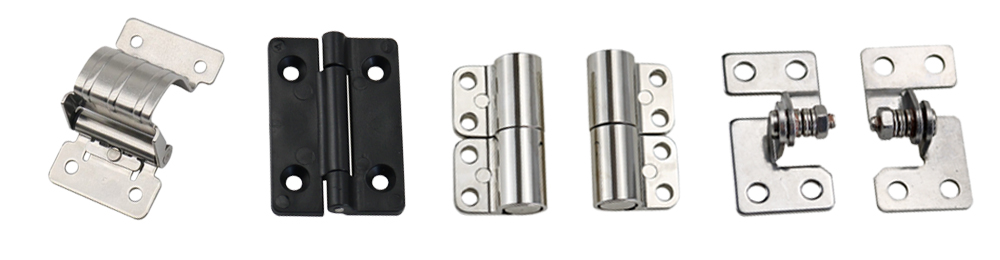
Introduction: Why might you be choosing the wrong hinge?
Torque hinges are not something that everyone is familiar with. Non-structural professionals in particular may be confused when they hear this term. Have you ever wondered why laptop screens can be held at any angle without falling? The answer is torque hinges. They are ubiquitous in daily life, but many people make mistakes when selecting them. Some use them as ordinary hinges, others choose the wrong torque value, and some install them in the wrong direction. These errors can cause equipment malfunctions and even safety hazards. Our goal is clear: to help you understand the key considerations when selecting torque hinges, so you can choose the right one the first time and avoid trouble.
What is a torque hinge? How does it differ from a regular hinge?
A torque hinge is a precision mechanical component that uses internal friction to generate rotational resistance. Its core function is to allow a panel, lid, or display screen to be held stable at any angle within its range of motion — without the need for gas springs or external locking mechanisms. This free-stop capability is what fundamentally distinguishes it from traditional hinges, which only rotate and do not control the angle.
For example, open your laptop and adjust the screen angle. It won’t close on its own or spring back. That’s the torque hinge at work. Laboratory equipment lids also commonly use them. When you open the lid, it stays in mid-air, making it easier to operate.
Don’t confuse them. Torque hinges are not support hinges or damping hinges. Support hinges primarily carry a load and allow rotation, while damping hinges mainly slow down closing speed. The focus of torque hinges is to maintain angle and provide controlled resistance throughout movement.
🔧 Tip: Don’t use torque hinges as ordinary hinges—their functions are completely different.
Torque Hinges, Friction Hinges, and Position-Control Hinges: Are They the Same?
In real engineering and sourcing discussions, the terms torque hinge, friction hinge, and position-control hinge are often used very closely. In many applications, they refer to the same basic idea: a hinge with built-in resistance that allows a panel to stay at the required angle instead of falling freely.
The difference is usually in emphasis rather than in completely separate product categories. The term torque hinge highlights the rotational resistance value. The term friction hinge emphasizes the internal friction mechanism. The term position-control hinge focuses on the functional result — holding a panel or screen at a chosen angle. In industrial selection, these names often overlap, so what matters most is the actual torque behavior, direction of resistance, load range, and installation requirement.
Compared with standard hinges, these hinges do much more than provide a pivot point. A standard hinge allows free rotation but does not actively hold position. A torque hinge adds controlled resistance inside the hinge body, allowing the panel to remain stable without separate supports, stays, or gas springs in many designs.
How Do Torque Hinges Generate Controlled Friction Torque?
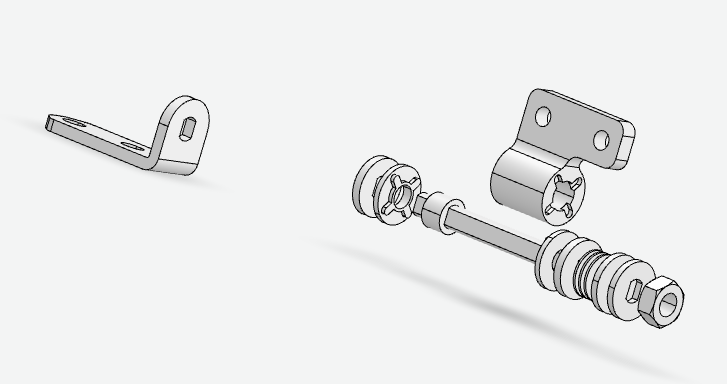
The key to free-stop performance lies in the internal friction mechanism. A typical torque hinge contains a fixed leaf, a rotating leaf, and friction elements such as washers or discs. These internal parts are compressed by preload during manufacturing or adjustment, creating resistance during rotation.
When the panel moves, the hinge generates rotational resistance that counteracts the force created by the panel’s weight. If the resistance is correctly matched to the application, the panel can remain stable at a chosen angle instead of dropping or springing back. This is why torque hinges are widely used in screens, lids, access panels, and control box covers that must hold position without external support hardware.
In adjustable models, the internal preload can be changed to fine-tune the resistance. This is useful during prototyping or when the final panel weight may vary. In fixed-torque models, the resistance is preset during manufacturing and selected according to the intended application range.
How do I know if my equipment needs a hinge that “maintains the angle”?
Before purchasing a torque hinge, ask yourself a few questions. Does your equipment have components that need to stay at a specific angle? Does it need to hold the angle on its own after you let go? Do users need to easily adjust the angle? If the answer is yes, then you probably need a torque hinge.
Consider real-world scenarios. The screen on a medical cart needs to be adjusted to different angles for doctors and nurses to view. A torque hinge keeps the screen securely in place without additional support. The same applies to the cover of an industrial control box. Technicians need to open the cover for maintenance, and it must stay suspended in mid-air without dropping and hitting their hands.
We’ve summarized the criteria:
- The component must stay at any angle.
- No additional support is needed.
- Users must be able to adjust it easily.
If these criteria are met, your equipment is suitable for a torque hinge. In many cases, this design improves both safety and usability.
The video demonstrates the application of torque hinges on a cover panel
Single-direction vs. double-direction torque: Choosing the wrong one is a waste?
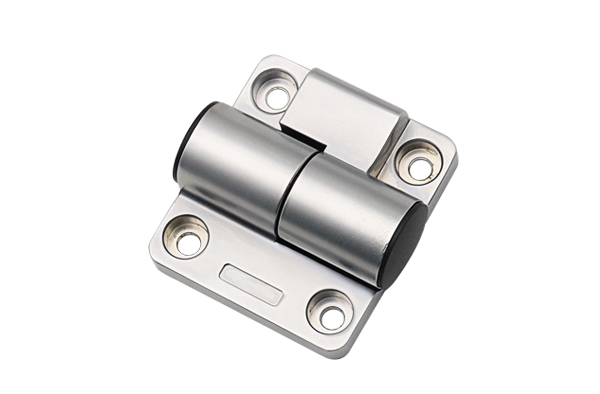
One-Way Torque Hinges
Torque hinges come in two common functional types: one-way and two-way. Choosing the wrong type can make the installation ineffective.
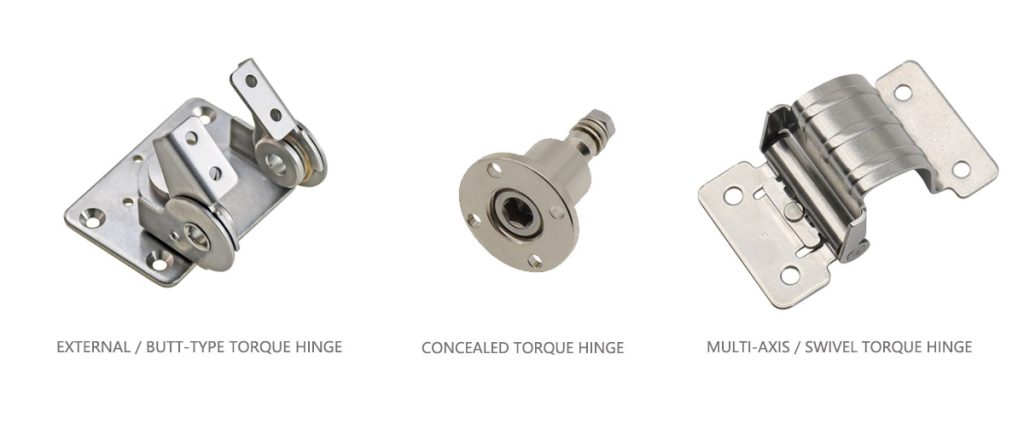
One-way torque hinges only provide resistance in one direction. Typically, torque is applied when opening, with minimal resistance when closing. They are suitable for equipment requiring quick closure. Two-way torque hinges operate differently. Torque is applied during both opening and closing, allowing the door panel to stop at any angle. They are ideal for scenarios requiring full control throughout the process.
A real-world example: A laboratory equipment lid used a one-way torque hinge, but it was installed in the wrong direction. After opening, the lid sprang back and directly hit the operator’s hand. The opening and closing requirements were not understood. When selecting a torque hinge, first confirm how the equipment moves. Whether it’s one-way or two-way, the correct type must be chosen.
📌 Pitfall avoidance guide: Before placing an order, confirm the opening and closing direction with the supplier—don’t choose based on intuition.
Other Common Torque Hinge Types
| Type | Typical Applications | Main Feature |
|---|---|---|
| Constant torque hinge | Laptop displays, instrument covers, industrial access doors | Provides relatively consistent resistance throughout the movement range for smooth positioning at many angles. |
| Dual-axis torque hinge | Medical display arms, monitor mounts, multi-axis equipment | Provides torque control across more than one axis, allowing more complex adjustment and positioning behavior. |
| Adjustable torque hinge | Prototyping, modular panels, variable-load equipment | Allows torque to be increased or decreased after installation within the design range. |
| One-way control hinge | Electrical cabinets, maintenance covers, lift-up panels | Provides resistance mainly in one direction while allowing freer movement in the other. |
Selecting the right torque hinge involves matching torque behavior to the application, not just choosing a hinge by size. The opening direction, holding requirement, and adjustment need must all be confirmed before ordering.
What torque value do I need? Is there an empirical formula?
Torque value is the core consideration when selecting a torque hinge. If the value is incorrect, the equipment will either not move properly or be unstable. Here’s how to calculate it precisely.
There is a simple formula: Torque = Weight (kg) × Distance from center of gravity to hinge axis (m) × 9.8. Then multiply by a safety margin of 1.2–1.3 to account for vibration, impact, and frequent use.
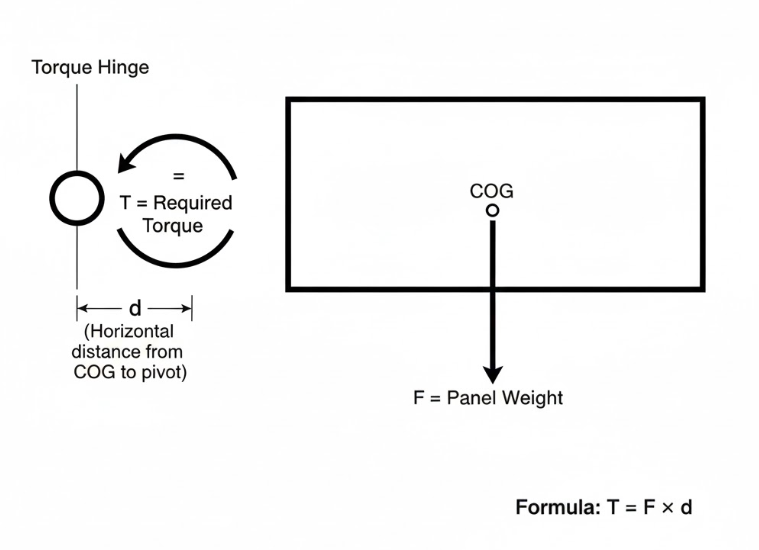
For example, if the door panel weighs 5 kilograms and the center of gravity is 0.3 meters from the hinge: 5 × 0.3 × 9.8 = 14.7 N·m. With a 1.25 safety margin: 18.4 N·m. If two hinges are installed, each bears 9.2 N·m. When selecting, look for models within this range.
Quick Reference: Torque Range by Door Weight
For common cabinet and panel door applications, use this table as a starting point before running the full calculation:
| Door Category | Torque Range | Typical Weight | Typical Applications |
|---|---|---|---|
| Light doors | 0 – 1.5 N·m | < 5 kg | Lockers, mirror cabinets, instrument covers |
| Medium doors | 1.5 – 2.5 N·m | 5 – 15 kg | Bookcase doors, electrical cabinet panels |
| Heavy-duty doors | 2.5 – 3.0 N·m | > 15 kg | Industrial enclosures, environmental test chambers, display cabinets |
| Laptop screens | 0.3 – 0.8 N·m | 0.3 – 1.5 kg | Laptop hinges, tablet stands, monitor arms |
Don’t make a mistake in your calculations. The shape of the door panel and the installation location will affect the results. It is best to verify with the supplier.
🧠 Reminder: Always add a 20–30% safety margin for equipment under vibration or frequent use. When in doubt, verify with the supplier before ordering.
Is the installation direction important? Why do spring hinges sometimes fail to spring back?
If the torque hinge is installed incorrectly, it will be ineffective. Especially for spring-type torque hinges, incorrect direction renders them useless.
This issue commonly occurs with control cabinet doors. If the spring-type torque hinge is installed incorrectly, the door will not spring back after opening or will not close properly. The reason is simple. The design specifies a fixed direction, and installing it incorrectly prevents the spring from exerting force. When purchasing, check the manual; hinges have arrows or markings. Install according to the instructions, and there will be no issues.
There is another critical issue. The spring force must match the door weight. If the force is insufficient, the door won’t close. If the force is too strong, it will slam shut and cause damage. Test it before installation to ensure it’s appropriate.
Installation Tips to Get It Right the First Time
- Use manufacturer-specified fasteners only — the correct screw size and strength grade are critical. Using undersized screws creates micro-movement that erodes torque over time.
- Align the hinge axis precisely — misalignment by even 1–2° introduces uneven friction wear, causing torque to degrade faster on one side.
- Start at minimum torque setting — adjust upward incrementally until the door holds position at the required angle. Never force the adjustment screw to maximum immediately.
- Corrosive or high-humidity environments — choose 316 stainless steel hinges and apply anti-rust lubricant to all contact surfaces before assembly.
After installation, open and close the door slowly to test natural stopping at 30°, 60°, 90°, and 120°. If the door drifts downward, tighten the adjustment screw in quarter-turn increments. If it feels stiff, back off slightly and retest.
We have seen too many cases of incorrect installation. Do not take it lightly. After purchasing torque hinges, installation is the critical step that determines success or failure.
Which industries most commonly use torque hinges?
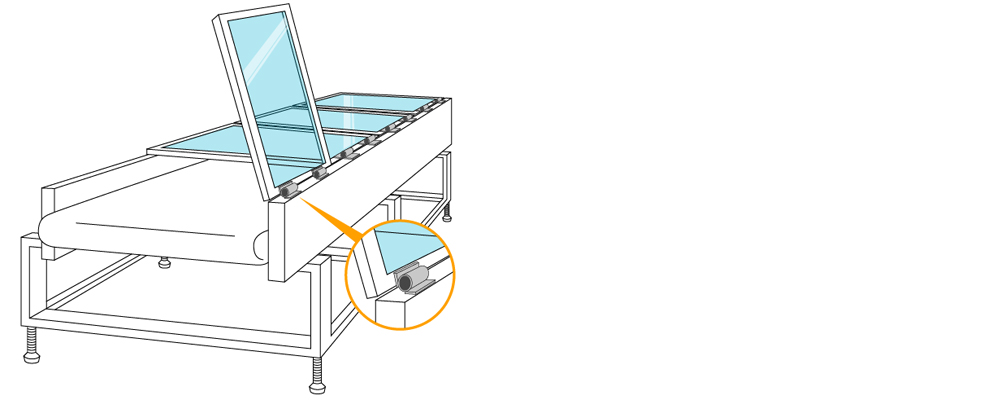
Image source: Sugatsune
Torque hinges have a wide range of applications and are indispensable in many industries. Here are the most common use cases — along with real-world specification examples to show how the engineering translates into practice.
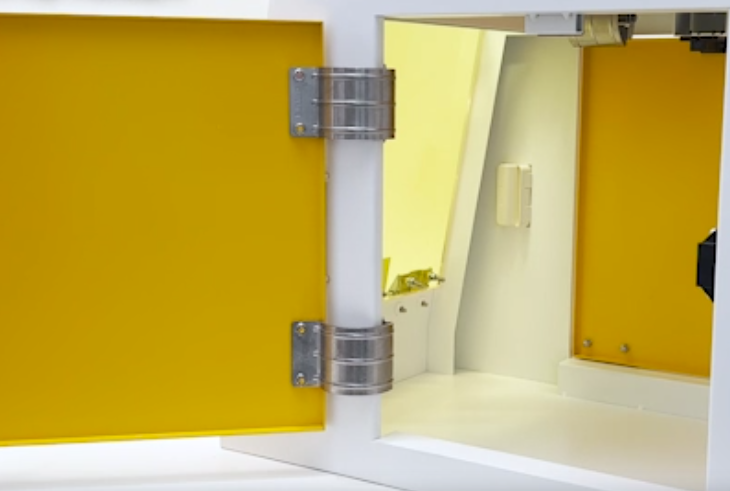
- Medical equipment: Mobile cart screens need to be adjusted to different angles for doctors and nurses to view. Surgical monitor arms use 0.5–2.0 N·m swivel torque hinges to hold displays at precise angles during procedures, preventing unintentional movement that could compromise sterile fields.
- Industrial control systems: Control panel covers must remain fixed in place when technicians perform maintenance. Cabinet doors in vibration-heavy environments use 2.5–3.0 N·m torque hinges to ensure reliable positioning and operational safety.
- Consumer electronics: Foldable devices, laptops, and display stands all rely on torque control to maintain stable positioning without wobble.
- Transportation: High-speed train interior cabinet doors and vehicle display panels use torque hinges to help maintain safe positioning under continuous vibration.
- Industrial automation: Equipment covers and machine access doors often use torque hinges to simplify maintenance access and improve operator safety.
Consider your industry when selecting. When the application is right, torque hinges prove invaluable.
Plastic hinges vs. stainless steel torque hinges: Which material should you choose?
Material selection is critical when choosing torque hinges. Plastic and stainless steel each have their advantages and disadvantages.
Plastic torque hinges are lightweight, cost-effective, and corrosion-resistant. They are suitable for light-duty applications, such as small laboratory covers. Stainless steel torque hinges are sturdier and can support heavier doors. They are often preferred for outdoor or corrosive environments because of their longer service life and better structural performance.
Let’s compare:
| Feature | Plastic | Stainless Steel |
|---|---|---|
| Strength | Low | High |
| Price | Low | High |
| Lifespan | Moderate | Long |
| Suitable Env. | Indoor, light load | Outdoor, heavy load |
If you’ve decided on stainless steel, the next decision is grade — the wrong grade in a corrosive environment can sharply reduce hinge lifespan.
| Grade | Corrosion Resistance | Best For | Avoid In |
|---|---|---|---|
| 304 Stainless Steel | Good general-purpose | Indoor industrial equipment, food processing, standard cabinet doors | Coastal / high-salt environments |
| 316 Stainless Steel | Excellent (molybdenum-added) | Marine, chemical plants, salt spray environments, outdoor enclosures | Cost-sensitive indoor applications |
| Zinc Alloy | Moderate | Budget indoor applications, light-duty panels | High-humidity or outdoor use |
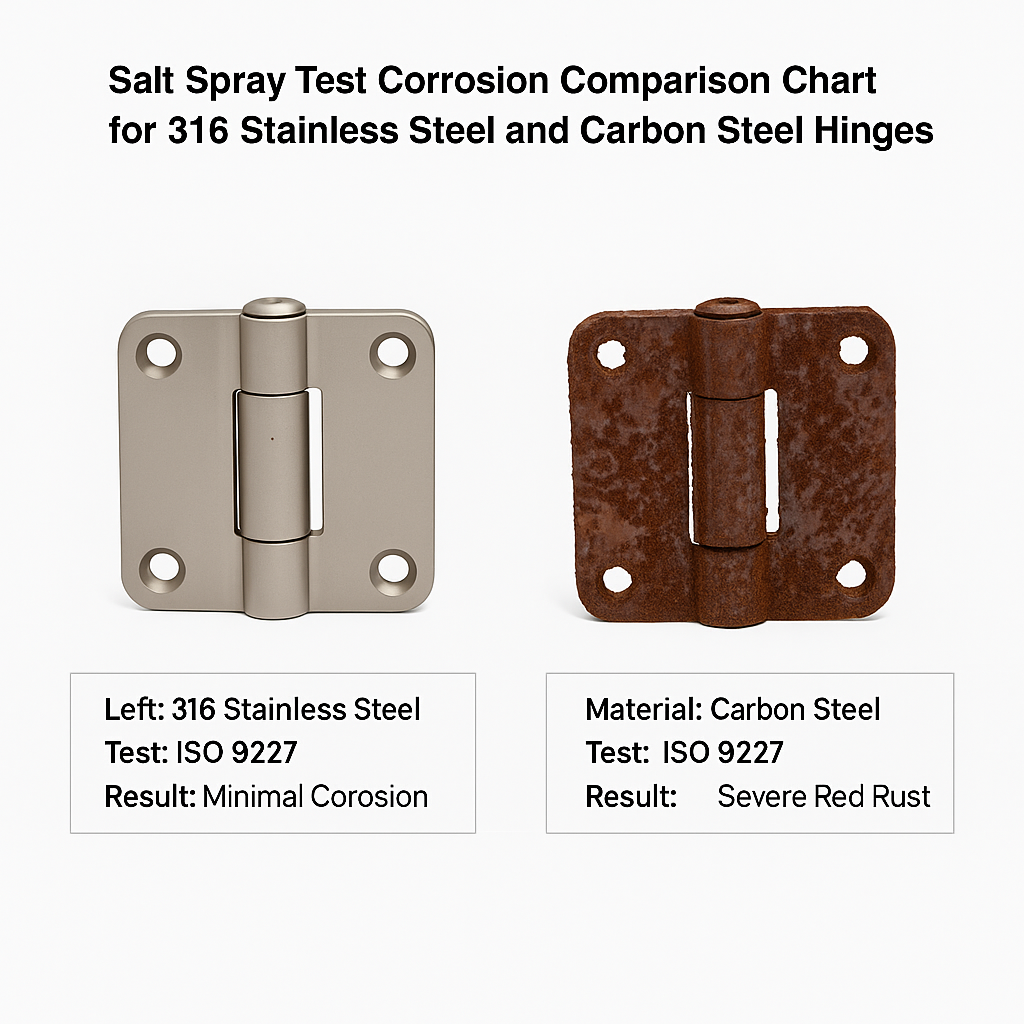
For environments with meaningful salt spray or chemical exposure, material grade matters. Read our 304 vs. 316 outdoor hinge selection guide before finalizing your order.
📌 Pitfall avoidance guide: In corrosive environments, don’t use plastic by default; stainless steel is usually more reliable. And between 304 and 316, always check the real exposure condition first.
Are torque-adjustable hinges better? What equipment are they suitable for?
Torque-adjustable hinges can modify the torque value, which sounds advanced. Are they really useful?
They are especially useful during R&D and prototyping. During the testing phase, when torque values are uncertain, they can be adjusted without replacing the hinge. They are also suitable for equipment with variable functions or changing panel loads. Once the final product parameters are fixed, however, a standard non-adjustable model is often more cost-effective.
Do not use them indiscriminately. Adjustments must be made according to the manufacturer’s instructions; otherwise, the hinge may be damaged. When selecting, consider your real need and do not pursue adjustability blindly.
Will the torque loosen over time? What factors affect its lifespan?
Customers often ask: Will the torque hinge loosen over time? The answer is clear: High-quality hinges should not loosen quickly when correctly specified and installed.
Lifespan depends on the number of rotations, the quality of internal friction materials, environmental contamination, alignment, and whether the hinge is overloaded. Stainless steel structures are generally more durable than plastic in demanding service conditions. Internal design also matters. Well-designed friction plates, preload systems, and shafts extend usable life.
With proper installation and maintenance, torque hinges can last for years. Follow this simple schedule to keep yours performing at their best:
| Interval | Action | What to Look For |
|---|---|---|
| Every 6 months | Visual inspection + torque check | Friction wear, loose fasteners, visible rust |
| Annually | Lubrication if required by design | Apply suitable lubricant to the shaft only when recommended by the manufacturer |
| On symptom | Friction plate replacement or hinge replacement | Sudden drop in resistance, angle drift, abnormal movement |
Troubleshooting: What to Do When Something Goes Wrong
Even well-specified torque hinges can develop issues over time — usually from wear, contamination, overload, or incorrect installation. Use this table to diagnose the most common problems before replacing the hinge.
| Symptom | Most Likely Cause | Fix |
|---|---|---|
| Door drifts down / resistance suddenly drops | Friction plate wear or spring fatigue | Replace worn internal parts or the hinge assembly as required |
| Door feels stiff or jerky | Contamination or poor lubrication condition | Clean and service according to the manufacturer guidance |
| Door won’t hold at a specific angle | Incorrect torque specification or internal wear | Re-check torque requirement before ordering replacement |
| Uneven resistance left vs. right | Installation misalignment | Loosen fasteners, realign hinge axis, and re-torque correctly |
If you’re experiencing repeated failures on the same unit, the root cause is more often incorrect torque specification than product defect. Re-run the torque calculation before ordering a replacement.
Recommended models (including specifications) for beginners
First-time purchaser of torque hinges? We recommend the following models:
- HL127
Torque: 0.1–1.5 N·m
Material: PA6
Dimensions: 72mm × 56mm
Application: Medical equipment, instrument equipment, control cabinets - SK2-2
Torque: 0–6.0 N·m
Material: Stainless steel
Dimensions: 90mm × 82.5mm
Application: Office equipment, furniture, control panels - DP046
Torque: 0.7–3.0 N·m
Material: Stainless steel
Dimensions: 76mm × 14mm
Application: Lighting equipment, medical equipment
📌 Compare your requirements when selecting. With clear parameters, selection is straightforward. If you have any questions, consult technical support; do not experiment on your own.
Conclusion: Choosing the right torque hinge saves years of maintenance hassle
Choosing the right torque hinge ensures smoother equipment operation, better user experience, and lower long-term maintenance cost. One wrong decision in torque value, direction, material, or installation can create repeated service problems. That is why torque hinge selection deserves careful attention from the start.
If you have any questions, contact technical support. They can provide recommendations and even send samples for testing. Contact us — don’t let choosing the wrong hinge hold you back.
FAQ
Q: Do torque hinges wear out?
A: High-quality torque hinges incorporate wear-resistant materials on internal friction surfaces and are designed for long cycle life. In real use, wear rate depends on load, opening frequency, alignment, contamination, and whether the hinge is overloaded. Correct specification is the most important factor in maintaining stable torque over time.
Q: Can torque be adjusted after installation?
A: For adjustable hinges, built-in adjustment screws allow friction torque to be increased or decreased after installation within the product’s design range. Fixed-torque hinges, however, have their resistance set during manufacturing and generally cannot be altered afterward. Always confirm whether the selected model supports post-installation adjustment before purchase.
Q: How do torque hinges differ from gas springs?
A: Torque hinges use internal friction to hold position directly at the pivot point, while gas springs use pressurized force to support or assist movement through a separate mechanism. Torque hinges are compact, clean, and well suited to designs that require controlled positioning without adding external support hardware. Gas springs are more suitable when strong lift assistance over a longer movement arc is required.
Q: What is the service life of a torque hinge?
A: High-quality torque hinges are tested for long cycle life, often reaching tens of thousands or more opening and closing cycles. Actual lifespan depends on frequency, torque load, environment, and installation accuracy. Always refer to product specifications and validate against the real application.
Q: Do hinges require regular lubrication?
A: Many torque hinges use self-lubricating internal elements and do not require routine lubrication in normal conditions. However, in corrosive, dusty, or extreme environments, periodic inspection and suitable external protection may still be necessary. Follow the product-specific maintenance guidance instead of applying lubricant by default.
Q: How do I replace standard hinges?
A: Position-retaining hinges may share similar mounting profiles with standard hinges, but direct replacement should never be based on size alone. The new hinge must match the required torque value, panel load, and movement direction. Always verify mounting parameters and torque specification before replacing a standard hinge with a torque hinge.

Anson Li
文章: 524RELATED POSTS
Switching to Foldable Handles: Technical Benefits & Selection Guide
Zinc Alloy Cabinet Latches Plans and Essential Needs
Where Can I Buy High Quality Mechanical Equipment Hinges?
Selecting 3D Adjustable Concealed Hinges for Electrical Cabinets
Door Lock&latches Installation Guide