HTAN is one of the leading manufacturers of industrial hinges, handles and latches in China.


The Real Challenge of Outdoor Environments
In my career as an industrial consultant, I have found that purchasing managers and engineers often make a common mistake: assuming that outdoor handles only need to be waterproof.
This is a dangerous misconception.
Based on my field failure analysis data, the failure of outdoor handles is rarely caused by a single factor but is the result of Combined Exposure. Your equipment handles are subjected to the cumulative attack of the following environmental stresses every day:
- Solar Radiation: Primarily the high-energy destruction from the Ultraviolet (UV) spectrum.
- Temperature Cycling: Expansion and contraction stresses caused by day-night temperature differences.
- Moisture and Precipitation: Rain, high humidity, and salt spray in coastal regions.
- Chemical Load: Industrial pollutants, acid rain, or residues from potent cleaning agents.
If material selection is based solely on “indoor standards,” you will typically receive customer complaints within 6 to 18 months of installation. This article will analyze why UV-resistant materials are mandatory from the perspectives of materials science and engineering verification, and how to verify them using international standards.
Failure Modes of Outdoor Handles
Aesthetic Failure
This is the first phenomenon observed, typically occurring within the first 6 months of installation.
- Fading: Pigments decompose under UV light. For red or yellow emergency stop handles, this reduces visibility and constitutes a safety hazard.
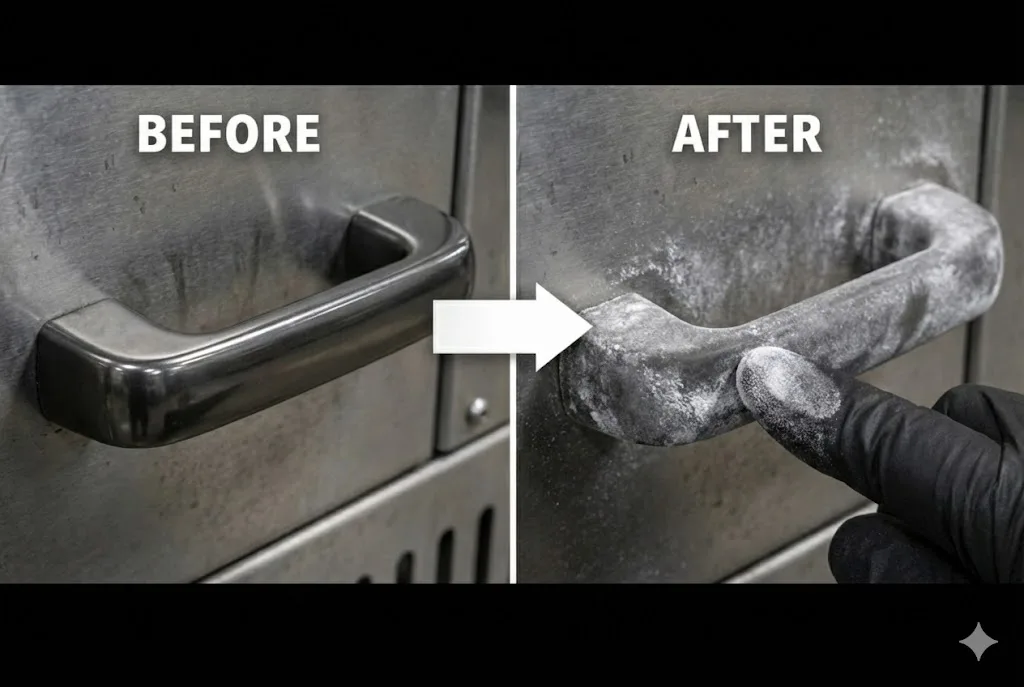
- Chalking: The polymer matrix degrades at the surface, precipitating a white powdery substance. This indicates that the surface protective capability of the material has been lost.
- Gloss Loss: The surface becomes rough, leading to accelerated dirt accumulation and difficulty in cleaning.
Structural Embrittlement Risks
This is the most dangerous stage.
- Mechanical Property Degradation: UV causes polymer chain scission. As molecular weight decreases, the Impact Strength and Tensile Strength of the material drop significantly.
- Micro-cracking: Microscopic cracks invisible to the naked eye appear on the surface. When moisture enters these cracks, freeze-thaw cycles will expand them.
- Fracture: The handle suffers a sudden catastrophic failure in low-temperature environments or when an operator applies force.
Functional & Sealing Failure
- Dimensional Stability: Degradation causes shrinkage or warping, leading to changes in assembly gaps and loosening of the handle.
- Sealing Failure: Many outdoor handles are equipped with rubber gaskets. If the rubber is not UV-resistant, it will crack and harden, causing the IP65/IP66 protection rating to fail and allowing rainwater to seep into the cabinet.
Mechanisms of UV Degradation
We need to understand “why” materials fail at a microscopic level to make the correct engineering decisions.
Photodegradation of Polymers
When UV photons from sunlight strike a polymer surface, if the photon energy is higher than the chemical bond energy, Chain Scission occurs.
- Process: Long molecular chains are broken into shorter segments.
- Consequence: Polymer strength relies on chain length and entanglement. A decrease in molecular weight directly leads to material Embrittlement. This explains why some plastic handles shatter upon touch after a year outdoors.
Surface Oxidation
UV radiation is usually accompanied by photo-oxidation reactions.
- For Metal Handles: Metals themselves do not degrade due to UV, but their surface coatings (such as paint or powder coating) are affected. UV destroys the coating resin, leading to chalking, blistering, or delamination, eventually exposing the metal substrate to corrosion.
- For Rubber: UV attacks the unsaturated double bonds in rubber, causing excessive cross-linking density. The rubber loses elasticity and cannot rebound, leading to a loss of sealing function.
Why Use UV-Resistant Materials: Risk & Compliance
Selecting UV-resistant materials is not just for aesthetics; it is a measure to control risk and cost.
Reducing Safety Liability
- Preventing Injury: Fractured handles create sharp edges that can lacerate operators.
- Ensuring Emergency Access: In emergencies such as fire or equipment failure, if a door handle breaks and prevents the door from opening, the consequences are catastrophic. Equipment compliant with OSHA or ISO safety standards must guarantee the structural integrity of operating parts.
Reducing Total Cost of Ownership (TCO)
- Maintenance Costs: Non-UV-resistant handles may need replacement annually.
- Downtime Costs: Replacing hardware requires downtime, and the indirect costs often far exceed the purchase cost of the handle itself.
Brand Reputation and Consistency
- Inspection Efficiency: In large photovoltaic power stations or outdoor data centers, faded handles affect visual consistency and increase inspection difficulty.
- Customer Perception: Rusted or faded handles send a direct signal of “low quality” to the customer.
Technical Routes for UV-Resistant Materials
When purchasing outdoor handles, I advise focusing on the following three main material solutions:
Metal Systems: Corrosion-Resistant Substrate + Weatherable Surface
Core Strategy: The metal primarily defends against corrosion, while the coating defends against UV.
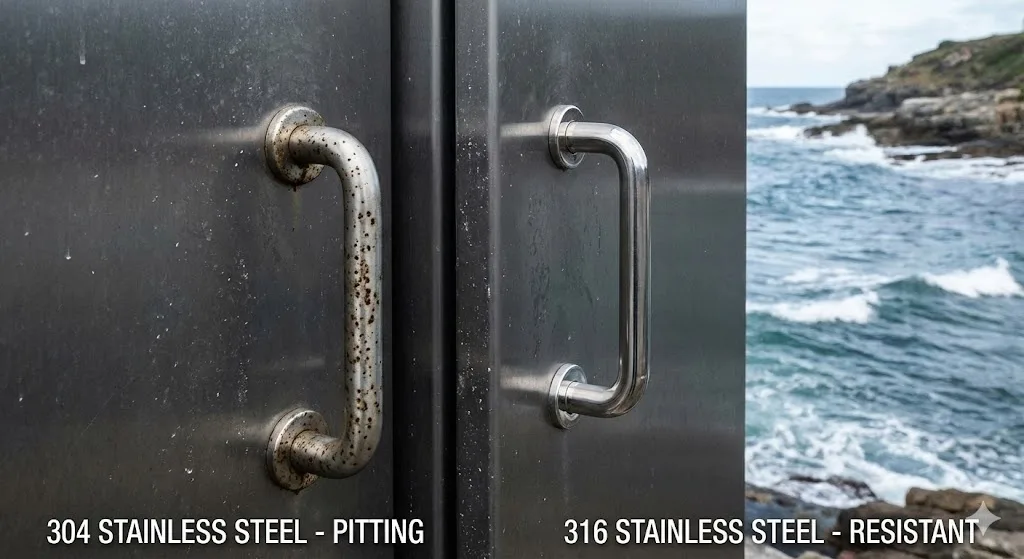
- Stainless Steel: I recommend AISI 316 or 316L. 304 Stainless Steel is prone to pitting in coastal environments. Electropolishing or PVD treatment is recommended for the surface.
- Powder Coating: You must specify Polyester or Fluorocarbon systems.
- Warning: Strictly prohibit the use of Epoxy powder outdoors, as it chalks extremely easily under UV exposure.
Engineering Plastic Systems: Inherently UV-Resistant Materials
Core Strategy: Select polymers with stable molecular structures.
- ASA (Acrylonitrile Styrene Acrylate): This is the gold standard for outdoor plastics. Its chemical structure does not contain double bonds vulnerable to UV attack, providing naturally high aging resistance.
- UV-Stabilized Nylon (PA): Standard nylon yellows and becomes brittle outdoors. UV Stabilizers must be added.
- Carbon Black Solution: Black is generally more UV-resistant than colors. Adding 2-3% high-quality Carbon Black can effectively absorb UV energy and protect the internal material.
Composite Structures: Focus on Weak Points
Core Strategy: Verify the overmolding layer.
- Many industrial handles use a metal core with plastic overmolding.
- Note: The UV resistance of the overmolding layer (TPE/TPU) must be validated separately. If the overmolding cracks or peels, tactile feel degrades, and water accumulation can lead to internal metal corrosion.
Recommended Testing Standards
Accelerated Weathering for Plastics and Coatings
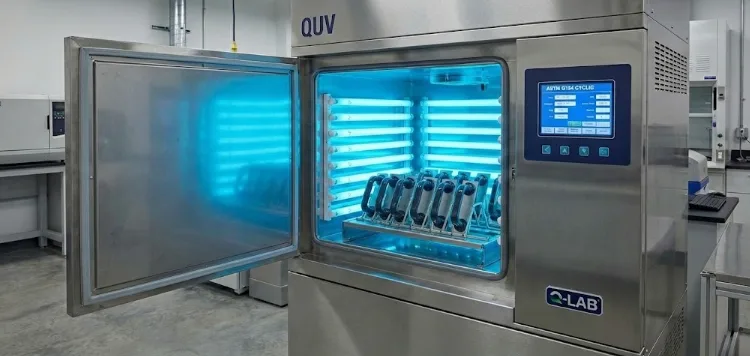
- ASTM G154: Standard Practice for Operating Fluorescent Ultraviolet (UV) Lamp Apparatus.
- Characteristics: Uses fluorescent UV lamps. Fast testing speed, very effective for evaluating physical properties (such as embrittlement).
- Application: Industrial-grade rapid screening.
- ASTM G155 / ISO 4892-2: Xenon-arc lamp exposure.
- Characteristics: Uses xenon arc lamps to simulate full-spectrum sunlight.
- Application: More accurate for evaluating color changes (Fading) than G154. If you have extremely high aesthetic requirements, request this standard.
Corrosion Resistance Testing for Coatings
- ISO 9227 / ASTM B117: Salt Spray (Fog) Apparatus.
- Note: Salt spray testing does not equal outdoor life testing, nor does it include UV testing. However, when selecting for outdoors, salt spray testing must be combined with UV aging testing to form a testing matrix.
Comprehensive Evaluation Standards
- UL 746C: Polymeric Materials – Use in Electrical Equipment Evaluations.
- If exporting electrical equipment to the US, the (f1) material rating in UL 746C is an important reference, covering UV exposure and water immersion testing.
Scenario-Based Recommendations
Based on the risk level of the specific application, I recommend adopting different material selection strategies:
Architectural Gating & Fencing
- Primary Risk: Extremely high Aesthetic requirements.
- Recommended Material: 316 Stainless Steel (Brushed or Mirror), or PVDF coated Aluminum.
- Verification Focus: Color difference control (Delta E < 2.0), Coating Adhesion test.
Industrial Cabinets & Generators
- Primary Risk: Functional failure and high-frequency operation.
- Recommended Material: Black ASA plastic, or Glass-Fiber reinforced UV-stabilized Nylon (PA6-GF30).
- Verification Focus: Retention of Mechanical Strength (ASTM D638), IP Sealing Rating test (IEC 60529).
Transportation (Trucks, Marine, RV)
- Primary Risk: Vibration + Salt Spray + UV.
- Recommended Material: Polished 316 Stainless Steel (Best for corrosion resistance). Avoid using standard ABS.
- Verification Focus: Combination of Vibration test (IEC 61373) and Salt Spray test (ASTM B117).
Key Selection Metrics
I recommend copying the following table into your procurement technical agreement:
| Metric Category | Key Parameter | Outdoor Application Requirement |
| Mechanical Properties | Tensile Strength Retention | > 80% after UV aging test |
| Impact Strength | No brittle fracture after aging | |
| Aesthetic Performance | Color Difference (Delta E) | < 3.0 after 1000 hours exposure |
| Gray Scale | ≥ Grade 4 (ISO 105-A02) | |
| Environmental Adaptability | Operating Temperature | -40°C to +85°C |
| Protection Rating (IP) | IP65 or IP66 (with gasket) |
Documentation & Acceptance
Do not accept verbal promises. As a buyer, you should require the supplier to provide the following documents to ensure compliance:
- Technical Data Sheet (TDS): Must clearly state the base resin grade and the UV stabilizer system.
- Third-Party Lab Reports: Must be reports executed according to ASTM G154 or ISO 4892.
- Check Point: The report must show the exposure time (e.g., 1000 hours) and comparative data before and after aging.
- Batch Traceability: Require the supplier to record the production batch number for every shipment to ensure consistency in the material formulation.
FAQ
Q1: If I use stainless steel for outdoor handles, do I still need to worry about UV?
A: Not entirely. The stainless steel substrate is immune to UV. However, if there is a transparent clear coat or powder coating on the surface, these coatings must be UV resistant. Additionally, rubber gaskets on the handle must be UV resistant, otherwise, the seal will fail.
Q2: Are black plastic handles more sun-resistant than colored ones?
A: Generally, yes. Black materials usually contain Carbon Black, which is a highly effective UV absorber. In contrast, red or yellow pigments fade much faster outdoors.
Q3: Does UV resistance affect the strength of the handle?
A: The purpose of UV-resistant additives is to maintain strength. Without additives, materials will rapidly lose strength after outdoor exposure. The additives themselves have negligible impact on initial strength but are critical for long-term service life.
Conclusion
The selection of outdoor handles is an engineering decision that balances durability, safety, and cost.
Neglecting UV-resistant design will inevitably lead to product fading, chalking, and even fracture accidents, increasing massive maintenance costs. I strongly recommend incorporating ASTM G154 or ISO 4892 testing into your procurement specifications. Prioritize 316 Stainless Steel or ASA Engineering Plastic, and use verifiable data to guarantee the safety of your equipment.

Anson Li
文章: 595RELATED POSTS
Control Box Flat Hinge Your Accessory Solutions
Redefining Modern Design with Compact Torque Hinges
The Complete Guide to Hinges: From Basics to Creative Applications
Industrial Folding Handles: Stainless Steel vs. Aluminum vs. Plastic Guide
Application of Recessed Door Latches in Ambulances