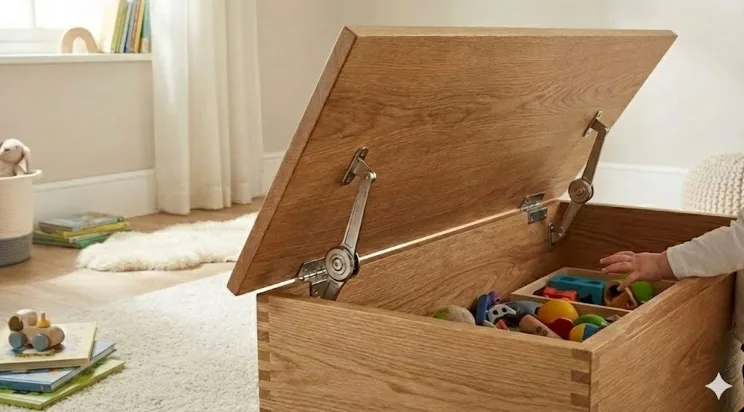
HTAN es uno de los principales fabricantes de bisagras, manillas y pestillos industriales de China.


On industrial doors, handle problems rarely stay small. A U-shaped handle with poor grip clearance can slow operators down, pinch gloved hands, or make a heavy door harder to control. A handle with weak mounting can loosen, deform the door panel, damage fasteners, or create repeated maintenance complaints. In wet, outdoor, or corrosive environments, the wrong material can turn a simple pull handle into a replacement item.
This guide focuses on one practical decision: how to choose U-shaped handles for industrial doors by grip clearance, mounting strength, and material fit. It is not a general handle encyclopedia. The goal is to help engineers, cabinet builders, and buyers avoid the most common problems before approving a handle for sliding doors, swing doors, machine access doors, warehouse doors, cold-room doors, or large equipment panels.
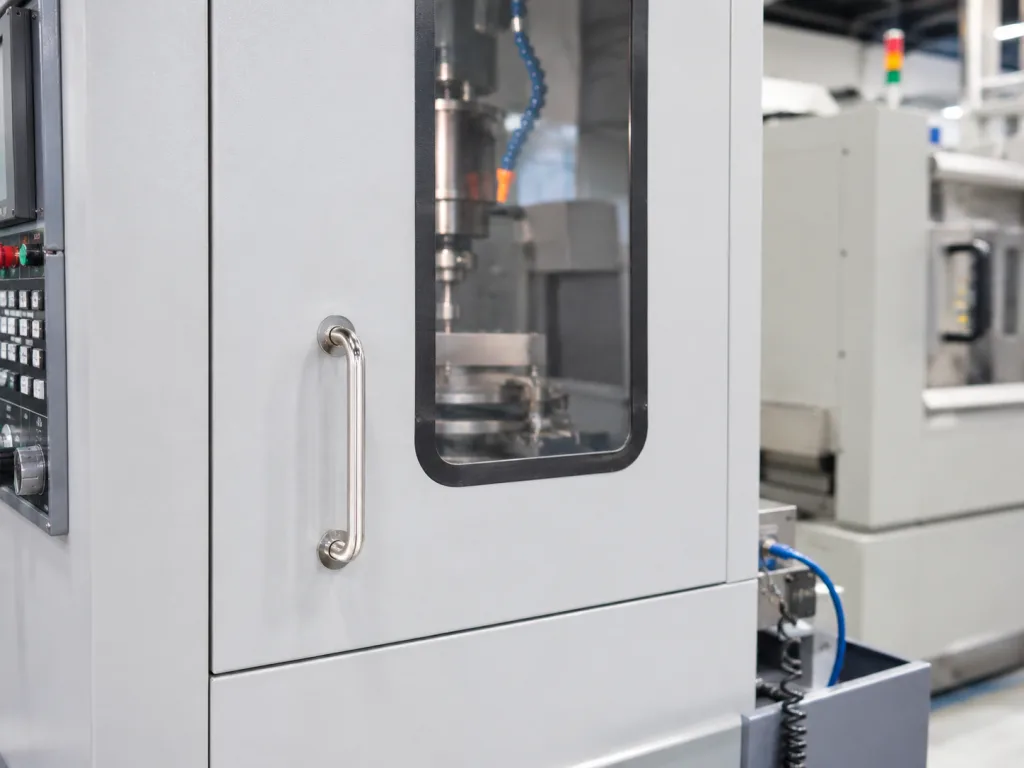
U-shaped handles are one type within the broader industrial handle category, but this article only covers the industrial door use case where grip space, mounting stability, and operating environment decide whether the handle works reliably.
Why U-Shaped Handles Fail on Industrial Doors
A U-shaped handle may look strong enough in a catalog but fail after installation because the door system was not checked as a whole. The handle, door panel, fasteners, backing plate, operator hand position, and working environment all affect performance.
The most common failure is not the handle bar breaking. It is usually one of these problems: the hand clearance is too small for gloves, the handle is mounted too close to the door edge, the door skin is too thin to support repeated pulling, the fasteners loosen over time, or the material is not suitable for moisture, chemicals, cleaning, or outdoor exposure.
For industrial buyers, these problems create real business consequences: field complaints, door rework, loose hardware, worker frustration, higher replacement cost, and equipment downtime. This is why U-shaped handle selection should start from the door application, not from the handle appearance.
Start with Grip Clearance, Not Handle Appearance
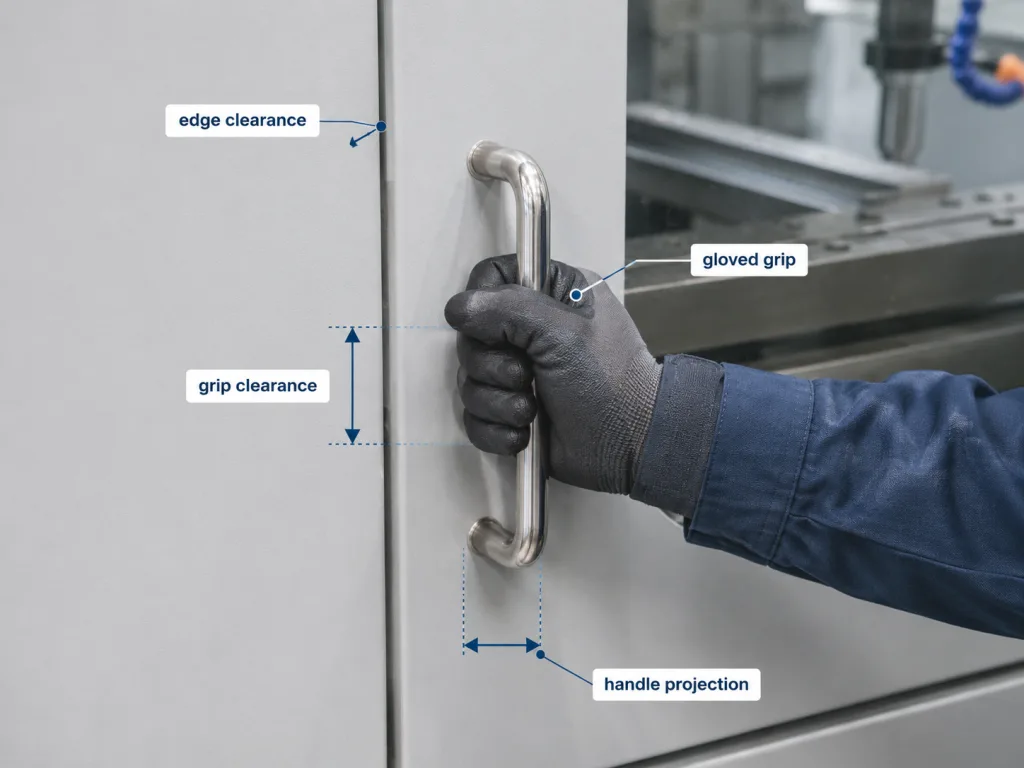
Grip clearance is the open space between the handle bar and the door surface. If this space is too narrow, operators cannot wrap their fingers around the handle comfortably. This becomes more serious when workers wear gloves, handle wet surfaces, or open heavy doors repeatedly during a shift.
A good U-shaped handle should allow the operator to grip without scraping knuckles, pinching fingers, or twisting the wrist into an awkward position. The handle should also provide enough projection from the door to create a controlled pull, but not so much that it becomes a collision point in a narrow aisle or service area. These grip and clearance factors are part of the broader ergonomic principles described in ISO 6385, the core ergonomics standard for designing work systems around human safety and comfort.
When operators wear gloves or open heavy doors repeatedly, grip clearance should be reviewed together with broader asas industriales ergonómicas requirements such as hand space, edge radius, grip comfort, and repeated-use safety.
Grip Clearance Checks
| Check Point | What to Confirm | Risk If Ignored |
|---|---|---|
| Glove Use | Whether operators wear work gloves, cold-storage gloves, or chemical-resistant gloves | Handle may be difficult to grip or too slow to operate |
| Hand Clearance | Enough space between handle and door surface for fingers to wrap safely | Knuckle scraping, finger pinch, poor grip control |
| Handle Projection | Whether protrusion is acceptable in the working aisle or equipment layout | Collision risk, snagging, impact damage |
| Edge Distance | Distance from handle to door edge, frame, or adjacent panel | Hand pinch or limited pulling angle |
| Grip Direction | Vertical, horizontal, or angled mounting based on door movement | Poor leverage or uneven pulling force |
Mounting Strength: Door Panel, Backing Plate, and Fasteners
Mounting strength is often more important than the handle material itself. A strong stainless steel U-shaped handle can still fail if it is mounted on a thin sheet-metal door without reinforcement. Repeated pulling can deform the door skin, enlarge mounting holes, loosen screws, or create cracks around the fasteners.
Before selecting the handle, check the door material, panel thickness, internal reinforcement, mounting hole spacing, fastener size, and whether the door needs a backing plate. For heavy doors or frequently used access doors, the pulling force should be distributed across a larger area instead of concentrated at two small mounting points.
When the mounting method is uncertain, compare rear mounting, through-bolt mounting, threaded inserts, and weld-on options within the broader guide to métodos de instalación de asas before finalizing the U-shaped handle design.
Mounting Method Selection
| Método de montaje | Mejor ajuste | Key Risk |
|---|---|---|
| Through-Bolt Mounting | Heavy doors, frequent-use panels, sheet-metal doors with rear access | Requires correct rear clearance and backing support |
| Rear-Mount Screws | Cleaner front appearance, equipment doors with interior access | Thread engagement and panel strength must be verified |
| Threaded Inserts | Doors where repeated removal may be required | Insert pull-out risk if panel is weak |
| Placa de apoyo | Thin sheet-metal doors, hollow doors, composite panels | Extra part and installation step required |
| Weld-On Mounting | Steel doors or custom OEM structures where permanent mounting is acceptable | Finish repair and corrosion control after welding |
Material Fit by Operating Environment
Material selection should follow the working environment. A dry indoor warehouse door does not need the same handle material as a washdown equipment door, outdoor steel door, coastal facility door, or cold-room access door. The handle material, fasteners, washers, and door material should be compatible as a system.
Stainless steel is usually preferred where corrosion resistance, cleaning, or long service life matters. Aluminum can reduce weight but may not be suitable for every heavy-door or corrosive environment. Plastic or nylon handles can help with insulation and corrosion-free operation, but they should not be used where high pull force, impact, or repeated heavy use exceeds the material limits.
For outdoor doors, washdown equipment, coastal locations, or chemical exposure, material selection should follow the same logic used for asas resistentes a la corrosión y a la intemperie, including material grade, fastener compatibility, drainage, cleaning chemicals, and long-term surface condition.
Environment-Based Material Check
| Medio ambiente | Dirección recomendada | What to Verify |
|---|---|---|
| Dry Indoor Warehouse | Plated steel, aluminum, or stainless steel depending on load | Mounting strength and grip clearance |
| Outdoor Industrial Door | Stainless steel or protected metal finish | Rain exposure, fastener compatibility, coating durability |
| Washdown or Food-Adjacent Area | Stainless steel with easy-to-clean geometry | Cleaning chemicals, surface finish, crevice control |
| Cold Storage Door | Metal handle with adequate glove clearance or insulated grip design | Condensation, glove use, operator comfort |
| Chemical or Coastal Area | Higher corrosion-resistance material and compatible fasteners | Chlorides, chemicals, galvanic corrosion, inspection interval |
| Light Indoor Electrical Panel | Plastic, nylon, zinc alloy, or light metal handle depending on load | Insulation need, load, temperature, and durability |
Sliding Doors vs. Swing Doors: Handle Position Matters
U-shaped handles are used on both sliding and swing doors, but the pulling direction is different. A sliding door often needs lateral pulling force, while a swing door usually needs a forward pull or push-pull motion. If the handle orientation does not match the door movement, operators may pull at an awkward angle and increase stress on the mounting points.
For sliding doors, the handle position should help the operator apply force in the direction of travel. For swing doors, the handle should provide enough leverage without placing the hand too close to the door frame. For wide or heavy doors, mounting height and distance from the edge should be checked with the actual operator workflow.
| Door Type | Handle Concern | Selection Focus |
|---|---|---|
| Sliding Industrial Door | Lateral pulling force | Grip space, mounting direction, door travel clearance |
| Swing Door | Forward pull and frame clearance | Edge distance, hand pinch risk, operator leverage |
| Heavy Access Door | Repeated high pulling force | Through-bolt mounting, backing plate, robust grip |
| Cold-Room Door | Gloved operation and condensation | Larger grip clearance, corrosion resistance, inspection access |
| Narrow Aisle Door | Projection and snag risk | Handle projection, traffic clearance, possible recessed alternative |
U-Shaped Handles vs. Recessed Pulls and Folding Handles
A U-shaped handle is not always the safest or most efficient choice. If the working aisle is narrow, if protruding hardware may be hit by moving equipment, or if the door must remain flush during transport, a recessed pull handle or folding handle may fit the application better.
Use a U-shaped handle when operators need a clear, secure grip and enough leverage to pull the door. Use a recessed pull when low projection matters more than maximum grip comfort. Use a folding handle when the handle needs to be available during operation but folded down during transport or storage.
| Tipo de asa | Fuerza | Limitación | Mejor uso |
|---|---|---|---|
| U-Shaped Handle | Strong, easy grip for gloved operation | Protrudes from the door surface | Industrial doors, access doors, heavy panels |
| Recessed Pull | Low profile and reduced snag risk | Less grip space, harder with gloves | Narrow aisles, flush panels, transport equipment |
| Asa plegable | Grip available when needed, lower profile when folded | Moving parts and load rating must be checked | Tool cases, mobile equipment, equipment covers |
| Bar Handle | Good for wide hand positions and two-hand use | May need more mounting space | Large doors, machine guards, service panels |
Errores comunes de selección
Mistake1: Choosing by Shape Alone
A U-shaped handle shape does not automatically mean the handle is suitable for an industrial door. Grip clearance, mounting strength, material, door thickness, and working environment still need to be checked before approval.
Mistake2: Ignoring Glove Clearance
A handle that feels comfortable with bare hands may be difficult to use with work gloves, cold-room gloves, or chemical-resistant gloves. Always check the handle with the actual operator conditions.
Mistake3: Mounting on Thin Sheet Metal Without Reinforcement
Thin door panels can deform around the mounting holes when operators pull repeatedly. Backing plates, through-bolts, or reinforced mounting zones should be considered when the door skin cannot support the expected load alone.
Mistake4: Using the Wrong Material for the Environment
Dry indoor doors, outdoor doors, washdown doors, and cold-room doors do not require the same handle material. Material choice should reflect corrosion exposure, cleaning conditions, temperature, and maintenance expectations.
Mistake5: Forgetting Fastener Compatibility
The handle material is only one part of the assembly. Fasteners, washers, inserts, and backing plates should also match the environment. A corrosion-resistant handle can still fail if the mounting hardware rusts or loosens first.
U-Shaped Handle Selection Checklist for Industrial Doors
| Especificación Artículo | El ingeniero o el comprador deben confirmar |
|---|---|
| Door Type | Sliding door, swing door, machine access door, warehouse door, cold-room door, or equipment panel |
| Grip Clearance | Enough space for bare hands or gloved hands without pinch risk |
| Handle Projection | Whether protrusion is acceptable in the aisle, machine layout, or traffic path |
| Door Material | Steel, stainless steel, aluminum, composite, hollow metal, or insulated panel |
| Panel Strength | Whether the door skin needs backing plates or reinforcement |
| Método de montaje | Through-bolt, rear-mount, threaded insert, backing plate, or weld-on design |
| Fastener Compatibility | Fastener material, washer type, thread engagement, and corrosion risk |
| Entorno operativo | Dry indoor, outdoor, wet, chemical, coastal, cold storage, or washdown exposure |
| Operator Conditions | Glove use, one-hand or two-hand operation, frequency of opening, and access speed |
| Maintenance Risk | Likelihood of loosening, corrosion, surface wear, or panel deformation over time |
PREGUNTAS FRECUENTES
Are U-shaped handles suitable for heavy industrial doors?
Yes, U-shaped handles can be suitable for heavy industrial doors when the handle material, mounting method, fasteners, and door reinforcement are matched to the application. The mounting structure is often more important than the handle shape alone.
How much grip clearance should a U-shaped handle have?
Grip clearance should be based on the operator’s hand size, glove use, and door opening force. Instead of relying on a fixed number, test the handle with the actual gloves and working conditions used in the facility.
What mounting method is best for U-shaped handles on sheet-metal doors?
For thin sheet-metal doors, through-bolt mounting with a backing plate or reinforced mounting area is usually safer than relying only on short screws. The goal is to distribute pulling force and prevent deformation around the mounting holes.
Should I choose stainless steel, aluminum, or plastic U-shaped handles?
Choose stainless steel for corrosion resistance, washdown, outdoor, or heavy-duty use. Choose aluminum when lower weight matters and the environment is not highly corrosive. Choose plastic or nylon only when the door is light-duty or when insulation and corrosion-free material are more important than high mechanical strength.
When should I avoid a U-shaped handle?
Avoid a protruding U-shaped handle when aisle clearance is limited, when moving equipment may hit the handle, or when the door must remain flush. In those cases, a recessed pull or folding handle may be more suitable.
Consejos para la selección final
Choose U-shaped handles for industrial doors when operators need a clear, reliable grip and the door structure can support repeated pulling force. The safest selection process is to confirm grip clearance first, then check mounting strength, door reinforcement, fastener compatibility, and material fit for the operating environment.
If your project involves sliding doors, swing doors, equipment access doors, warehouse doors, or cold-room panels, HTAN can help review handle size, mounting method, door material, fastener choice, and corrosion exposure before sample production. Share your door drawing, panel material, operating environment, and glove-use requirements to receive a suitable U-shaped handle recommendation.