HTAN est l'un des principaux fabricants de charnières, de poignées et de loquets industriels en Chine.


A control cabinet holds the switches, PLCs, and wiring that keep a machine or process running, and the cam latch on its door decides one thing before anything else: can just anyone open it, or only the people who should? A non-locking cam latch lets a technician open the door in a quarter turn. A locking cam latch adds a key or tool step that keeps unqualified hands out. Neither is universally “better” — the right one depends on who can reach the cabinet and what is behind the door.
This guide compares locking and non-locking cam latches for control cabinets across access control, safety, and maintenance speed, so you can match the latch to how the cabinet is used and who needs to get in. It focuses on the locking decision, not on cam latch types in general.
Core question
Does access need to be controlled at the door, or is it already controlled by the room?
Main risk
A non-locking latch on an exposed cabinet leaves live equipment open to unqualified access.
Next step
Confirm where the cabinet sits and who can reach it before choosing the latch.
Principaux enseignements
- A non-locking cam latch opens in a quarter turn with no key; a locking cam latch adds a key or tool step to restrict who can open the door.
- Choose a locking cam latch when unqualified people can reach the cabinet, when live equipment makes access a safety issue, or when a standard requires restricted access.
- Choose a non-locking cam latch when the cabinet is already in a secured area and speed of frequent access matters more than a lock at the door.
- The deciding question is not which latch is stronger, but whether access needs to be controlled at the door or is already controlled by the room around it.
Quick Answer: Locking or Non-Locking?
| If the control cabinet… | Un meilleur choix | Pourquoi |
|---|---|---|
| Can be reached by unqualified people | Loquet à came de verrouillage | Restricts access to authorized staff |
| Holds live equipment that is a safety hazard | Loquet à came de verrouillage | Keeps untrained hands out |
| Must meet a restricted-access requirement | Loquet à came de verrouillage | Provides controlled entry at the door |
| Sits in a locked electrical room | Non-locking cam latch | L'accès est déjà contrôlé |
| Is opened many times a shift by trained staff | Non-locking cam latch | Faster, no key needed |
In short, a locking cam latch is the default wherever the cabinet is exposed to people who should not open it, and a non-locking cam latch is the practical choice where access is already controlled and speed matters. Where the cabinet sits usually decides it before the latch itself does.
What Each Latch Does
A non-locking cam latch secures the door by rotating a cam behind the frame, usually with a quarter turn of a knob, wing, or tool. It holds the door shut and is fast to operate, but anyone who can turn it can open the door. Its job is to keep the door closed, not to control who opens it.
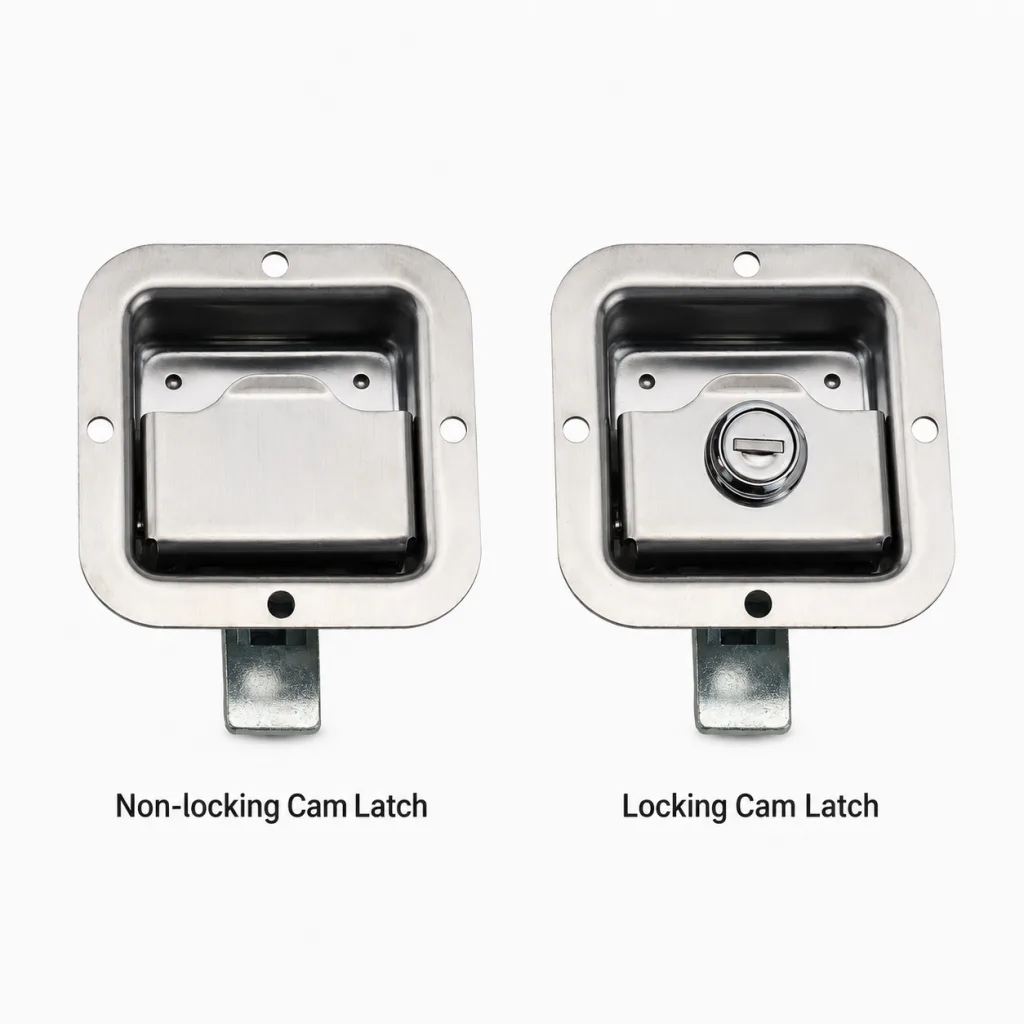
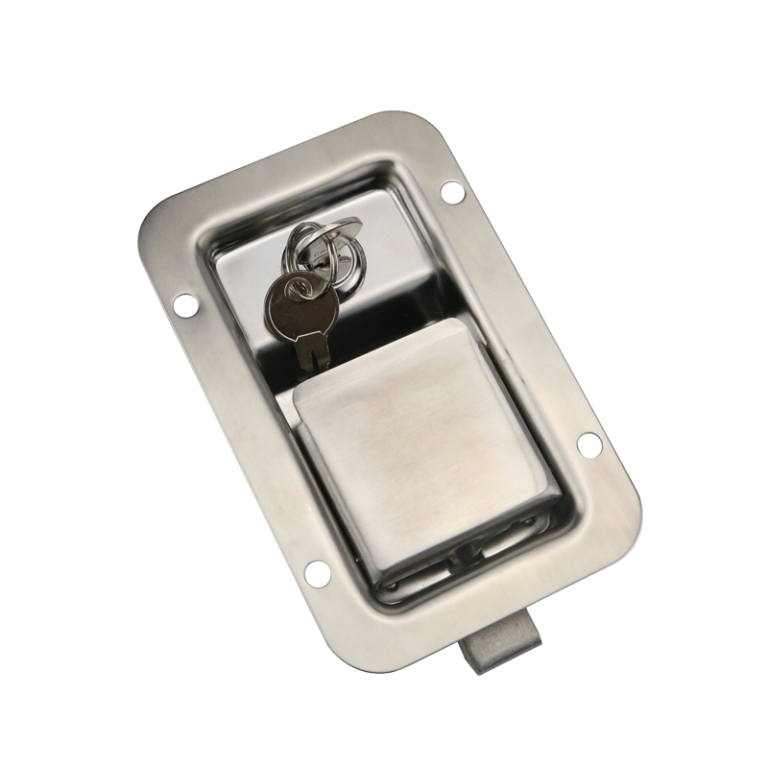
A locking cam latch adds a lock to that same cam mechanism. Opening it requires a key, a coded tool, or a standardized cabinet key before the cam will turn. This combines closure and access control in one component, so the door cannot be opened without first defeating the lock. The underlying cam mechanism is the same; the difference is the barrier to opening it, explained further in the guide to Les serrures à loquet et où les utiliser.
Contrôle d'accès : la différence fondamentale
The defining difference is who can open the door. Control cabinets often contain live electrical equipment that is dangerous to anyone not trained to work on it, which is why many installations require the enclosure to restrict access to authorized personnel. A locking cam latch is how that requirement is usually met at the door itself.
Locking cam latches offer several levels of control. A keyed lock limits opening to whoever holds the key. A standardized cabinet key — a common double-bit or triangular pattern — lets any authorized technician open the cabinet with a standard tool while still excluding the public. Some accept a padlock for lockout/tagout during maintenance. A non-locking cam latch offers none of this: anyone who can reach and turn it can open the door, so it is only appropriate where access is controlled by other means.
Is Access Controlled at the Room or the Door?
The most useful question is where access is controlled. If the control cabinet sits inside a locked electrical room that only trained staff can enter, access is already controlled at the room level, and a non-locking cam latch may be entirely sufficient — adding a lock at the door just slows down staff who are already authorized to be there. This is a common, legitimate use of non-locking latches.
If the cabinet sits on a production floor, in a public corridor, outdoors, or anywhere mixed traffic can reach it, there is no controlled room doing that job, so access has to be controlled at the door — which means a locking cam latch. This is why two identical control cabinets can correctly use different latches: it is not the cabinet that decides, but where it sits and who can walk up to it.
Maintenance Speed and Daily Operation
Non-locking cam latches win on speed. A quarter turn opens the door with no key to find or fumble, which matters on a cabinet that trained technicians open many times a shift in an already-secure area. In that situation a locking latch adds a step to every single access with no security benefit, because access is controlled elsewhere. Where frequent, fast entry by authorized staff is the daily reality, the non-locking latch is the better working choice.
Locking cam latches trade a little of that speed for control, and that trade is the whole point when control is needed. The key step is exactly what keeps unqualified people out. Many facilities settle the tension by using a standardized cabinet key: authorized technicians all carry the common key, so opening stays quick for them while the public is still excluded. The installation of either type is the same at the panel; the practical steps are in the guide d'installation du loquet à came.
Comment se décider
Work through these in order — access reach first, then frequency:
| Question | Si oui → Verrouillage | If no → Non-locking may be enough |
|---|---|---|
| Les personnes non qualifiées peuvent-elles atteindre physiquement l'armoire ? | Loquet à came de verrouillage | Non-locking possible |
| Does a standard require restricted access? | Loquet à came de verrouillage | Non-locking possible |
| Is the cabinet already inside a secured room? | Non-locking cam latch | - |
| Is it opened very frequently by trained staff only? | Non-locking cam latch | - |
For control cabinets specifically, the presence of live equipment means a locking cam latch is the default in most exposed or public-facing installations, while non-locking latches are reserved for cabinets already protected by a secured area. If access control is also a question of the handle rather than the latch, the comparison of locking versus standard handles for electrical cabinets covers that side of the decision.
The Cost of Choosing Wrong
The two ways to get this wrong have very different consequences, which is why it helps to look at the risk of each mistake rather than just the choice:
| The mistake | Where it happens | What it risks |
|---|---|---|
| Non-locking latch on an exposed cabinet | Public floor, corridor, outdoors, mixed traffic | Unqualified access to live equipment — a safety and compliance failure |
| Locking latch on a cabinet in a secured room | Locked electrical room, restricted area | Wasted time on every access, and lost or duplicated keys slowing trained staff |
| Locking latch chosen for security, keyed individually across a large site | Facilities with many control cabinets | Key management burden — use a standardized cabinet key instead |
| Assuming a locking latch supports lockout/tagout | Maintenance with padlock requirements | No padlock provision when needed — verify the specific latch first |
The asymmetry is the key point: putting a non-locking latch where access should be controlled is a safety and compliance risk, while putting a locking latch where access is already controlled is mostly a cost and convenience penalty. When the two are close, that difference in what each mistake risks is usually the more reliable thing to decide on.
FAQ
What is the difference between a locking and non-locking cam latch?
A non-locking cam latch holds the door shut by rotating a cam, opened in a quarter turn by anyone who can reach it. A locking cam latch adds a key or tool step to that same cam mechanism, so the door cannot be opened without first defeating the lock. The mechanism is the same; the difference is whether opening the door is restricted to authorized people.
Do control cabinets need locking cam latches?
It depends on where the cabinet sits and who can reach it. Many installations with live equipment require restricted access, and a locking cam latch is the usual way to meet that at the door. But if the cabinet is already inside a locked electrical room that only trained staff can enter, a non-locking latch can be sufficient because access is controlled at the room level. Confirm the specific requirements that apply to your installation.
When is a non-locking cam latch the better choice?
A non-locking cam latch is the better choice when the cabinet is already in a secured area and is opened frequently by trained staff. In that case a lock at the door adds a step to every access without adding security, since access is controlled by the room. The quarter-turn speed of a non-locking latch is a real advantage where fast, frequent entry by authorized people is the daily pattern.
Can a locking cam latch use a standard key across many cabinets?
Yes. Standardized cabinet keys, such as common double-bit or triangular patterns, are widely used so that any authorized technician can open many cabinets with one tool while the public is still excluded. This keeps access quick for trained staff without leaving the cabinets unsecured. It is a common way to balance speed and control across a facility with many control cabinets.
Does a locking cam latch support lockout/tagout?
Some locking cam latches accept a padlock or are designed to be locked out during maintenance, which supports lockout/tagout procedures by physically preventing the door from being opened while work is in progress. If lockout/tagout is part of your maintenance process, confirm that the specific latch supports a padlock or lockout device before selecting it. Not every locking latch is built for this, so it should be verified rather than assumed.
Résultat final
Locking versus non-locking cam latches comes down to one question: can someone who should not open this control cabinet physically reach it? If yes, a locking cam latch is how you keep them out. If the cabinet already sits in a secured area and only trained staff reach it, a non-locking cam latch is faster and entirely sufficient. Decide by the cabinet’s exposure and who can walk up to it, not by a default, and the choice is clear.
If you can tell us where the control cabinet sits, who needs access, and how many cabinets are involved, HTAN can recommend a locking or non-locking cam latch to match — including standardized-key versions that let one technician key open many cabinets across a site. As a manufacturer, we can also supply samples for fit testing and build to your panel thickness and access requirements. Browse the plage de verrouillage des cames, or send your cabinet layout and access needs for a model recommendation.
Note de sélection : The final choice depends on the specific installation — where the cabinet sits, who can physically reach it, and any access-control or electrical safety standards that apply. Where restricted access is required by a standard or facility rule, confirm that requirement before ordering, and specify a locking latch that meets it.