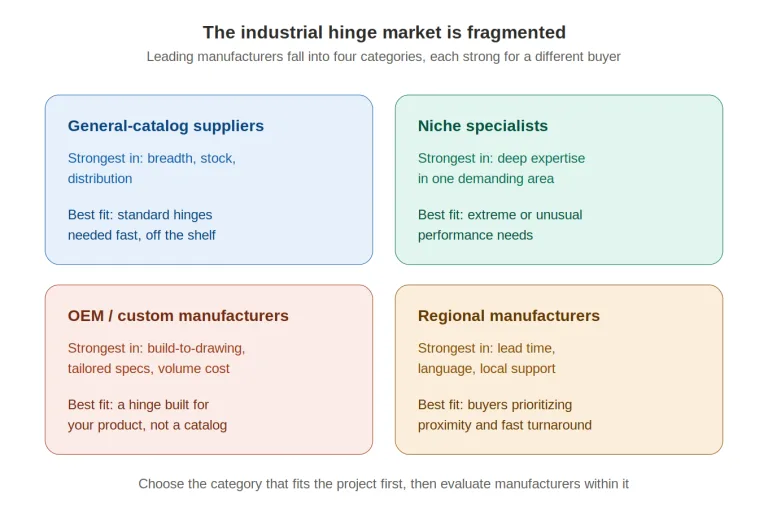
HTAN is one of the leading manufacturers of industrial hinges, handles and latches in China.


Spring-Loaded Motion for Doors and Panels
A spring hinge can move a door and still fail to close it.
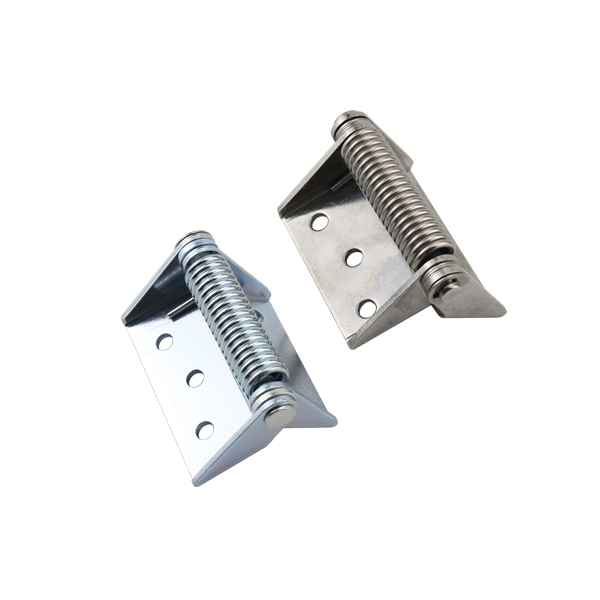
A spring hinge integrates a spring that applies return torque toward a preferred open or closed position after the door is released. Unlike a plain hinge, it can drive the panel back without an external actuator.
The last few degrees are usually the difficult part. Gasket compression, latch engagement, cable drag, bracket flex, misalignment, or an unfavorable spring-torque curve may stop the door before it reaches the required end position.
Core question
Will the hinge return the complete door through the required angle range?
Main risk
Enough mid-travel torque may still be insufficient near the latch or gasket.
Next step
Check return direction, torque, hinge count, alignment, and the complete door.
Page scope: this guide explains how to choose, install, inspect, and maintain spring hinges for cabinet, enclosure, guard, access-panel, and equipment doors. Arbitrary-angle holding belongs to position-control hinges. Controlled closing speed belongs to hinge damping.
How Spring Hinges Work
As the door moves away from the hinge’s preferred position, the internal spring deflects and stores energy. Releasing the door allows that stored energy to create a return moment around the hinge axis. A spring-close hinge returns toward the frame. A spring-open hinge returns toward an open service position.
The available torque is not necessarily constant. It can change with angle, preload, spring geometry, internal friction, temperature, cycle history, and manufacturing tolerance. One catalog value—or a quick hand test—cannot describe the complete door motion.
Spring Return
The spring supplies return torque toward a defined end position. It does not automatically guarantee latch engagement, free-stop holding, or a controlled closing time.
Door Resistance
Friction, gaskets, latches, magnets, cables, seals, gravity, pressure difference, and mounting deformation can oppose the return motion at different angles.
Main Types of Spring Hinges
Spring hinges are commonly classified in two ways: by return direction and by spring setting. These classifications overlap. An adjustable hinge can be spring-close or spring-open, and a fixed-tension hinge can also use either return direction.
Spring Close
Use this direction when the door should return toward its closed condition. Define whether it only needs to move toward the frame or must also compress a gasket and engage a latch.
Spring Open
Use this direction when the cover should return toward an open service position. The spring does not replace a rated structural stop.
| Spring Setting | What It Changes | What to Verify |
|---|---|---|
| Fixed tension | Uses a factory-defined return setting | Torque range, tolerance, usable angle range, and compatibility with the complete door |
| Adjustable tension | Allows the spring setting to change within a model-specific range | Adjustment direction, increments, locking method, tool access, maximum setting, and production reference |
How to Choose Spring Hinges
Return Direction and End Position
Start with the required end state. A spring-close door may need to restore a cover, bring a latch into engagement, or return a guard toward its intended position. A spring-open panel may improve service access, but it still needs a structural stop and a project-defined failure condition.
Where a door forms part of a guarding or protective system, the acceptable return and failure behavior must come from the complete machine risk assessment rather than from the hinge alone.
Hinge Axis and Door Load
Door mass affects every hinge installation, but it does not create the same return-torque problem in every orientation.
- Vertical-axis swing door: gravity mainly contributes to structural hinge load, sag, pin reaction, and bracket bending. It normally does not create the main opening or closing torque around a truly vertical axis.
- Horizontal-axis lid or cover: gravity creates an angle-dependent moment around the hinge line. For a preliminary static check, Tg(θ) = W × d⊥(θ), where W is weight force rather than mass.
A nominally vertical door can develop an unintended gravity-driven tendency when the hinge axis is tilted, the machine frame is not level, or structural deflection changes the axis orientation. An out-of-plane center-of-gravity offset increases hinge bending and door sag, but it contributes to opening or closing torque only when combined with a nonvertical axis or another asymmetric mechanism.
Use the industrial hinge load-capacity guide when door sag, radial or axial load, hinge spacing, or mounting strength requires a separate structural calculation.
Closing Force Through the Swing
A spring hinge does not necessarily produce one constant torque. Spring return and door resistance both change through the swing. The door returns only where the available net torque acts toward the required end position.
Direction-specific torque balance:
Tnet(θ) = Tspring(θ) + Tassist(θ) – Tresistance(θ)
Treat spring and assist torque as positive magnitudes when they act toward the required end position. Enter friction, gasket, latch, cable, gravity, seal, magnet, pressure-difference, and bracket-deformation effects as positive magnitudes in Tresistance. Evaluate any contribution that changes direction separately at each angle.
When the requirement is stated as closing force at the latch or door edge, use Fclose(θ) ≈ Tnet(θ) ÷ r⊥(θ). State the door angle, force-measurement point, and force direction. Force values measured at different radii are not directly comparable.
The Last Ten Degrees
A side-hinged enclosure door may return freely from the open position and stop just before the latch. The gasket begins to compress, the latch ramp adds resistance, and the door bracket twists slightly. Increasing preload may make the door latch, but it also raises opening force and mounting load. A better correction may be a different spring curve, revised latch geometry, lower gasket compression, a stiffer bracket, or a combination of changes.
This is an illustrative engineering scenario, not a customer project record or product test claim.
How Many Spring Hinges per Door?
When spring hinges share a common axis, act in the same return direction, and are evaluated at the same angle and setting, their return moments can be combined for a preliminary system estimate. The final quantity still depends on structural load, opening effort, alignment, and production tolerance.
- Every added spring hinge increases return torque and opening effort.
- More hinges do not guarantee equal sharing of door weight, sag, or bracket reaction.
- Additional hinges increase sensitivity to hole position, leaf flatness, weld distortion, and frame twist.
- A door may use spring hinges together with plain support hinges, but the arrangement requires model-specific review.
Return torque is not structural load capacity. A hinge may provide enough spring moment while its leaves, pin, fasteners, or mounting sheet remain inadequate for the door weight and moment.
How to Install Spring Hinges
The exact leaf orientation, fasteners, adjustment method, and installation direction depend on the model drawing and instructions. The following sequence covers the engineering checks that remain valid across industrial doors.
- Confirm the return direction. Identify spring-close or spring-open before drilling or tightening. Match the supplier’s viewing direction and rotation convention to the installed door.
- Support and align the door. Support the complete door independently. Align all hinge pins on one intended centerline. Do not use spring preload or loose fasteners to pull a sagging door into place.
- Install the production hardware. Fit the production-representative gasket, latch, magnet, cables, seals, and structural stop before the final spring setting is approved.
- Set preload after alignment. Follow the exact model instructions. Clockwise adjustment does not universally increase tension, and the strongest setting is not automatically correct.
- Test several release angles. Confirm return, latch engagement, permitted opening effort, and the absence of binding, bracket flex, fastener movement, leaf lift, and door sag.
Spring Hinge Maintenance
Maintenance should preserve alignment, return force, and the mounting joint. It should not rely on one universal monthly, quarterly, or six-month schedule. Inspection frequency depends on the hinge model, operating frequency, contamination, environment, lubricant, and the consequence of a door failing to return.
- Fasteners and leaf seating: look for loose screws, insert movement, leaf lift, cracked welds, or deformation around the mounting holes.
- Return behavior: release the door from defined angles and compare the result with the approved setup.
- Alignment and free play: inspect binding, rattling, pin movement, door sag, and unequal movement between paired hinges.
- Spring adjustment: check damaged adjustment features, loss of the recorded setting, or evidence that preload has been used to compensate for a structural problem.
- Corrosion and contamination: inspect the spring, pin, leaves, fasteners, lubricant, and nearby surfaces—not only the visible outer leaf.
- Lubrication: follow the model-specific instructions. Adding the wrong oil or grease can attract abrasive contamination or change the designed friction.
When Replacement Is Required
Replace or remove the hinge from service when a cracked spring, damaged pin, uncontrolled free play, severe corrosion, repeated loss of setting, or permanent leaf deformation prevents the door from meeting its approved return and opening-force requirements. Whether the spring can be replaced separately is model-specific; do not assume that every hinge is serviceable.
Common Spring Hinge Problems
| Observed Problem | Likely Checks | Corrective Direction |
|---|---|---|
| Door stops before the latch | Gasket compression, latch ramp, magnet, cable drag, bracket flex, final-angle spring torque | Correct the resistance or spring curve before simply increasing preload |
| Door is difficult to open | Excessive preload, too many spring hinges, cable or seal resistance, poor handle location | Rebalance return margin and user effort |
| Door closes too quickly or impacts the stop | Excess spring energy, gravity assistance, missing or inadequate damping | Specify damping or revise the spring setting; do not use the spring as a speed-control device |
| Hinges bind after installation | Pin-axis misalignment, twisted frame, uneven leaf seating, door sag | Realign and reinforce the hinge line before changing preload |
| Return force becomes uneven | Paired-hinge tolerance, adjustment mismatch, spring fatigue, contamination, damage | Measure each hinge and the assembled door under the same condition |
| Fasteners repeatedly loosen | Flexible sheet, insufficient backing, stop impact, cyclic spring reaction | Correct the joint and load path rather than relying only on thread locking |
Supplier Data and Door Validation
A useful datasheet lets two suppliers describe the same function under the same conditions. Nominal torque, door-weight, and cycle claims are not comparable when the angle, direction, preload, test geometry, and acceptance criteria differ.
| Supplier Item | What Must Be Defined | Buyer Action |
|---|---|---|
| Return direction | Spring-close or spring-open, viewed from a stated side and rotation convention | Match the drawing to the installed door |
| Spring torque | Angle, direction, preload, tolerance, temperature, and whether the value is a point or curve | Request torque-angle data for the usable range |
| Closing force | Door angle, force-measurement point, direction, and complete-door condition | Do not compare force values measured at different radii |
| Door or load rating | Door size, center of gravity, hinge count, spacing, orientation, substrate, and test method | Do not compare kilograms without the geometry |
| Adjustment | Range, increments, direction, locking method, tool access, and maximum permitted setting | Define the production setting and inspection method |
| Cycle statement | Load, range, speed, dwell, temperature, lubrication, preload, and acceptance criteria | Request before-and-after return torque and free-play data |
| Material and finish | Leaves, pin, spring, adjustment parts, fasteners, and surface treatment | Confirm compatibility with the environment |
Approve the full hinge set on representative door and frame structures. Record the exact model, orientation, hinge count, spring setting, mounting drawing, starting angles, latch or gasket condition, opening effort, and before-and-after results after any required cycle or environmental exposure.
Engineering Review
Send the Door Return Requirements
Provide the complete door data so the return direction, spring torque, opening effort, mounting, and validation can be reviewed under the same conditions.
- Door orientation, mass, and center of gravity
- Spring-close or spring-open direction
- Required start and end angles
- Latch, gasket, cable, magnet, and seal resistance
- Maximum acceptable opening force
- Hinge count, spacing, mounting drawing, environment, and cycle requirement
FAQ
What is a spring hinge?
A spring hinge integrates a spring that applies return torque toward a preferred open or closed position after the door is released.
How do spring hinges work?
Moving the door deflects the internal spring and stores energy. When the door is released, that stored energy creates a return moment around the hinge axis.
How many spring hinges should be used per door?
The answer depends on the required total return torque, structural door load, hinge spacing, door and frame stiffness, axis alignment, and the supplier’s rating method. More spring hinges also increase opening effort.
Can a spring hinge hold a door at any angle?
Not as a general rule. A standard spring hinge returns toward a defined open or closed position. Arbitrary-angle holding normally requires position-control hardware, a detent, a lock, or another holding mechanism.
Why can a spring hinge return the door but fail to engage the latch?
Resistance can rise sharply near the closed position because of gasket compression, latch ramps, magnets, cable drag, bracket flex, or misalignment. The spring may have enough torque in mid-travel but not enough margin in the last few degrees.
Can a spring hinge provide soft-close motion?
Spring force creates return motion but does not automatically control closing speed. When closing time, rebound, or impact matters, specify damping separately and test the spring and damper together on the complete door.
The correct spring hinge is the one that returns the complete door in the required direction, through the required angle range, with acceptable opening effort and verified structural behavior. Reliable service depends on selection, installation, inspection, and maintenance being based on the actual hinge model and complete door assembly.