






Industrial hinges, handles and latches for OEM equipment.
- +86 13720060320


The Ultimate Guide to Push-to-Open Latches for Industrial Cabinets
A push-to-open latch can release correctly and still leave the cabinet door closed. The mechanism may click, but gasket preload, hinge friction, cable drag or insufficient panel travel can consume the motion needed to eject the door. For push-to-open latches for industrial cabinets, reliable operation depends on the latch and the complete door assembly reaching the release point together.
This is why a touch-release latch should not be selected from a product photo or holding-force figure alone. The door must move inward far enough to trigger the mechanism, the keeper must meet the latch in the correct position, and the released door must move outward far enough to create usable access. A mismatch at any one of those interfaces can make a mechanically sound latch behave unreliably.
This page stays on that problem. It explains the working window between the cabinet door, latch body and keeper. Broad model browsing belongs in the industrial latch range; the sections below define what the cabinet must provide before a specific push-to-open model can be approved.
What “Push-to-Open” Means Here
On this page, push-to-open means the user presses the door or panel itself. That inward motion trips an internal touch-release mechanism, and the latch then allows or helps the door move outward. The door surface is the actuator.
That definition matters because several other industrial latch families also use the word “push.” A visible pushbutton latch is actuated by pressing a button or knob. A quarter-turn latch is released by rotation. A paddle latch uses an external paddle or handle. Those mechanisms may be suitable for the same cabinet, but their operating geometry is different and they should not be mixed into a push-to-open setup calculation.
Push-to-open mechanisms themselves are not all identical. Some retain the door magnetically and use a spring-loaded plunger to create the opening movement. Others use a mechanical pin, catch or receptacle. The exact engagement depth, release travel and ejection stroke therefore come from the selected model drawing, not from a generic industry value.
Scope rule: if the operator must press a separate button, rotate a cam or pull a paddle, that mechanism is outside this page. The engineering task here is the door-surface push → release → outward-opening sequence.
Push-to-Open Latches Need Door Travel
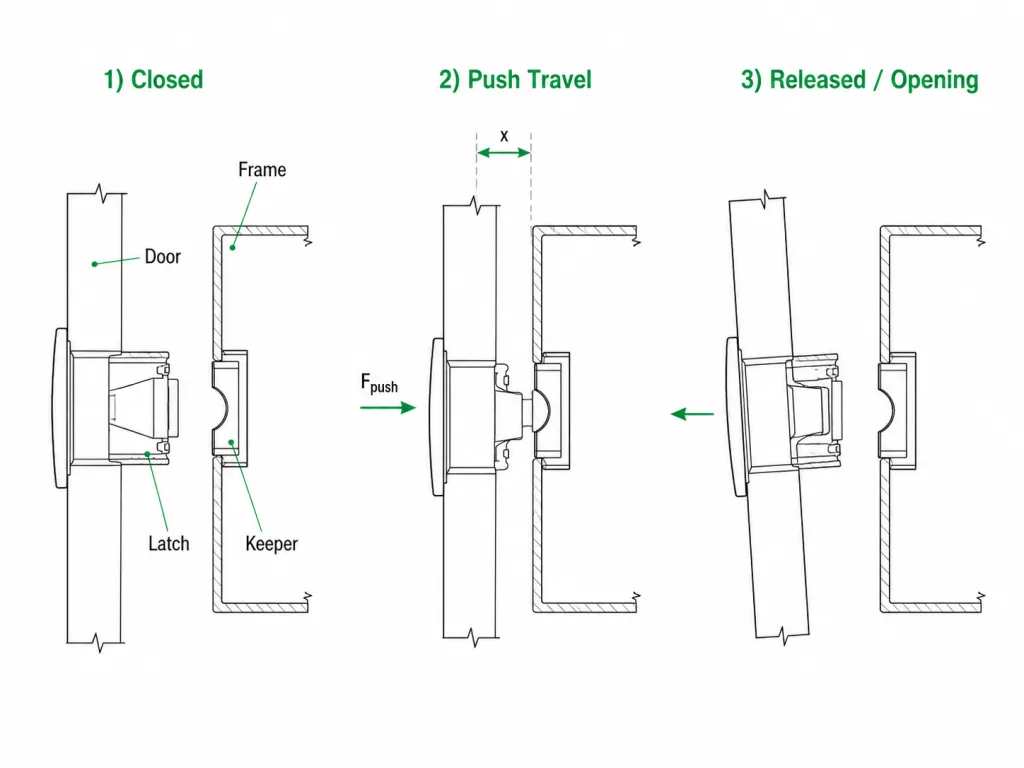
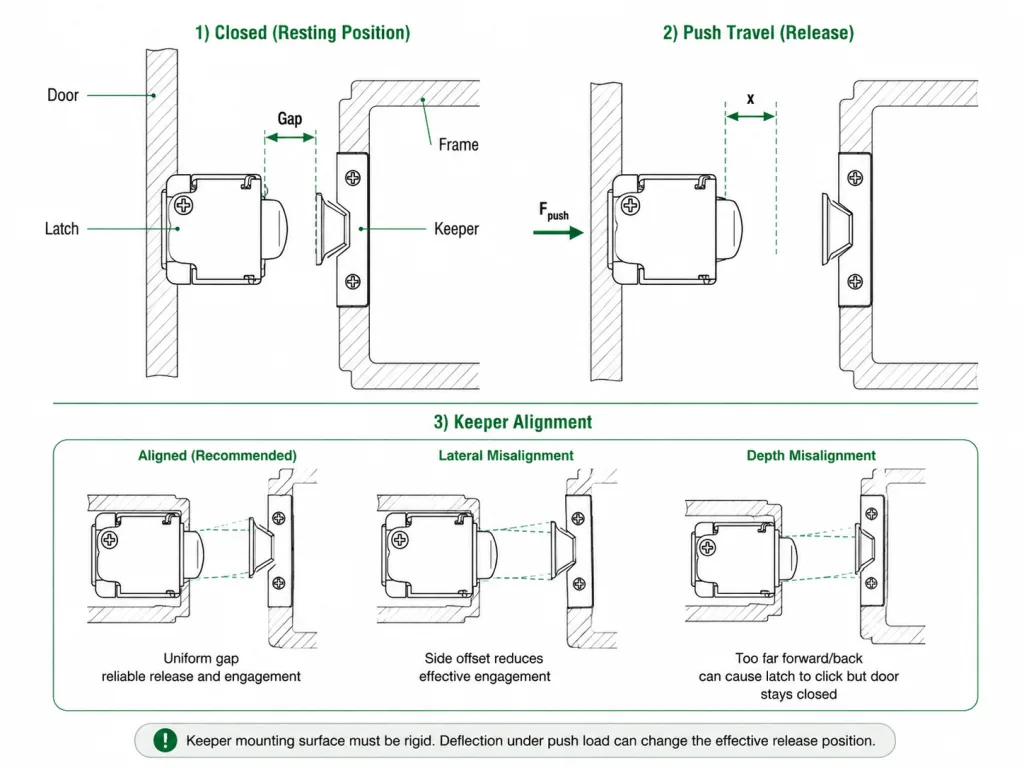
A closed cabinet door is not necessarily at the latch release position. In many touch-release mechanisms, the user must push the door farther inward from its normal resting position before the internal mechanism changes state.
That creates three distinct positions that should be visible on the project drawing:
- Closed resting position: the door is retained and sits at its intended closed location.
- Push/release position: the door has moved inward enough for the latch to trip.
- Released position: the mechanism has changed state and the door can move outward.
If the frame stop, gasket, door return or nearby hardware prevents the second position from being reached, the latch can never release consistently. The cutout may be correct. The latch can be mounted square. The door still does not have enough travel.
The reverse problem also exists. Excess free movement at the closed position can leave the door loose, reduce engagement or allow the keeper to meet the latch at an inconsistent depth. The useful design target is not “as much gap as possible.” It is a controlled motion window that includes both secure retention and the model-specific release movement.
Push Force Is Not One Number
A single “push force” value can hide several different forces in the same door. They should be separated before the operator feel or opening reliability is judged.
Operator input
This is the force the user applies to the door surface. It must overcome the resistance present before the mechanism reaches its release point. Where the user presses also matters: a flexible panel may deflect locally instead of transferring the full motion to the latch.
Door resistance
Hinge friction, gasket reaction, magnetic attraction, cable drag, door sag, rubbing edges and panel stiffness can all oppose inward or outward motion. The latch body does not know which component created that resistance; it only sees whether the door reaches the required position.
Ejection after release
After the latch trips, the door needs enough outward movement to become visibly or physically open. Depending on the mechanism, that motion may come from an internal spring plunger, a separate spring hinge, panel preload, gravity or another element in the assembly. Do not assume the latch alone provides all of the opening energy unless the selected product data says so.
Useful engineering check: the available release/ejection action must exceed the resisting effects that prevent the door from moving into a usable open position. This is a force-and-travel balance, not a universal numerical formula.
A latch that works on an empty sheet-metal sample can therefore fail after a gasket, display harness or stiffer hinge is added. The product has not necessarily changed. The resisting system has.
Panel Gap Sets the Working Window
The visible door-to-frame gap is only one part of the stack-up. A push-to-open latch also depends on how far the door can move inward from its retained position, how the keeper enters the latch, and how much outward clearance is available after release.
The correct gap cannot be copied from another cabinet unless the latch model and door geometry are the same. The selected drawing should identify the latch-to-keeper relationship in the closed state and the movement required to trip the mechanism. The cabinet drawing should then show that the door can physically reach those positions.
| Door / Latch Condition | What It Changes | What to Verify |
|---|---|---|
| Frame stop too close to the door | Reduces available inward travel | Confirm the door can reach the model-specific release position without structural interference. |
| Gasket heavily preloaded at rest | Increases push resistance and can consume travel | Measure the actual closed stack-up and determine whether a touch-release latch is appropriate. |
| Large free gap at the keeper | Can reduce engagement depth or allow rattle | Set keeper position from the latch drawing, not from visual appearance alone. |
| Flexible door skin at the push point | User motion may bend the panel instead of moving the latch interface | Check local panel stiffness and the distance between the push area and latch location. |
| Door opens only a very small distance after release | Access may still be difficult even though the latch technically released | Verify usable ejection/opening travel on the assembled cabinet. |
For a sealed enclosure that depends on active gasket compression, this motion requirement becomes a warning sign. A normal touch-release latch is not a substitute for a mechanism designed to pull the door into a defined gasket preload. Where controlled sealing compression is the main requirement, route the application to the compression latch range instead of trying to make the push-to-open mechanism perform both tasks.
Keeper Alignment Controls Repeatability
The keeper, strike or receptacle is not a passive accessory. It determines where the latch enters engagement and how deeply the mechanism sits when the door reaches its resting position.
Alignment needs to be checked in more than one direction. Lateral offset can make the pin or catch rub the side of the receptacle. Incorrect depth can leave the latch barely engaged or pushed too far into its travel. Angular mismatch can make one edge contact first, which changes the force felt at the door surface.
This is where cabinet fabrication tolerance becomes part of latch behavior. A keeper located from one bent flange and a latch body located from another can drift relative to each other after forming, welding or coating. The local hole patterns may both be correct while the working pair is not.
Keeper alignment is only useful if the mounting surface stays rigid under the push load. A thin bracket or flexible flange can deflect during actuation and move the effective release position even when the nominal latch and keeper dimensions are correct.
Adjustment is not infinite
Slots, floating receptacles or adjustable strikes can absorb some assembly variation when the selected hardware provides them. They should not be used to hide a cabinet geometry problem that pushes the mechanism outside its intended engagement window. Record the nominal keeper position first; use adjustment for controlled fit-up, not as the only datum system.
The Latch Clicks, but the Door Stays Closed
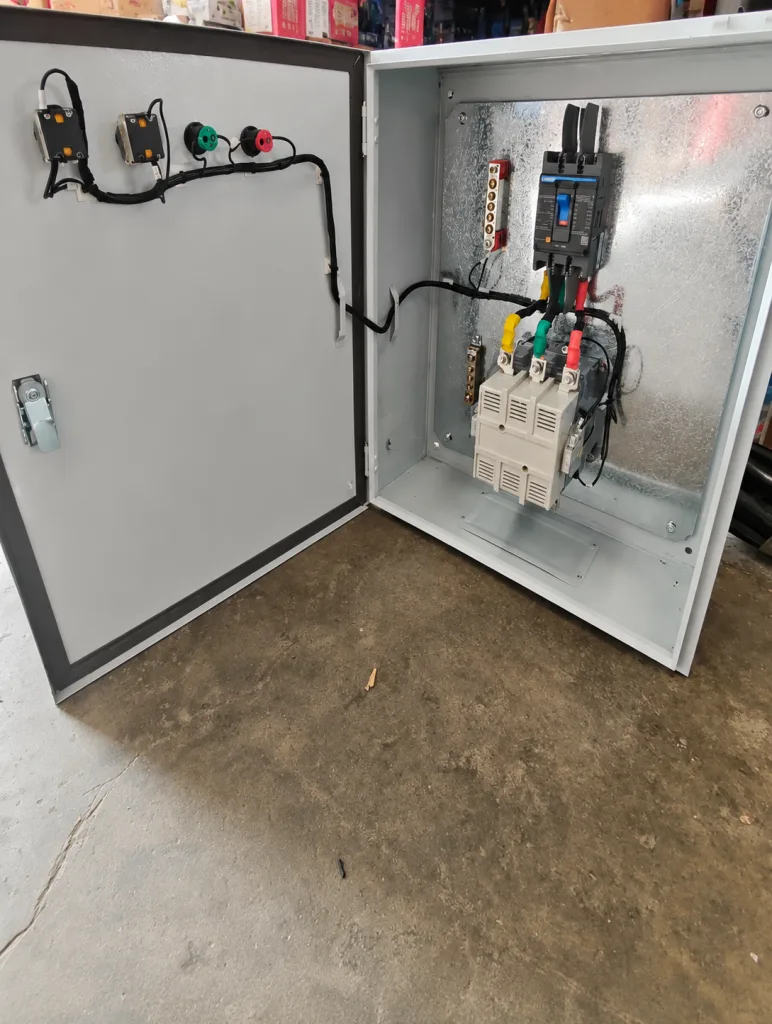
The mechanism releases. The cabinet still fails the user task. Consider a vertical control-cabinet door that operates correctly before the perimeter gasket and wiring harness are installed. After final assembly, pressing the door still produces the normal latch click, but the panel remains nearly flush with the frame. The added gasket reaction and cable drag consume the small outward movement that previously exposed the door edge. Increasing the user’s push does not solve the released-state resistance. The project must reduce the resisting load, change the opening assist, change the latch arrangement, or choose a different mechanism. This is an illustrative engineering scenario, not a customer project record or product test claim.
The audible click is therefore evidence of only one event: the internal latch changed state. It does not prove that the door reached the expected opening position.
| Observed Symptom | Likely Interface to Inspect | Next Check |
|---|---|---|
| Latch clicks, door remains flush | Released-state resistance or insufficient ejection travel | Separate latch release from door opening; inspect gasket, hinge drag, cables and opening assist. |
| Door cannot be pushed far enough to release | Closed stack-up, frame stop or excessive gasket compression | Compare available inward movement with the selected latch drawing. |
| Door releases only when pushed near the latch | Panel flex or poor load transfer from the normal push area | Inspect door stiffness and the distance between the push point and latch location. |
| Door rattles after re-latching | Keeper depth, engagement or excessive free gap | Inspect the retained position and keeper adjustment. |
| Intermittent release after assembly changes | Keeper alignment or tolerance stack-up | Check latch and keeper from a common cabinet datum in the final assembly. |
Orientation Changes Door Resistance
A push-to-open mechanism that works on a vertical side-hinged door should not be assumed to behave the same way on a horizontal cover.
On a vertical cabinet door, gravity mainly affects hinge loading, sag and rubbing relationships. The outward opening movement is often dominated by hinge friction, gasket reaction, magnetic retention, cables and whatever spring or plunger assists the door.
On a top-hinged horizontal cover, gravity may directly oppose the opening movement. A latch can release perfectly while the cover stays shut because there is no mechanism capable of lifting the mass through the required first part of travel. A downward-opening panel creates the opposite concern: gravity may help release movement but then allow the panel to drop farther than intended.
Orientation is therefore a model-and-assembly condition. Confirm the permitted installation direction from the selected latch information, then test the real door with its hinges, mounted equipment and any opening assist. “Works in either direction” should not be assumed from a product category name.
When Push-to-Open Is the Wrong Mechanism
Push-to-open is a useful access method, not a universal cabinet latch architecture. Stop trying to force it into the application when the cabinet requirement is dominated by a function the touch-release mechanism does not provide.
Accidental Pushes and Positive Retention
The same feature that makes a touch latch convenient can be a limitation in industrial service: pressing the door is the release command. Review what can contact the panel during normal operation, cleaning, transport and maintenance. An operator may lean against the cabinet, a service cart may strike the panel, packaging can apply pressure during shipment, and vibration can move a flexible door relative to the fixed latch interface.
If the application needs restricted access, a deliberate positive lock, high retention under shock, a safety interlock or a clear two-step release action, a basic push-to-open latch may be the wrong mechanism. A stronger spring does not change the release command.
Do not confuse convenience with positive locking. A touch-release panel is useful when intentional push access is acceptable. Where the door must remain secured against incidental contact, the retention strategy needs a separate review.
- Controlled gasket compression: the enclosure needs the latch to pull the panel into a defined sealing preload.
- Keyed or tool-controlled access: the door must not release from a simple panel push.
- Positive retention under severe shock or vibration: accidental release risk is more important than handle-free access.
- Very high door resistance: the available release/ejection action cannot create a usable opening after the complete door is assembled.
- No available inward overtravel: the frame, gasket or surrounding geometry prevents the door from reaching the release position.
- Heavy horizontal cover without opening assist: gravity opposes the first opening movement and the selected latch does not provide the required lifting action.
If the project instead needs a visible actuator and a defined pull/retract action on a metal door, keep that work on the dedicated paddle latch installation guide. The actuation method is different, so mixing those installation rules into this page would make the push-to-open geometry less clear.
What the Model Drawing Must Show
Once the cabinet is known to suit a touch-release mechanism, compare model drawings against the actual door stack-up. The useful dimensions are the ones that define the latch-to-keeper relationship and movement, not only the outer product size.
- Latch body mounting datum and orientation
- Keeper, strike or receptacle location
- Closed engagement position
- Required inward push/release travel
- Released or projected position of the plunger/pin where applicable
- Permitted alignment or adjustment features
- Required mounting clearance and fastener access
- Specified installation orientation, where model-dependent
- Model-specific retention, push or cycle data if the supplier publishes it
Do not replace missing model data with a generic push-latch dimension copied from another product. If release travel, retention or permitted misalignment is not available, mark it for supplier confirmation before the cabinet cutout or keeper position is frozen.
Validate the Complete Cabinet Door
A bench test of the latch body can confirm that the internal mechanism changes state. It cannot prove that the cabinet door provides the right travel, stiffness, keeper position or opening resistance.
The useful sample includes the real or representative door, frame, hinges, gasket, keeper, cable routing and any door-mounted equipment. Test the sequence as the user will experience it.
- Retained position: the door sits where the cabinet design expects, without rattle or incomplete engagement.
- Push travel: the normal push area transfers enough movement to reach the release point.
- Release consistency: repeated presses cause the mechanism to change state without side-loading or partial engagement.
- Usable opening: after release, the door moves far enough outward for the intended access method.
- Re-latching: the closing or second push action returns the selected mechanism and keeper to a repeatable retained position, as defined by the model.
- Cycle behavior: any project cycle requirement should track changes in push feel, release travel, keeper wear, mounting movement and failure-to-release events under defined test conditions.
- False release: check whether incidental panel contact, vibration or door flex can trigger the latch in the intended installation.
Supplier cycle-life or force data, when available, belongs to the exact model and its stated test method. Do not turn one supplier result into a universal push-to-open requirement for every cabinet. The production assembly still needs its own acceptance condition.
Push-to-Open Latch FAQ
How does a push-to-open latch work?
The user presses the door or panel inward. That movement trips the touch-release mechanism, which releases the keeper or retaining element and allows the door to move outward. The exact travel and opening action depend on the selected latch design.
How much travel does a push-to-open latch need?
There is no universal travel value. Use the selected latch drawing to define the closed position and required inward release movement, then confirm the finished cabinet door can physically reach that position.
Why does the latch click but the cabinet door not open?
The latch may have released while gasket reaction, hinge friction, cable drag, panel interference or insufficient ejection travel still holds the door near the frame. Check released-state resistance separately from the latch release event.
Can a push-to-open latch be used on a horizontal panel?
Only when the selected model and complete assembly can produce the required release and opening movement in that orientation. Gravity may oppose or assist the panel, so a horizontal cover should be tested with its actual mass and opening assist.
When should a push-to-open latch not be used?
Avoid using a basic touch-release latch when the door needs active gasket compression, keyed or tool-controlled access, deliberate positive retention against severe shock, or when the cabinet cannot provide the inward travel required to release the mechanism.
Send the Door and Latch Layout
Provide the door and frame section, proposed latch position, keeper location, available inward travel, required opening behavior and any gasket or cable resistance that affects the door. Those inputs can be compared with available latch forms without inventing a generic force or gap value.
Push-to-open latches for industrial cabinets work reliably only when the cabinet provides the travel, alignment and released-state movement the selected mechanism requires. Treat the latch body, keeper and door as one moving interface.