HTAN is one of the leading manufacturers of industrial hinges, handles and latches in China.


Two industrial hinge quotes can show the same quantity and nearly the same part description while pricing different products, evidence, and delivery obligations. One supplier may quote a controlled drawing revision, specified leaf and pin materials, a defined finish, production tooling, dimensional inspection, and export packaging. Another may price from a photograph and nominal dimensions, with several construction details left open. The lower unit price is not yet the lower-cost decision.
To compare industrial hinge quotes, first establish that every supplier priced the same purchase definition. Then separate technical acceptance from commercial ranking. Normalize one-time charges, samples, inspection, packaging, quantity breaks, payment terms, freight, and delivery scope against the same decision quantity. Any unresolved difference remains a deviation, not a price advantage.
Comparison rule: A quotation can enter the price ranking only after the quoted hinge, manufacturing scope, acceptance evidence, quantity basis, and delivery point are identified. Until then, mark it Clarification Required or Not Comparable.
Start With One Purchase Definition
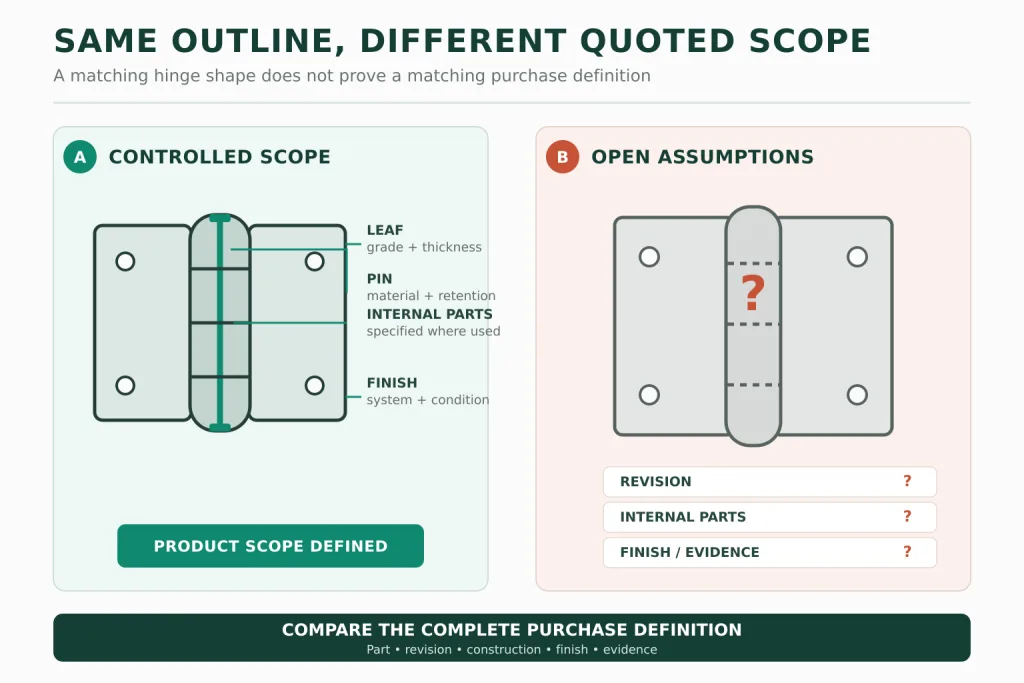
The comparison begins with the item being purchased, not with the spreadsheet total. A supplier quote should point to a part number, drawing number and revision, approved sample reference, or clearly defined catalog model. If Supplier A priced Drawing Rev B while Supplier B priced Rev C, the difference must be resolved before either price is evaluated.
A hinge is an assembly. The leaves may match while the pin, bushing, thrust washer, retainer, fasteners, lubricant, or finish differs. Those details affect manufacturing cost and installed behavior. A familiar outline and matching mounting holes do not establish equivalence.
Piece, Pair, and Door-Set Pricing
The quoted unit must be explicit. “One hinge” can mean one individual leaf-and-pin assembly, one left/right pair, or one complete door set containing two or more hinges. Lift-off designs may have handed upper and lower parts. A door set may also include mounting brackets, shims, backing plates, fasteners, or protective caps. If these items are separated on one quote and bundled on another, the unit prices cannot be placed in the same column without adjustment.
For paired or multi-hinge doors, record the quantity of each position and whether the supplier controls them as a matched set. Torque, spring, detent, cam-rise, and removable arrangements may also have directional variants. A quote for 2,000 pieces is not necessarily a quote for 2,000 doors.
Packaging units can create another mismatch. Ten individually wrapped hinges, five pairs, and five labeled door kits may contain the same number of hinges but require different sorting and line-side handling. Write the commercial unit, physical quantity, and door-set quantity separately. That small step prevents errors in evaluated cost, sample count, spare-part planning, and purchase-order release.
| Comparison field | Evidence to use | What remains uncertain if missing |
|---|---|---|
| Part identity | Part number, catalog model, drawing number, and revision | Whether the suppliers priced the same geometry |
| Complete construction | Leaf, knuckle, pin, bushing, washer, retainer, fastener, and lubricant definition | Whether hidden components have been substituted or omitted |
| Material and finish | Material grades, finish system, color or appearance requirement, and delivered condition | Whether corrosion, wear, appearance, and processing costs are comparable |
| Order basis | Quantity per release, annual demand, packaging quantity, and price-break assumptions | Whether the quoted unit prices apply to the same purchasing pattern |
| Application boundary | Door assembly, load, motion, mounting, environment, and required evidence | Whether the quoted hinge was reviewed for the same duty |
If the hinge family itself is still unsettled, finish that decision before comparing supplier prices. The industrial hinge selection guide owns the earlier task of matching motion, load path, mounting, access, and environment to a suitable hinge architecture. This article starts after a purchase definition exists.
Technical Acceptance Comes Before Price
Do not compensate for a technical gap by assigning it a small cost penalty. A quote either meets the mandatory requirement, contains an approved deviation, or needs clarification. This gate prevents an inexpensive but unsuitable offer from appearing competitive simply because its missing requirements have not yet been priced.
For an industrial hinge, the technical gate may include:
- the released geometry and mounting pattern;
- the complete material and finish system;
- pin retention, removable-door behavior, stop angle, detent, spring, or torque direction where applicable;
- the required opening range and clearance through the complete door swing;
- the relevant load, duty, environment, and mounting conditions;
- critical dimensions, inspection requirements, and required documentation.
A supplier may propose a legitimate alternative: a different pin material, a modified retainer, another forming process, or a finish judged equivalent for the stated environment. That offer should not be rejected automatically. It should be recorded as a deviation with its technical basis, affected dimensions, evidence, cost effect, and schedule effect. Silent substitutions are the real problem.
One Load Number Can Hide Different Hinges
Two quoted hinges may both be described as suitable for the same door weight and still rest on different evidence. One recommendation may assume a pair of hinges on a narrow, stiff test door. Another may account for the production door width, center-of-gravity offset, hinge spacing, mounting section, stop impact, and required service life. The printed load number alone does not reveal that difference.
Ask what the quoted rating represents: allowable working condition, proof load, static test result, or supplier application recommendation. Record the hinge quantity, load direction, lever arm, fixture, mounting method, cycle condition, and acceptance criterion behind it. If those conditions cannot be identified, the rating remains supporting information rather than proof of equivalence.
Detailed sizing and rating interpretation belong in the industrial hinge load capacity guide. In the quote comparison, the narrower question is whether each supplier accepted the same door duty and supported that acceptance with evidence that can be reviewed.
Hinge-specific conflict: A thicker leaf or larger pin can raise material and processing cost, yet it may not improve the installed door if the quoted mounting pattern places the fasteners in a flexible sheet-metal return. Compare the complete load path, not isolated dimensions.
Material Names Must Cover the Assembly
“Stainless steel hinge” is not a complete quotation basis. It may describe only the visible leaves. The pin, washer, bushing, retainer, spring, fasteners, or embedded friction parts may use different materials, and their suitability depends on wear, galling, corrosion, temperature, cleaning chemistry, and electrical requirements.
Read material line by line against the purchase definition. If a grade is required, the quote should state that grade or explicitly identify a proposed alternative. If the requirement is performance-based, the supplier should state the material system used to meet it. Do not treat “equivalent material” as closed until the equivalence basis and approval path are recorded.
The finish also needs a complete description. “Zinc plated,” “black,” and “passivated” can hide differences in base preparation, coating sequence, thickness requirement, post-treatment, appearance range, masked areas, thread condition, and corrosion evidence. The quote should separate included processing from optional upgrades and identify any feature that cannot receive the specified finish.
Material certificates, coating certificates, and test reports are not interchangeable. A material report can support alloy identity. It does not prove coating performance. A salt-spray report can document a particular test specimen and condition. It does not automatically prove that every production lot or every crevice in the installed hinge will behave identically.
Quoted Scope Changes the Unit Price
The unit price should be read as the price of a defined delivered scope. A low number may exclude operations that another supplier included. The difference is not limited to obvious features such as machining or coating. Deburring, pin assembly, lubrication, staking, thread locking, part marking, inspection, cleaning, and packaging can all change the usable delivered condition.
| Scope item | Question for each quote | Evidence to retain |
|---|---|---|
| Manufacturing operations | Are forming, machining, welding, deburring, heat treatment, and assembly included? | Process notes or explicit inclusions |
| Pin and retention | Is the pin installed, lubricated, staked, clipped, headed, or otherwise retained as specified? | Construction description and drawing reference |
| Surface condition | Are polishing, cleaning, passivation, plating, coating, masking, and touch-up included? | Finish callout and supplier deviation list |
| Fasteners and accessories | Are screws, nuts, washers, spacers, shims, backing plates, or brackets supplied? | Quoted bill of materials |
| Inspection | Is routine inspection included, and which additional reports carry a charge? | Inspection scope and report format |
| Identification | Are part marking, lot marking, labels, barcodes, and certificate references included? | Marking and traceability statement |
| Packaging | Is the hinge bulk packed, separated, protected from abrasion, or packed as an assembly kit? | Packaging specification and pack quantity |
| Shipping scope | Where does the supplier’s responsibility and quoted cost end? | Named place, trade term, and freight line |
Mark every excluded operation that the buyer or another vendor must complete. Then add its known cost and schedule effect to the comparison. If the cost cannot yet be established, leave it visible as an open item. Zero is not a valid estimate for missing work.
Buyer-Side Assembly Work
A hinge can arrive within its individual drawing limits and still require extra work at the door line. One supplier may control the hinge as a finished assembly. Another may leave pin insertion, lubrication, fastener installation, shim selection, or final adjustment to the buyer. The unit price difference should be compared with the actual work content transferred downstream.
Look for operations that affect the installed hinge axis or closure:
- sorting left-hand and right-hand hinges or upper and lower members;
- installing loose pins, clips, washers, bushings, or springs;
- cleaning oil, abrasive residue, or coating buildup from mounting and bearing surfaces;
- reaming, slotting, shimming, or forcing a hinge into a misaligned hole pattern;
- adding threadlocker, torque marking, lubrication, or corrosion protection;
- repacking parts into production kits or replacing transit-damaged cosmetic surfaces.
Only add a buyer-side cost when the operation, labor content, and occurrence are supported by the project. If the assembly impact is unknown, flag a trial build or sample observation instead of assigning an invented burden. The purpose is not to make the preferred supplier look cheaper. It is to keep transferred work from disappearing between quotation and production.
Tooling Is More Than a One-Time Charge
Custom hinge quotes may include stamping dies, forming tools, casting dies, machining fixtures, welding fixtures, assembly tools, checking fixtures, gauges, or programming and engineering charges. Suppliers do not always use the word “tooling” for the same assets. A single total therefore needs to be unpacked before comparison.
For each one-time charge, identify:
- which physical tool, gauge, fixture, or engineering activity the charge covers;
- whether the asset is dedicated to the buyer’s part or shared with other products;
- who owns it after payment and whether ownership permits physical transfer;
- where it will be stored and who pays for maintenance, repair, or replacement;
- which drawing revision it supports and what changes would require rework or new tooling;
- whether any portion is amortized into the unit price and at what quantity basis.
A supplier can reasonably charge more for a controlled checking fixture or more durable production tool than for a temporary prototype aid. The comparison should preserve that distinction. Dividing every one-time charge by the first purchase quantity may also mislead when the tool supports a multi-year program. Evaluate both the initial cash requirement and the intended program horizon, without inventing a tool life that the supplier did not state.
A Sample Price Needs a Sample Definition
One quote may include off-tool samples made from production-intent material and finish. Another may offer hand-built pieces intended only to check envelope and hole location. Both can be useful. They do not provide the same evidence, and their prices should not be compared as if they do.
Record the sample quantity, manufacturing route, material, finish, hinge construction, dimensional report, functional checks, expected delivery date, and known differences from production. If a temporary process changes the knuckle, pin fit, bushing, spring, torque element, or surface condition, state what the sample can and cannot validate.
The quote should also show what happens after sample review. Are reasonable corrections included? Does a drawing revision trigger a new sample charge? Is freight included? Will the supplier retain master samples or inspection records? These questions are especially important when the hinge is custom-developed rather than purchased from a stable catalog configuration. The custom hinge manufacturing overview covers supplier development capability; the present comparison only normalizes the quoted deliverables.
Quality Evidence Must Match the Quoted Part
A certificate logo is not a substitute for part-specific evidence. ISO 9001 addresses an organization’s quality management system. It does not, by itself, prove that a quoted hinge meets a particular load, dimension, material grade, finish, cycle requirement, or drawing revision.
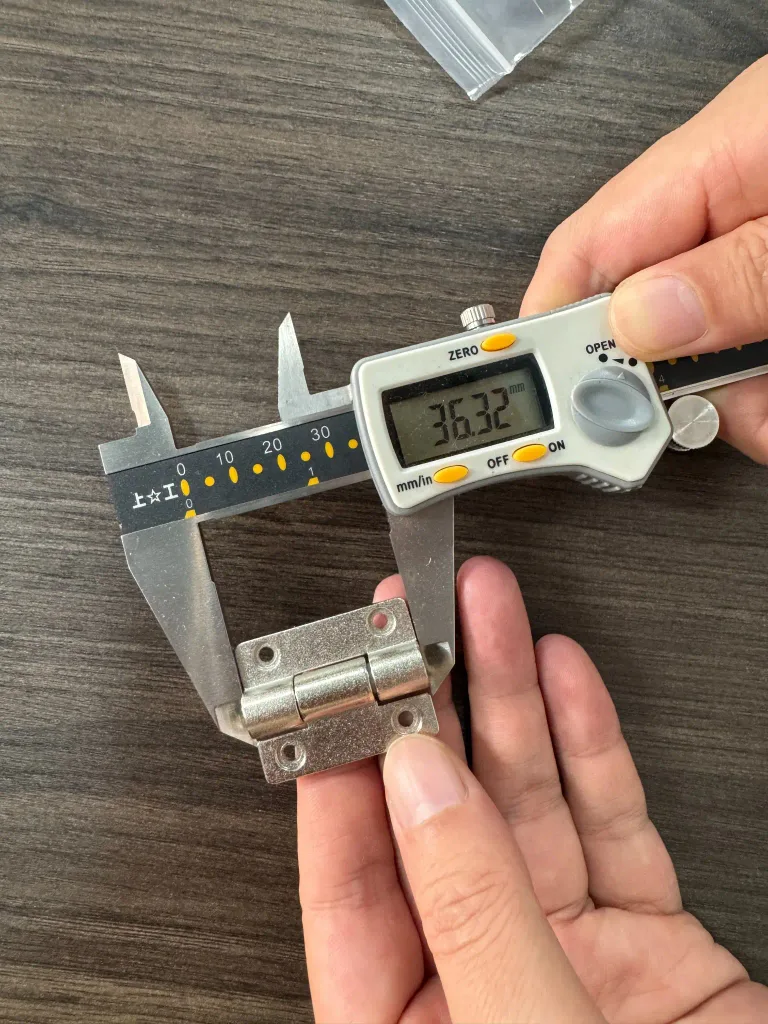
Review the evidence actually included in each quotation. Depending on the project, that may include a certificate of conformance, material report, coating certificate, dimensional inspection report, first-article report, capability data for selected characteristics, load or cycle report, finish test report, lot traceability, or retained sample. Ask which documents are standard, which are optional, and which require a separate test lot or outside laboratory.
The report must be connected to the quoted configuration. Check the part number, revision, material, finish, manufacturing location, test specimen, method, date, and acceptance criteria. A report for a visually similar hinge may be useful background, but it should not silently become evidence for a changed leaf thickness, pin construction, hole pattern, material, or manufacturing process.
Do not add every available certificate to every order. Documentation has cost. Select evidence because it controls a real project risk or contractual requirement, then give all suppliers the same requirement. Otherwise, one quote may appear expensive because it includes evidence that the others were never asked to provide.
MOQ and Price Breaks Need One Demand Model
Annual demand, order quantity, shipment quantity, packaging quantity, and minimum production run are different values. A supplier may price 20,000 pieces per year in four releases. Another may require all 20,000 pieces in one production and shipment. Their unit prices do not create the same inventory, cash-flow, storage, and obsolescence exposure.
Normalize every quote against the same demand model:
- decision quantity used for the commercial comparison;
- forecast annual demand and program duration, if known;
- purchase-order quantity and permitted release schedule;
- minimum manufacturing batch and minimum shipment quantity;
- standard pack quantity and any full-carton rule;
- price validity, material surcharge mechanism, and currency.
Use the same quantity point when comparing unit prices. If one supplier cannot quote that point, retain its actual break and show the resulting excess inventory or unmet demand. Do not interpolate a price between quantity breaks unless the supplier confirms it.
Currency, Payment, and Price Validity
Currency and payment timing affect cash exposure even when they do not change the supplier’s nominal unit price. Record the quotation currency, exchange-rate date used for internal evaluation, payment milestones, deposit requirement, balance trigger, bank charges, and any credit terms. Use one documented exchange-rate basis for all quotes rather than converting each offer on a different day.
Price validity also matters when sample and tooling work will delay the production order. A quote may expire before approval is complete, or it may allow changes for metal, coating, energy, or freight. Ask how an adjustment will be calculated and which reference or supplier evidence supports it. “Price subject to material change” is too open to normalize unless the trigger and affected portion are identified.
Do not rank payment terms by headline percentage alone. A deposit tied to released tooling, a balance due before shipment, and payment after receipt place cash and performance risk at different points. The correct commercial choice depends on the buyer’s policy and the supplier relationship. The comparison sheet should make the timing visible without pretending there is one universally best term.
Lead Time Has Several Clocks
“Four weeks” is incomplete unless the start event and finish event are named. The clock might begin after purchase order, deposit, drawing approval, sample approval, material receipt, or resolution of technical questions. It may end at sample dispatch, production completion, shipment, port arrival, or delivery to the buyer.
Separate the schedule into the portions that matter for the project:
- engineering review and quotation validity;
- tool design and manufacture;
- prototype or sample manufacture;
- correction and resubmission allowance;
- production after release;
- inspection, packaging, dispatch, and transit.
A shorter production time may not create an earlier usable delivery if tooling, sample correction, inspection, or transit is excluded. Conversely, a longer stated lead time may be more credible when the supplier has included steps that another quote left unstated. Record supplier dependencies as well: final CAD, signed drawing, color sample, nominated fastener, test requirement, or buyer-supplied mating parts.
Freight Terms Change Cost and Risk
Freight becomes comparable only after every quote uses a named place and a defined trade term. “FOB,” “DAP,” or “delivered” without the exact location and applicable rule can leave transport, terminal, insurance, import, and handling costs unclear. Currency, payment timing, bank charges, taxes, and duties may also sit outside the unit price.
The ICC Incoterms rules clarify tasks, costs, and risks between seller and buyer for delivery. They do not define product quality, payment method, transfer of title, warranty, or every contractual obligation. Record the selected rule, named place, version, freight inclusion, insurance responsibility where applicable, and who handles export and import formalities.
Packaging belongs in the same review. An industrial hinge with exposed polished leaves may require separation to prevent rubbing. A pre-lubricated hinge may need contamination control. A loose removable pin or accessory kit needs retention and count control. If repacking is required before the parts can enter the buyer’s production line, include that known work in the evaluated cost.
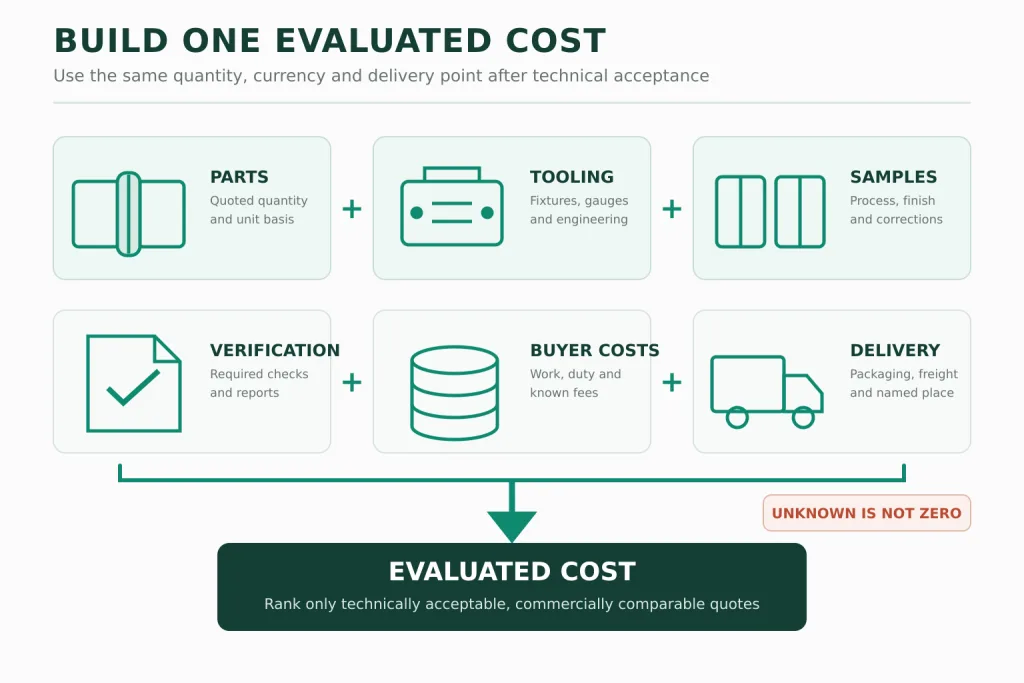
Known evaluated cost = part cost + one-time charges + samples + required evidence + special packaging + freight and other known buyer-paid costs for the same quantity and delivery point.
Keep unpriced risks visible beside this total. Do not convert an uncertain failure, delay, or quality concern into a convenient dollar value without evidence.
When the Lower Unit Price Loses
Consider an illustrative first order of 10,000 custom hinges. Supplier A quotes $1.80 per hinge, $4,000 tooling, $300 samples, and $900 freight. Supplier B quotes $2.05 per hinge, $1,500 tooling, includes the required samples, and quotes $650 freight. Supplier A’s unit price is lower, but its known first-order evaluated cost is $23,200. Supplier B’s is $22,650. The difference is $550 before any technical deviation, duty, tax, inventory, or risk is considered. These figures demonstrate the comparison method; they are not HTAN prices, customer data, or industry benchmarks.
The reverse result is also possible over later releases because one-time tooling no longer enters every order. That is why the comparison should show at least the initial cash requirement and the cost over the buyer’s defined decision horizon. It should not force every program into a single lifetime-cost claim.
Price also loses meaning when the technical basis differs. A quote that omits the specified bushing, changes the pin retention, leaves the finish undefined, or assumes a different drawing revision is not a bargain. It is a different offer.
Compare Industrial Hinge Quotes on One Sheet
Use one row per decision area and one column per supplier. Preserve the supplier’s original wording in a note or attachment, then enter the normalized result. This prevents a buyer’s shorthand from erasing a qualification or exclusion that matters later.
| Decision area | What to enter for each supplier | Disposition if incomplete |
|---|---|---|
| Quoted item | Part or drawing, revision, construction, material, finish, and approved deviations | Not Comparable if product identity is unresolved |
| Technical gate | Compliant, approved deviation, or unsupported against each mandatory requirement | Technical Review Required |
| Unit-price basis | Currency, quantity break, order quantity, shipment quantity, validity, and surcharge terms | Clarification Required |
| One-time charges | Tooling, fixtures, gauges, programming, engineering, ownership, maintenance, and amortization | Clarification Required |
| Samples | Quantity, process, material, finish, reports, freight, corrections, and production differences | Sample Scope Open |
| Quality evidence | Included reports, charged options, lot link, test basis, and document timing | Evidence Gap |
| Schedule | Start event, completion event, tooling, sample, production, inspection, and transit periods | Schedule Basis Open |
| Delivery scope | Packaging, named place, trade term, freight, insurance, customs responsibility, and exclusions | Commercial Clarification Required |
| Known evaluated cost | Total for the same decision quantity and delivery point, with each added cost visible | Do not rank until comparable |
| Final status | Technically Acceptable, Clarification Required, or Not Comparable | Only acceptable quotes enter award ranking |
Keep technical acceptance and known evaluated cost in separate cells. This allows the team to see a commercially attractive offer without accidentally treating it as technically approved. It also shows where a supplier’s price changed because the scope changed rather than because the same hinge became more or less expensive.
Close Assumptions Before Award
Every clarification that changes the price, part, evidence, or schedule should return in a revised quotation or controlled deviation list. Email discussion can explain the change, but the final commercial record should identify what was accepted. Otherwise, the purchase order may reference a drawing while the supplier’s price still rests on an earlier assumption.
Review these closing points before award:
- the quotation and purchase order reference the same drawing and revision;
- all approved deviations are listed and incorporated where required;
- the price break matches the release and shipment plan;
- tooling, ownership, sample scope, reports, packaging, freight, and delivery point are explicit;
- lead-time start and finish events are named;
- the payment and currency basis remains valid at award;
- no mandatory requirement is being carried as an unpriced assumption.
A purchase order should not repair an unclear quotation by implication. If the supplier cannot identify what was priced, the buyer cannot reliably compare it, approve it, or control later changes.
If an HTAN offer will be added to the comparison, use the same controlled part definition, application boundary, quantity model, evidence requirements, packaging, and delivery point already applied to the other suppliers. The available industrial hinge range can establish a standard or customizable product direction, but a product image alone cannot establish a comparable quotation.
Request a Comparable Hinge Quote
Share the hinge drawing or model, door application, quantity basis, material and finish, required evidence, packaging, and delivery point. HTAN can state the scope of its offer, listed deviations, open engineering items, and sample conditions so the quotation can enter the same comparison.
Industrial Hinge Quote Comparison FAQ
Should I choose the industrial hinge quote with the lowest unit price?
Not until the offers are technically acceptable and commercially comparable. Normalize the part revision, complete construction, material, finish, quantity basis, tooling, samples, inspection, packaging, freight, and delivery scope. A lower unit price may exclude work or evidence included elsewhere.
How do I know whether two industrial hinge quotes are comparable?
Confirm that both quotes reference the same part or drawing revision, complete hinge construction, materials, finish, quantity and delivery basis, technical requirements, and acceptance evidence. Unresolved differences should be marked Clarification Required or Not Comparable rather than treated as price differences.
What should I compare in industrial hinge tooling charges?
Identify the tool, fixture, gauge, programming, or engineering activity covered; ownership; storage; maintenance; expected use; transfer rights; revision basis; replacement responsibility; and whether any amount is amortized into unit price. Do not compare one tooling total without knowing what assets it covers.
Is hinge MOQ the same as annual order volume?
No. MOQ may refer to the minimum production run, purchase-order quantity, shipment quantity, or packaging quantity. Annual demand is a forecast across a longer period. Compare suppliers using the same release and shipment model, not only the same annual total.
Why can industrial hinge sample prices differ so much?
The samples may use different manufacturing routes, tooling, materials, finishes, quantities, inspection, or shipping scope. A hand-built fit sample and an off-tool production-intent sample do not provide the same evidence. Compare what each sample is designed to validate and which production differences remain.
Does ISO 9001 certification prove that the quoted hinge meets my specification?
No. ISO 9001 addresses the supplier’s quality management system. Part conformity still needs evidence tied to the quoted hinge, such as the controlled drawing, material and finish records, dimensional inspection, functional checks, and any project-required test report.
How should I compare hinge lead times?
Define the start and finish event for every quoted period. Separate engineering review, tooling, samples, corrections, production, inspection, dispatch, and transit. A short production lead time is not the same as an early delivered date when other stages are excluded.
What belongs in the evaluated cost of an industrial hinge quote?
For the same quantity and delivery point, include part cost, one-time charges, samples, required inspection or reports, special packaging, freight, and other known buyer-paid costs. Keep uncertain risks visible as open items instead of converting them into unsupported dollar values.