HTAN is one of the leading manufacturers of industrial hinges, handles and latches in China.


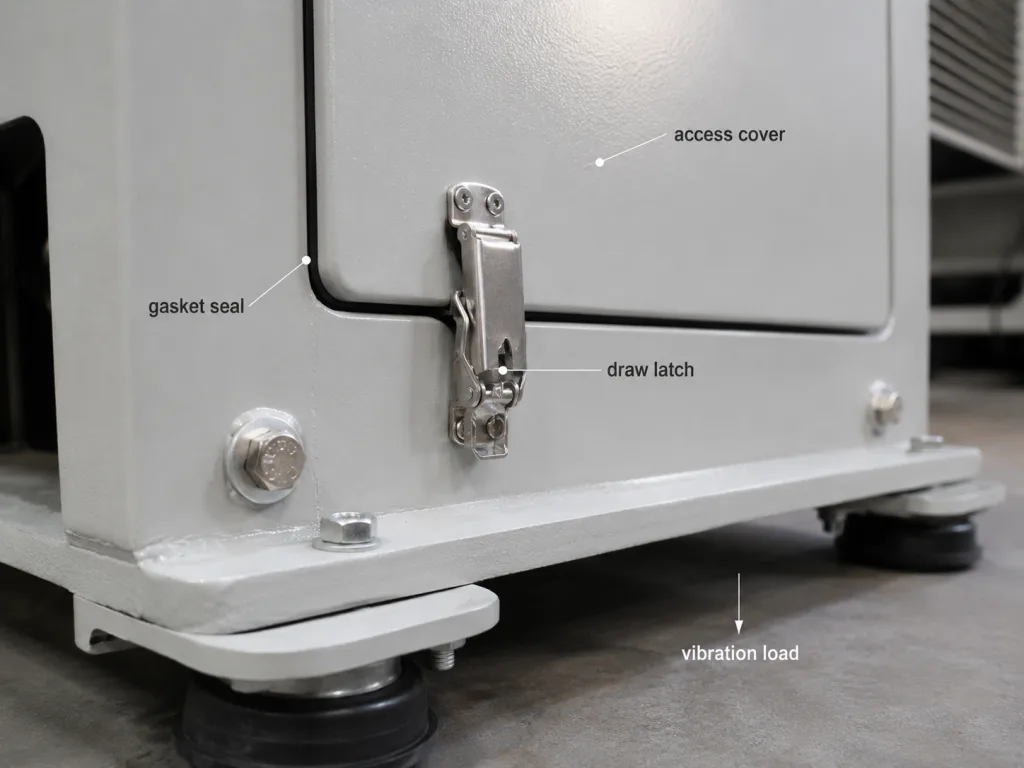
Draw latches for vibration equipment must do more than hold a cover closed. On vibrating screens, conveyors, generator boxes, mobile equipment, compressor panels, machine guards, and gasketed access doors, the latch must maintain pull-down force, resist loosening, and keep the seal compressed under repeated dynamic loads.
If the latch is too light, poorly mounted, or not designed for vibration, the result can be loose covers, rattling panels, gasket leakage, dust ingress, water ingress, fastener wear, and unplanned downtime. This guide explains how engineers and buyers should evaluate draw latches for vibration equipment, including latch type, anti-loosening features, gasket compression, material selection, mounting stability, and inspection requirements.
Why Vibration Equipment Needs the Right Draw Latch
Vibration changes how a latch behaves in service. A latch that performs well on a static cabinet may loosen when it is installed on a vibrating machine. Repeated movement can reduce clamp force, back out fasteners, wear the catch, damage the gasket, or allow the lever to move out of its locked position. Standardized vibration test methods such as IEC 60068-2-6 are used across industries to evaluate how mechanical components respond to sinusoidal vibration over defined frequency ranges, and the same principles apply when selecting draw latches for vibrating equipment.
For vibration equipment, the latch must maintain a stable closing force while absorbing movement from the panel, frame, gasket, and mounting screws. The best choice depends on vibration severity, access frequency, gasket type, environmental exposure, and the force needed to keep the cover sealed.
Key Selection Factors for Vibration-Resistant Draw Latches
| Selection Factor | What Engineers Should Check | Why It Matters |
|---|---|---|
| Pull-Down Force | Force required to close the panel and compress the gasket | Maintains seal pressure and reduces rattling |
| Anti-Loosening Design | Positive lock, threaded adjustment, spring preload, locking pin, or secondary retention | Prevents latch release under vibration |
| Gasket Compression | Compression range recommended by gasket supplier | Prevents leakage without over-compressing the seal |
| Mounting Strength | Panel thickness, screw size, base width, reinforcement, and fastener locking | Prevents loose mounting and sheet metal deformation |
| Access Frequency | How often operators open the door, cover, or inspection panel | Determines whether quick-release or screwdown operation is practical |
| Material and Finish | Stainless steel, plated steel, zinc alloy, or coated components | Controls corrosion resistance and service life |
| Environment | Dust, water, washdown, salt spray, temperature, oil, or chemicals | Affects latch material, seal type, and maintenance interval |
Draw Latch Types for Vibration Equipment
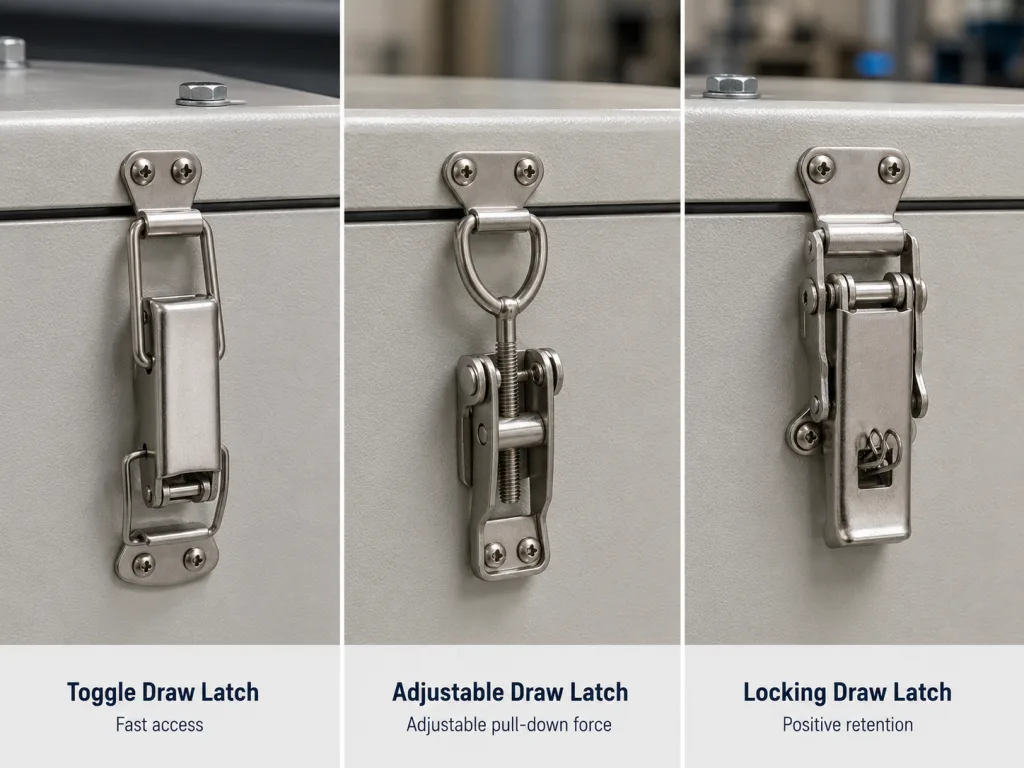
Different draw latch types apply and maintain closing force in different ways. For vibration equipment, the best latch is not always the strongest one; it is the one that maintains enough force without loosening, damaging the gasket, or making maintenance access too slow.
Toggle Draw Latches
Toggle draw latches are fast to open and close. They use an over-center lever action to pull two surfaces together. They are useful on inspection covers, light access doors, and panels that need frequent opening.
For vibration equipment, a basic toggle latch should not be used unless it includes a locking feature, safety catch, locking pin, or secondary retention. Without a positive lock, vibration may gradually reduce tension or allow the latch handle to move.
Screwdown Draw Latches
Screwdown draw latches use a threaded mechanism to apply and adjust closing force. They are slower to operate than toggle latches, but they are often more suitable when the application requires stronger pull-down force, controlled gasket compression, or better resistance to loosening.
They are commonly used on vibrating equipment covers, generator boxes, heavy access panels, and gasketed machine doors where maintaining seal pressure is more important than very fast access.
Cam-Action Draw Latches
Cam-action latches use a rotating cam to pull the panel into position. They can offer faster operation than screwdown designs while still providing more controlled closing force than a basic toggle latch.
Cam-action designs can work well on moderate-vibration panels, filter housings, equipment covers, and access doors that require repeated service. However, they require good alignment between the latch and catch. If the frame is warped or the gasket thickness varies, compression may become uneven.
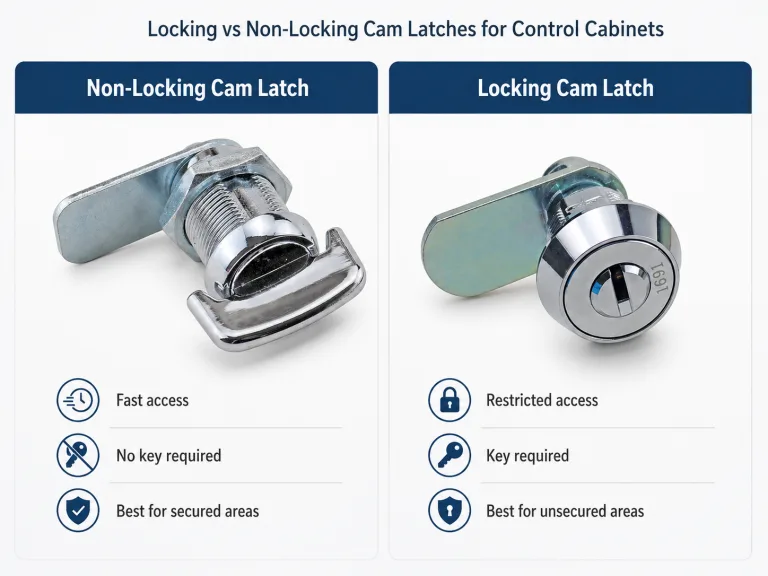
For applications where the choice is between cam-style and compression-style latching, the guide on cam latch vs compression latch can help compare locking motion, sealing force, and access speed.
If you have not yet decided between a draw latch and a cam latch for a vibrating cover — before narrowing down to a specific draw latch type — see the full comparison of draw latch vs cam latch for vibration equipment covers.
Comparison of Draw Latch Types
| Latch Type | Strength | Limitation | Best Fit |
|---|---|---|---|
| Toggle Draw Latch | Fast operation and simple structure | Needs locking feature for vibration | Light to moderate vibration, frequent access panels |
| Screwdown Draw Latch | Adjustable clamping force and strong seal control | Slower to open and close | High vibration, gasketed covers, heavy equipment panels |
| Cam-Action Draw Latch | Good balance of access speed and compression | Sensitive to alignment and gasket variation | Moderate vibration, filter panels, service covers |
| Spring-Loaded Draw Latch | Helps maintain tension as gasket or panel moves | Spring rating must match the application | Panels with gasket compression variation or thermal movement |
| Locking Draw Latch | Reduces accidental release | More components and higher cost | Mobile equipment, safety panels, transport enclosures |
Pull-Down Force and Gasket Compression
Pull-down force is the force the latch applies to bring the panel, cover, or door against the frame. In vibration equipment, this force must be enough to prevent rattling and maintain gasket contact, but not so high that it crushes the gasket or deforms the panel.
Gasket compression should be based on the gasket supplier’s recommended compression range. Different gasket materials — such as EPDM, silicone, neoprene, foam, or sponge rubber — require different compression levels. A latch that works well with one gasket may over-compress or under-compress another.
For sealed electrical enclosures or gasketed panels, draw latch selection should be reviewed together with sealing requirements. The guide on compression latches for enclosure sealing explains how latch force, gasket compression, and enclosure sealing performance are connected.
Basic Gasket Force Check
A simple way to estimate required latch force is to review the gasket compression stress and the gasket contact area. However, the final latch force should not be selected by formula alone. Engineers should validate the assembly with the actual gasket, panel stiffness, latch spacing, and vibration condition.
If one latch cannot provide even compression across the seal, multiple latches may be required. Latch spacing should be chosen to prevent gaps, panel bowing, and uneven gasket compression around corners or long access covers.
Anti-Loosening Design Features
Anti-loosening performance is one of the most important requirements for draw latches used on vibrating equipment. Vibration can reduce preload, loosen mounting screws, move the handle, wear the catch, or allow the panel to shift against the gasket. The mechanism is well documented in industrial fastener engineering — under transverse vibration, threaded connections can gradually self-loosen even when tightened correctly, which is why mounting screw selection and locking method matter as much as the latch body itself.
Useful anti-loosening features include locking pins, secondary safety catches, threaded adjustment with locking nuts, spring preload, captive fasteners, wide mounting bases, serrated washers, thread-locking methods, and latch designs that resist back-driving under dynamic load.
When adjustable force or spring preload is part of the design, the related guide on adjustable or spring latches can help compare when adjustment, spring compensation, or a fixed latch structure makes more sense.
Application Scenarios for Vibration Equipment
Vibrating Screens and Conveyor Access Panels
Vibrating screens, conveyor covers, and feeder access panels often require latches that hold the cover firmly while allowing maintenance access. Dust sealing, panel movement, gasket compression, and fast access all need to be balanced.
For light covers, a locking toggle latch may be sufficient. For heavier covers, stronger vibration, or gasketed panels, screwdown or spring-loaded draw latches are usually safer because they provide more controlled pull-down force.
Generator Boxes and Mobile Equipment
Generator boxes, off-road equipment, service vehicles, and mobile machinery experience both engine vibration and road shock. The latch must resist loosening while also preventing rattling and noise from the cover.
In these applications, a positive locking feature is important. Cushioning at the striker, a spring-loaded latch body, or a secondary retention feature can help reduce vibration transfer and accidental release.
Compressor, Filter, and Pump Housings
Compressor covers, filter housings, and pump access panels often need quick maintenance access while keeping seals compressed. Cam-action or spring-loaded draw latches can work well when vibration is moderate and panel alignment is stable.
If the housing uses a gasket, the latch must be checked with the actual gasket material. Uneven compression can cause dust leakage, air leakage, or premature gasket wear.
Marine and Outdoor Vibration Equipment
Marine and outdoor equipment adds corrosion exposure to vibration. Salt air, rain, humidity, and cleaning chemicals can accelerate latch wear if the material or finish is not suitable.
For these environments, stainless steel or properly coated latch materials should be considered. The latch, catch, fasteners, springs, and mounting hardware should all be compatible with the operating environment, not just the visible handle or lever. For deeper material-level guidance on corrosion resistance and finish options, see the reference on industrial stainless steel draw latches.
Common Selection Mistakes
Mistake 1: Using a Standard Toggle Latch Without a Lock
A basic toggle latch may work on a static panel, but vibration can gradually reduce tension or move the handle. For vibrating equipment, a toggle latch should include a locking pin, safety catch, or other positive retention feature.
Mistake 2: Ignoring Gasket Compression
If the latch does not compress the gasket enough, the panel may leak. If it compresses the gasket too much, the gasket may deform, lose recovery, or squeeze out of position. Latch force should be matched to the gasket material and the enclosure design.
Mistake 3: Underestimating Mounting Strength
Latch failure often starts at the mounting screws or thin sheet metal around the base. A wide latch base, reinforced mounting area, suitable fasteners, and thread-locking method can be just as important as the latch body itself.
Mistake 4: Choosing the Latch Only by Pull Force
High pull-down force is not always better. The latch also needs suitable access speed, alignment tolerance, material, anti-loosening design, and compatibility with the gasket. A stronger latch can still perform poorly if it damages the panel or over-compresses the seal.
Mistake 5: Not Testing the Real Assembly
Vibration performance depends on the full system: latch, catch, screws, gasket, cover stiffness, hinge position, frame rigidity, and operating frequency. Always test the latch on the actual panel or prototype before mass production.
Draw Latch Selection Checklist for Vibration Equipment
| Specification Item | Engineer Should Confirm |
|---|---|
| Equipment Type | Vibrating screen, conveyor, generator box, compressor, mobile equipment, or access panel |
| Vibration Severity | Low, moderate, or high vibration; continuous or intermittent operation |
| Access Frequency | Daily service, weekly inspection, rare maintenance, or emergency access |
| Latch Type | Toggle, screwdown, cam-action, spring-loaded, or locking draw latch |
| Pull-Down Force | Enough to hold the panel and compress the gasket without damaging the seal |
| Gasket Type | EPDM, silicone, neoprene, foam, sponge rubber, or custom seal |
| Anti-Loosening Feature | Locking pin, safety catch, spring preload, thread locking, captive fastener, or secondary lock |
| Mounting Design | Panel thickness, screw size, base width, reinforcement, and alignment with catch |
| Environment | Indoor, outdoor, dust, water, oil, chemicals, washdown, salt air, or high temperature |
| Material | Stainless steel, plated steel, coated steel, aluminum, or polymer depending on environment |
| Testing | Prototype vibration test, gasket compression check, fastener inspection, and service access review |
FAQ
Can a standard draw latch be used on vibrating equipment?
A standard draw latch may work on light or occasional vibration, but it is not ideal for continuous vibration unless it has a locking feature, suitable mounting, and enough pull-down force. For high-vibration equipment, use a latch designed with positive retention, adjustable compression, or anti-loosening features.
Which draw latch type is best for vibration resistance?
Screwdown draw latches are often preferred for high vibration because they provide adjustable clamping force and better resistance to loosening. Locking toggle latches can work for lighter vibration, while cam-action latches can be suitable for moderate vibration and frequent access.
How do I choose pull-down force for a gasketed cover?
Start with the gasket supplier’s recommended compression range, then check the panel stiffness, latch spacing, and required sealing performance. The final pull-down force should be validated on the real assembly because gasket material, cover size, and mounting rigidity all affect compression.
What causes draw latches to loosen under vibration?
Common causes include lack of positive locking, loose mounting screws, insufficient thread engagement, panel flex, poor catch alignment, gasket compression loss, and latch wear. Anti-loosening features and reinforced mounting help reduce the risk.
Should stainless steel draw latches be used outdoors or near salt spray?
Stainless steel draw latches are usually preferred for outdoor, washdown, marine, or corrosive environments. 316 stainless steel is generally better for salt air or chloride exposure, but the latch, catch, fasteners, springs, and mounting hardware should all be compatible with the environment.
Final Selection Advice
Choose draw latches for vibration equipment by looking at the full system, not only the latch body. The latch type, pull-down force, gasket compression, anti-loosening design, mounting strength, material, catch alignment, and access frequency should all be reviewed together.
For light vibration and frequent access, a locking toggle draw latch may be enough. For higher vibration, stronger sealing needs, or heavier covers, screwdown, cam-action, spring-loaded, or positive-locking draw latches are usually safer. If your project involves vibrating screens, conveyors, generator boxes, compressor housings, mobile equipment, or gasketed access panels, HTAN can help review latch type, material, mounting method, and seal compression requirements before sample production.

-768x768-1.png)