HTAN is one of the leading manufacturers of industrial hinges, handles and latches in China.


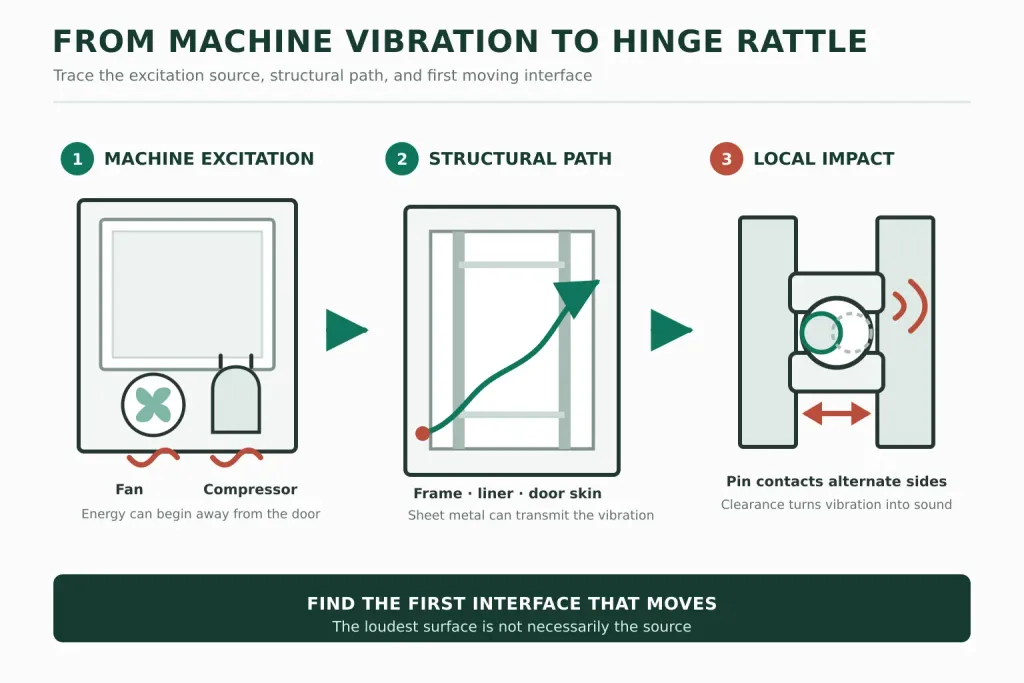
An environmental chamber hinge rattle does not prove that the hinge is worn. A circulation fan, compressor, pipe support, external shaker, loose panel, latch, or poorly restrained door can excite the enclosure. The hinge may be only the place where clearance turns that vibration into an audible impact.
Sound also travels through sheet metal. The loudest point is not always the first moving interface. Replacing a hinge because a technician can hear noise beside it may leave the actual fault untouched—and can erase the witness marks that would have shown where the movement began.
Diagnostic rule: reproduce the rattle under a defined operating state, then find the first interface showing relative movement. Separate the chamber’s excitation source from the door hardware that responds to it.
Do not loosen hinge fasteners, remove a pin, bypass an interlock, or work around energized, hot, cold, pressurized, or moving equipment without the chamber manufacturer’s service procedure. Support a heavy insulated door independently before disturbing any load-carrying joint.
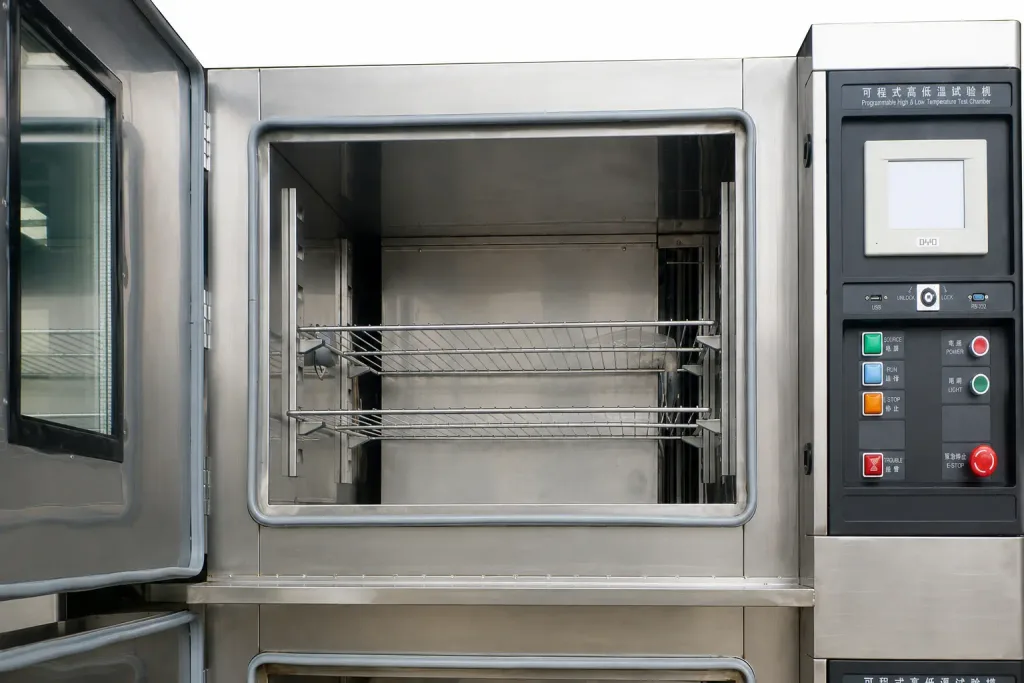
What Rattle Actually Means
A rattle is repeated contact after a clearance opens and closes. That clearance may be inside the hinge, between a hinge leaf and its mounting panel, between a bracket and reinforcement, or between the closed door and its restraint system. The energy may come from the chamber itself rather than from door operation.
The useful question is therefore not, “Which hinge should replace this one?” It is, “What moves first when the sound begins?” The answer determines whether the next action belongs to the chamber service team, the door and latch assembly, the hinge joint, or the mounting structure.
This page addresses an installed chamber that has developed noise or movement. General corrosion, fracture, and door-sag branches remain in the industrial hinge failure guide. Hinge selection for a new chamber is a different task.
Start With the Operating State
Do not begin by turning fasteners. Preserve the as-found condition and record exactly when the noise occurs. A chamber that rattles only during circulation-fan operation presents a different branch from a door that clicks when its direction is reversed by hand.
Chamber manufacturers recognize that fan blades, motor shafts, rubbing components, and loose motor brackets can produce vibration or noise. The AES chamber-noise troubleshooting guidance, for example, starts with those machine-side sources. That is a useful boundary: the presence of noise near the door does not place the root cause in the hinge.
| Observed state | What it separates | Evidence to record | Do not conclude yet |
|---|---|---|---|
| Chamber safely isolated at ambient condition | Manual door and hardware behavior without machine excitation | Play at the door edge, click on force reversal, pin motion, bracket movement, latch engagement | A quiet static check does not clear a joint that rattles only under vibration |
| Circulation fan operating | Air-handler excitation from door-generated noise | Fan state, sound onset, frequency character, location, change under light door preload | The hinge is not proven faulty because it is the loudest point |
| Compressor start or steady operation | Transient pipe or frame excitation from continuous door-hardware clearance | Whether the sound occurs at startup, shutdown, or throughout the run | Do not adjust the door to compensate for a refrigeration-system fault |
| Door fully latched versus resting against the frame | Closed-door restraint from free movement in the hinge system | Latch travel, gasket contact pattern, corner movement, change in sound after correct latch engagement | Higher latch force does not automatically mean better restraint or sealing |
| Hot, cold, or humidity dwell | Condition-dependent clearance, gasket stiffness, lubricant behavior, frost, or condensate | Setpoint state, actual door-area condition, dwell time, moisture or ice, repeatability after return to ambient | An ambient inspection cannot explain a fault that appears only at condition |
| Combined vibration or external shaker input | Externally imposed excitation from normal chamber machinery | Input state, mounting configuration, direction, sound threshold, affected hinge position | Do not convert the shaker setting directly into an allowable hinge rating |
Use the exact state that reproduces the complaint, but stay inside the equipment maker’s operating and service limits. Running with the door open, defeated interlocks, removed guards, or unsecured hardware may be unsafe and may change the vibration path enough to invalidate the observation.
Prove the Sound Reaches the Hinge
A thin door skin can transmit sound from a latch or internal bracket to the hinge line. A rigid hinge leaf can transmit vibration in the opposite direction. Listening alone cannot distinguish them.
- Mark the operating state. Note the chamber function, door position, latch condition, temperature state, and the moment the noise starts or stops.
- Apply only a light diagnostic preload. Where the manufacturer permits, press the closed door at one corner or near the handle without changing latch adjustment. A sound that stops when free motion is removed points toward a restraint or clearance path.
- Watch two datums at once. Compare the hinge leaf with the mounting panel, the pin with the knuckle or bushing, and the bracket with a stiff frame datum. The first visible separation matters more than the loudest surface.
- Use witness marks before disassembly. A fine line across a leaf and panel, fastener head and bracket, or bracket and frame can show slip that is difficult to see during operation.
- Repeat without changing the condition. If the result cannot be repeated, record it as intermittent rather than forcing a diagnosis.
A contact microphone or mechanic’s stethoscope can help compare accessible locations, but only when the chamber maker permits safe use. It localizes transmitted vibration; it does not by itself prove which interface has clearance.
Rattle, Click, Buzz, or Scrape
Maintenance reports often use “rattle” for every unwanted door sound. The timing and character of the sound narrow the mechanical branch.
- Repeated metallic chatter: two surfaces are separating and recontacting under ongoing excitation. Look for radial pin clearance, an unsecured leaf, a moving bracket, or a door that is not fully restrained.
- One click when force reverses: clearance is changing from one side to the other. The source may be pin-to-bushing play, axial end play, a slotted mounting joint, or latch free travel.
- Low-frequency buzz: a panel, reinforcement plate, guard, or bracket may be resonating. The hinge can transmit the sound without containing the loose interface.
- Squeak through the swing: sliding friction, contamination, gasket drag, or poor alignment is more likely than impact clearance.
- Scrape or grind at one angle: check axis alignment, edge contact, frost, or damaged bearing surfaces before treating the symptom as vibration looseness.
The distinctions are diagnostic, not acceptance limits. A quiet hinge can still be misaligned, and a short click may be permitted in one mechanism but unacceptable in another. The released drawing, service documentation, and complete-door requirements control.
Closed-Door Restraint Before Pin Wear
When a chamber door is closed, the latch, catch, gasket, stops, and frame geometry determine how firmly it is restrained. The hinge locates and carries the door, but it should not be expected to pull every part of the perimeter against the seal by itself.
A compressed gasket can provide damping. A set, damaged, poorly contacted, or conditionally stiff gasket may leave the door free to oscillate between the latch and hinge line. A latch with excess free travel can create the same symptom. Increasing latch pull without mapping the contact can crush one region while leaving another loose.
Environmental chamber maintenance guidance normally treats door operation and sealing as a system that includes the latch, catch, hinges, and gasket—not as independent parts. The AES service checklist reflects that combined inspection.
The Hinge Was Loud, but the Door Was Moving
Consider a chamber that is quiet while idle but chatters near the upper hinge when the circulation fan runs. The sound falls sharply when light hand pressure is applied near the latch. A mark across the upper hinge leaf and mounting panel remains aligned, and no pin-to-knuckle motion is visible. A perimeter contact check instead shows free movement at one latch-side corner. In that condition, replacing the upper hinge would address the loudest location, not the first moving interface. The next investigation belongs to latch travel, door position, gasket contact, and frame restraint.
This is an illustrative engineering scenario, not a customer project record or product test claim.
Find the First Moving Interface
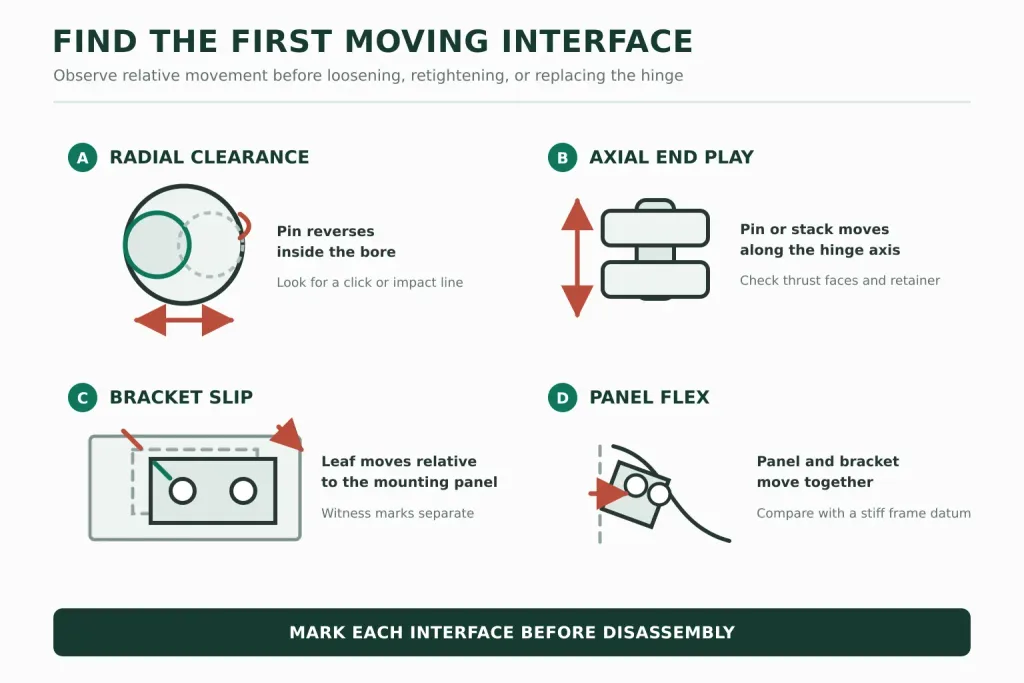
Once non-door excitation and closed-door restraint have been separated, inspect the hinge system from the smallest contact outward. Do not treat all motion measured at the door edge as pin clearance. The door is a lever, so small joint motion can become a much larger displacement at the handle side. Panel flex and bracket rotation add to that reading.
| Interface | Relative movement to observe | Useful evidence | What it suggests |
|---|---|---|---|
| Pin to knuckle or bushing | Radial reversal between the pin center and bearing surface | Localized click, visible center shift, polished impact line, uneven bore wear, debris | Running clearance, wear, missing or damaged bushing, or edge loading |
| Thrust face, washer, and retainer | Movement along the pin axis | Pin or strap lifting and dropping, end-face impact marks, displaced washer, retainer movement | Axial end play or a retention/thrust-stack problem |
| Hinge leaf or bracket to mounting panel | Slip or rocking across the clamped joint | Broken witness line, fretting dust, coating damage, slot movement, fastener-head motion | Lost joint preload, damaged threads, surface settlement, or inadequate support |
| Mounting panel to reinforcement | Panel and bracket moving together relative to the frame | Oil-canning, changing gap to a stiff datum, cracked coating or weld evidence | Local panel flexibility or a disconnected load path rather than an internal hinge fault |
| Upper hinge relative to lower hinge | One joint reverses, rises, or rocks before the other | Different engagement timing, one-sided wear, door twist, force change through the swing | Axis error, poor load sharing, bracket movement, or mismatched hinge condition |
| Door relative to latch, gasket, or frame stop | Closed door moving while hinge interfaces remain stable | Sound changes under light preload, uneven witness pattern, latch free travel, corner movement | Insufficient restraint or changed seal geometry |
| Machine frame or air handler | Whole door assembly responding without one local interface leading | Noise follows fan, motor, compressor, piping, or shaker state; source remains away from hinge | Machine-side excitation requiring chamber service diagnosis |
Pin and Bearing Clearance
Radial play lets the load transfer from one side of the pin to the other. Under steady door weight, the joint may remain seated and quiet. Add transverse vibration or reverse the hand force, and the unloaded side can close with a click or chatter.
Observe close to the bearing interface. If measurement is required, use a fixture or indicator arrangement that separates pin-to-bore displacement from leaf bending and panel movement. Compare upper and lower hinges under the same supported-door condition. No universal field clearance can be assigned without the hinge construction, bore size, bushing material, load, temperature, and supplier limit.
Dark or reddish debris can indicate micro-movement at a loaded interface, but color alone is not a diagnosis. Contamination, coating wear, lubricant, and corrosion can look similar. SKF’s explanation of fretting at interfaces under micromovement is useful background; the actual hinge still requires component-level inspection.
Axial End Play and Retention
A pin can be secure against complete removal and still have enough axial travel to strike a washer, cap, knuckle end, or retainer. Vertical orientation may keep it seated during a static check, while vibration or door motion lifts it intermittently. A horizontal or inclined axis changes how gravity acts on the same stack.
Record the installed pin direction, visible end play, thrust components, and retainer condition. Restore the specified stack rather than improvising a clip, peening the pin, or reversing its orientation. If axial movement is confirmed, any change to staking, circlips, headed pins, press fits, cross-pins, or pin direction requires a separate retention review against the released assembly.
Leaf, Bracket, and Panel Movement
A fastener can feel tight while the joint beneath it has lost effective clamp. Paint or powder coat may settle. A slotted adjustment can move. Threads can be damaged. A thin skin can flex with the bracket, making the hinge appear loose even though the leaf has not slipped on the panel.
Use separate witness lines across the fastener head and leaf, the leaf and panel, and the panel and a stiff frame datum. That three-level comparison answers three different questions. Retightening everything before making those observations destroys the evidence and may pull a distorted door into a new, unrecorded position.
The Hinge Pair Can Hide the Fault
Two or more hinges form one constrained axis. A loose sample on a bench cannot reproduce the installed door moment, hinge spacing, frame stiffness, and coaxiality. One hinge may carry most of the load while another alternately contacts both sides of its clearance.
Watch the upper and lower interfaces during the same force reversal. If the upper pin shifts first while the lower mounting panel flexes, replacing both hinges as a matched set may still leave the structural cause in place. If one bracket has moved, forcing the second hinge into alignment can create binding instead of eliminating noise.
- Compare engagement timing at each hinge, not only total door-edge play.
- Record the hinge-axis relationship before loosening adjustable brackets.
- Check whether one leaf, reinforcement, weld, or fastener group moves ahead of the others.
- Support the door before removing a pin or unloading one hinge; do not use the remaining hinge as a temporary service support.
Door mass, center of gravity, hinge spacing, and structural reactions require a separate load calculation. Sound alone cannot establish hinge capacity or load sharing.
Thermal Cycling Moves the Clearance Stack
A chamber can be quiet at room temperature and rattle after a hot, cold, or humidity dwell. The pin, bushing, hinge body, bracket, inner liner, outer skin, reinforcement, latch, and gasket do not necessarily reach the same temperature or move by the same amount.
- Differential movement can change pin clearance, bracket angle, and coaxiality between hinges.
- Gasket stiffness and compression can alter how firmly the closed door is restrained.
- Lubricant viscosity or migration can change damping and breakaway behavior.
- Condensate, frost, and ice can add intermittent contact or hold a joint away from its ambient position.
- Repeated expansion and contraction can work a marginal mounting joint after the initial installation appeared stable.
Record the condition at which the rattle starts, the condition at which it stops, and whether it returns after recovery to ambient. Do not infer component temperature from the chamber setpoint alone. The hinge-side outer bracket may be near room temperature while the inner skin, gasket, or local condensate follows a different path.
Use the industrial hinge temperature guide when the next decision concerns material expansion, lubricant limits, or component suitability across a defined thermal range. This rattle check uses temperature only to reproduce the fault and compare interface movement.
Lubrication Can Mask the Evidence
Lubricant may reduce a squeak, damp a small impact, or temporarily fill a clearance. That change is useful evidence, but it does not prove that lack of lubricant was the root cause. A worn bushing, misaligned axis, moving leaf, or overloaded edge contact can become quieter without becoming correct.
Use only a lubricant approved for the hinge materials, chamber condition, cleanliness requirements, and service procedure. Mixing products can change viscosity, attract contamination, attack polymer bushings or gaskets, or migrate toward the chamber workspace. More grease is not a dimensional repair.
If lubrication is part of the released maintenance plan, record the product, location, amount, as-found condition, and behavior before and after application. A rattle that returns quickly under the same excitation still requires an interface measurement.
Correct the Proven Interface
The repair should match the first moving interface. Avoid replacing or tightening several parts at once; that can stop the sound temporarily while leaving the original cause unknown.
| Proven source | Corrective direction | Avoid | Repair evidence |
|---|---|---|---|
| Fan, motor, compressor, piping, guard, or machine frame | Route the fault through the chamber manufacturer’s service procedure | Changing hinge geometry to absorb machine vibration | Machine-side source corrected and door hardware remains stable |
| Latch, catch, gasket, or door stop restraint | Restore the specified closed datum, latch travel, and perimeter contact | Overcompressing one gasket region or using the latch to pull a sagged door sideways | Door is restrained without excessive operating force or changed seal pattern |
| Pin-to-bushing or pin-to-knuckle wear | Replace the specified wear component or hinge when the service limit requires it; investigate edge loading | Peening the pin, using grease as a gap filler, or installing an unknown oversize pin | Controlled clearance, free swing, no localized impact under the original excitation |
| Axial end play or damaged retention stack | Restore the specified thrust washer, shoulder, retainer, and pin orientation | Improvised clips, reversed pins, or permanent staking without drawing approval | End play is within the released limit and the retainer remains seated through operation |
| Leaf or bracket mounting slip | Repair threads and seating surfaces; restore the approved fastener, preload method, and locking feature | Blind retorque over damaged threads, soft coating, an unsupported skin, or an already shifted slot | Witness marks remain aligned and joint preload is retained |
| Panel or reinforcement flex | Restore the load path into adequate structure and review local stiffness | Installing a stronger hinge on the same moving skin | Bracket position remains stable relative to a stiff frame datum |
| Hinge-pair axis error | Return the mounting points to the controlled axis and adjustment condition | Forcing one hinge to follow another or using the latch to overcome binding | Both hinges reverse and travel together without new drag or door twist |
| Condition-dependent frost, condensate, or lubricant behavior | Follow the chamber procedure for drainage, safe recovery, approved lubrication, and condition-specific clearance | Forcing a frozen door or assigning the chamber setpoint as the hinge temperature | Repeatable operation at the defined condition and after ambient recovery |
Replacement parts must match the released assembly—not just the visible dimensions. Pin diameter, bearing length, material pairing, thrust support, retainer, leaf offset, mounting-hole fit, and hinge-set arrangement can all change the result.
Prove the Repair Under the Same Excitation
A quiet manual swing at ambient temperature is not enough when the original complaint occurred during fan operation or after a cold dwell. Recreate the defined as-found state without exceeding the chamber manufacturer’s service limits.
- Restore the baseline configuration. Use the same door hardware, latch state, shelves or door-mounted accessories, chamber placement, and approved operating mode represented by the complaint.
- Check manual travel first. Confirm that the repair did not introduce binding, scraping, excessive opening force, pin migration, or changed latch engagement.
- Apply the original excitation. Compare fan, compressor, thermal, humidity, or external vibration states as applicable.
- Watch every interface that was marked. The sound may stop while a bracket still moves. Both the acoustic symptom and the mechanical evidence must improve.
- Inspect the closed-door function. Recheck latch travel, perimeter contact, gasket condition, door gap, and return to the controlled datum.
- Repeat after the defined exposure. Record whether the repair remains stable at condition and after recovery to ambient.
There is no universal decibel limit, allowable hinge play, or cycle count for every environmental chamber door. Define acceptance from the chamber design, hinge documentation, safety function, seal requirement, and production-intent assembly. Broader baseline control and before-and-after inspection belong in the machine-door hinge assembly validation process.
Share the As-Found Hinge Evidence
For a hinge-focused review, provide a short video of the reproduced sound, photos of the upper and lower hinge interfaces, the installed hinge part number, pin orientation, door size and mass, hinge spacing, mounting section, latch and gasket arrangement, operating state, temperature condition, and any witness-mark movement.
HTAN can compare the observed hinge and mounting interfaces with available hinge configurations and quotation inputs. Refrigeration, fan, electrical, controller, interlock, or chamber-safety faults should remain with the chamber manufacturer or qualified service team.
Environmental Chamber Hinge Rattle FAQ
Why does an environmental chamber hinge rattle only when the fan runs?
The fan may provide the vibration while clearance elsewhere turns it into sound. Check fan and motor sources first, then observe whether the closed door, hinge pin, mounting leaf, bracket, or panel moves when the rattle begins.
How can I separate hinge pin clearance from a loose mounting joint?
Place witness marks across the leaf and panel, then observe the pin relative to the knuckle or bushing during light force reversal. Pin-to-bearing motion with a stable leaf points toward internal clearance. Leaf movement relative to the panel points toward the mounting joint. Panel and leaf moving together indicates structural flex.
Will adding lubricant stop environmental chamber hinge rattle?
It may reduce noise temporarily, but it does not correct worn clearance, mounting slip, panel flex, misalignment, or poor door restraint. Use only the approved lubricant and treat any sound change as diagnostic evidence rather than proof of repair.
Can a worn gasket make the hinge area sound loose?
Yes. If the gasket and latch no longer restrain the closed door consistently, machine vibration can move the door through available clearance. Sheet metal may transmit the impact sound to the hinge area even when the pin and mounting leaf remain stable.
Why does a test chamber door rattle only at low or high temperature?
Temperature can change component dimensions, gasket stiffness, lubricant behavior, bracket alignment, and hinge-pair coaxiality. Condensate or frost can add another contact. Record the exact operating state and repeat the inspection after ambient recovery.
Does a rattling environmental chamber hinge mean the door is unsafe?
Noise alone cannot establish safety. Stop and follow the chamber service procedure if there is pin migration, retainer damage, cracked metal, fastener movement, door sag, binding, seal loss, or any change affecting containment or interlocks. A qualified review must determine continued use.
Should I replace the hinge pin or the complete hinge?
That depends on which parts form the approved wear pair and whether the bore, bushing, knuckle, thrust surfaces, retainer, leaves, and mounting structure remain within their service limits. Installing a new pin in a worn or distorted bore may not remove the clearance.
How should an environmental chamber hinge rattle repair be verified?
Repeat the original fan, compressor, thermal, humidity, or external vibration state as applicable. Confirm the sound is gone, the marked interfaces remain stable, the door travels freely, the latch and gasket function correctly, and the result remains after the defined exposure and ambient recovery.