HTAN is one of the leading manufacturers of industrial hinges, handles and latches in China.


Industrial hinges may appear to be simple hardware components. However, in applications such as cabinet doors, equipment hatches, automated production line safety gates, and outdoor enclosures, they often determine whether a door operates smoothly over the long term, whether equipment remains stable, and whether after-sales costs remain controllable.
Many procurement headaches—such as rework, customer complaints, passive delivery delays, and equipment downtime—can ultimately be traced back to a single point: incorrect or absent surface treatment.
This article provides an in-depth analysis of why surface treatment is an indispensable aspect of industrial hinges. We will cover physical protection, mechanical performance, and aesthetics, while offering professional selection advice.
Superior Corrosion Resistance
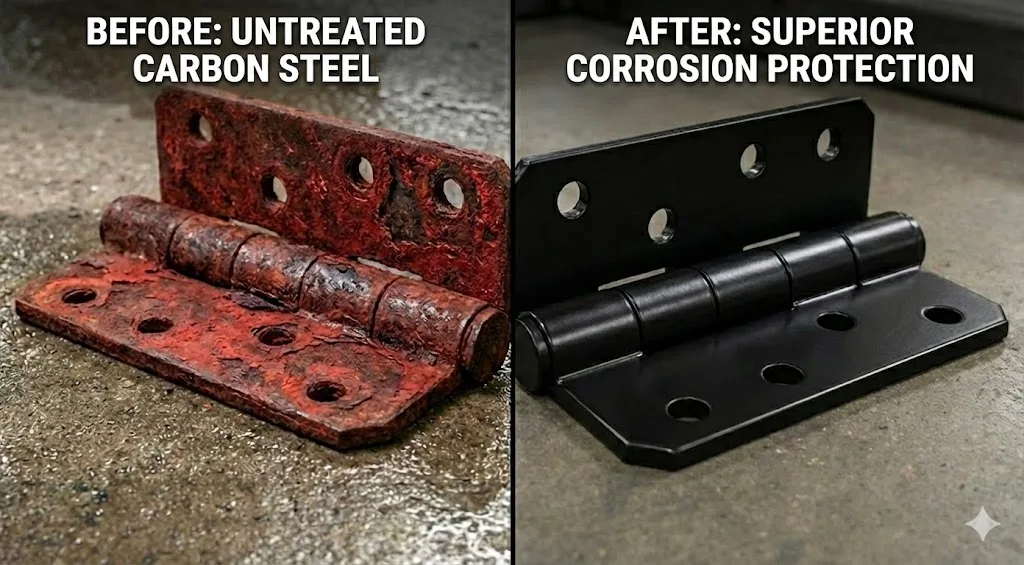
Industrial environments are unforgiving to metal. For carbon steel, and even certain grades of stainless steel, a lack of protection guarantees oxidation.
Environmental Isolation
Metal corrosion (rusting) is an electrochemical reaction. When exposed metal comes into contact with oxygen, moisture, or specific chemicals in the air, an oxidation layer forms.
- Oxidation Risk: In high-humidity environments or coastal areas containing Salt Spray, untreated steel hinges can rust completely within days.
- Chemical Attack: In chemical plants or cleaning equipment, acidic or alkaline environments can rapidly corrode the metal substrate, leading to structural failure.
Surface treatment—whether zinc plating or E-coating—essentially establishes a physical barrier between the metal substrate and the external environment, blocking the path for corrosion to occur.
Extending Product Lifecycle
For B2B buyers, procurement costs should not be evaluated solely on unit price, but on Total Cost of Ownership (TCO).
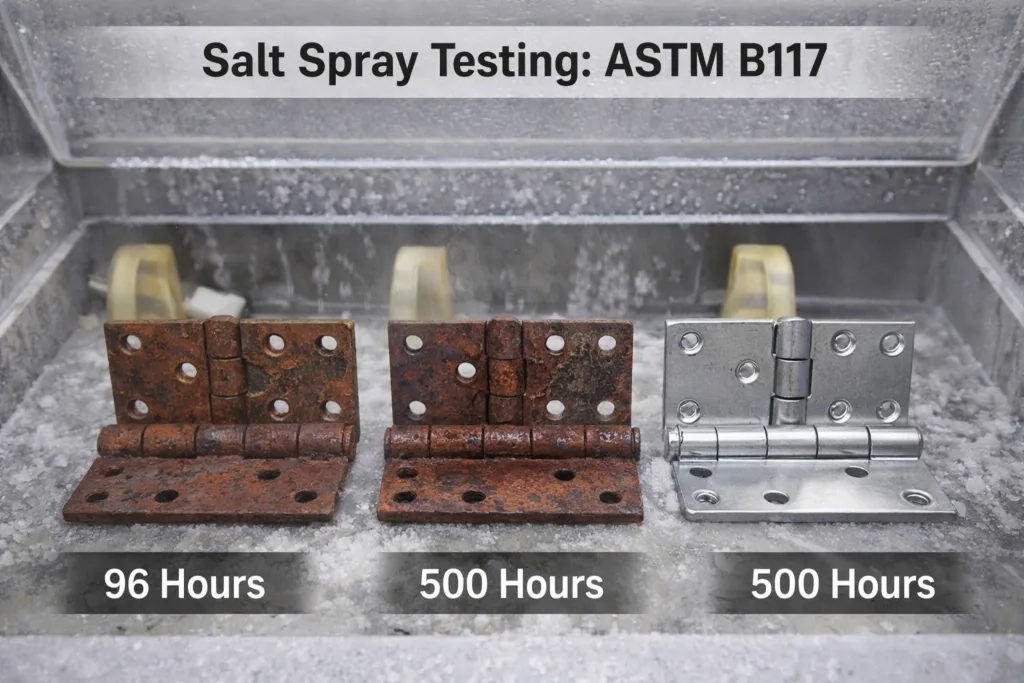
Comparative data from ASTM B117 salt spray testing indicates that while bare metal can begin to corrode within just a few hours, hinges with appropriate surface treatments (such as E-coating or high-grade plating) can withstand hundreds of hours of exposure. This superior protection effectively extends the service life by more than 10 times compared to untreated hardware, directly translating to less frequent replacement and lower downtime maintenance costs.
Pro Tip: About Salt Spray Testing (ASTM B117)
When evaluating suppliers, don’t just look for the words “rust-proof.” Ask for the ASTM B117 Salt Spray Test Report. This is the industry gold standard for measuring corrosion resistance.
- Standard Zinc Plating: Typically withstands 24-96 hours of salt spray testing.
- High-End E-coating or Powder Coating: Can withstand 500-1000+ hours.
Your application environment dictates how many “hours” of protection you need.
Enhanced Mechanical Performance & Wear Resistance
The role of surface treatment goes far beyond rust prevention; it significantly improves the movement performance of the hinge, which is critical in frequently operated industrial cabinets.
Reducing Friction
Direct friction between metals leads to wear and noise. Certain surface treatment processes possess natural Lubricity.
- For example, specific Teflon coatings or platings containing lubricating additives can reduce friction between the hinge pin and the knuckle.
- This not only makes operation smoother but also prevents Galling—a phenomenon where metal surfaces adhere to each other under high pressure, causing the hinge to seize.
Increasing Surface Hardness
In heavy-duty machinery, hinges are prone to physical impact or scratching. Hardening treatments (such as Anodizing or Hard Chrome Plating) can significantly improve the surface’s scratch resistance, protecting the substrate from physical damage.
Special Functional Requirements: Insulation & Conductivity
- Insulation: In electrical cabinets, Powder Coating may be required to ensure the hinge is electrically insulated, preventing short-circuit risks.
- Conductivity: Conversely, in telecommunications equipment requiring Electromagnetic Interference (EMI) shielding, a conductive chromate treatment may be needed to ensure grounding continuity.
Aesthetics & Brand Consistency
In modern industrial design, functionality and aesthetics are not mutually exclusive. The texture and finish of hardware directly influence the user’s perception of the equipment’s “class” and quality.
Visual Appeal
Imagine a high-end medical device worth tens of thousands of dollars equipped with a hinge that looks dull and bears machining scratches. What impression does that leave on the client?
- Matte Black: This finish is currently very popular in server cabinets and audiovisual equipment, conveying a low-key, professional technical aesthetic.
- Polished Chrome: Often used in laboratory or kitchen equipment, providing visual cues of cleanliness and hygiene.
Eliminating Defects
Manufacturing processes (such as stamping and welding) inevitably leave marks on the metal surface. Thick coating processes like powder coating can effectively mask these minor surface defects, providing high Uniformity and ensuring the final product looks flawless.
Analysis of Common Industrial Hinge Surface Treatment Processes
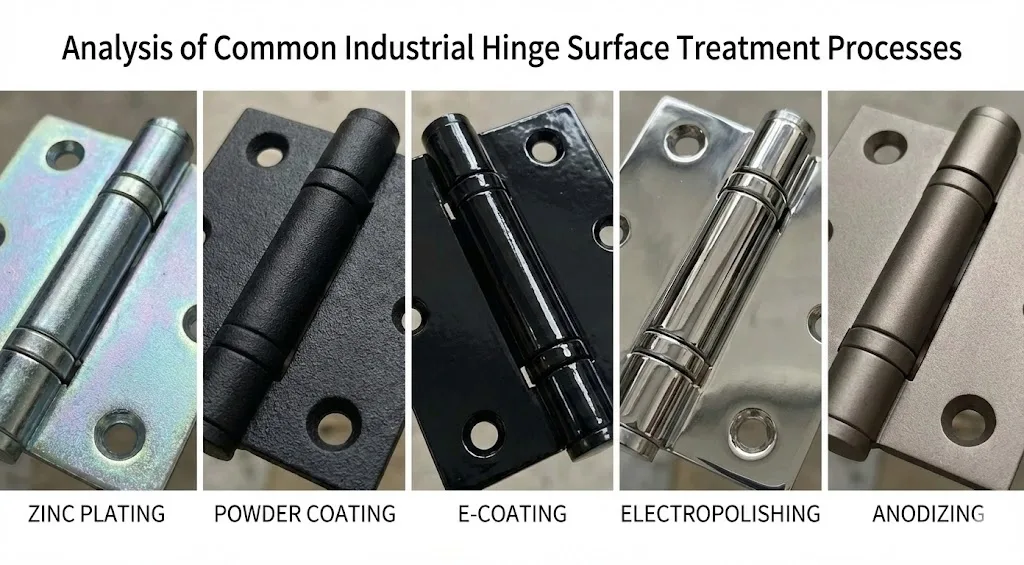
As a procurement professional, understanding the characteristics of different processes helps you make the right trade-offs. Here are five of the most mainstream processes:
| Process Name | Key Features | Typical Applications | Cost Level |
| Zinc Plating | High cost-effectiveness, provides basic rust protection. Appearance is usually blue-white or colored (yellow). | Indoor cabinets, general machinery. | Low |
| Powder Coating | Thick coating, wear-resistant, extensive color options (e.g., RAL colors). Good weather resistance. | Outdoor distribution boxes, generator set enclosures. | Medium |
| E-coating (Electrophoresis) | Extremely thin and uniform coating, strong coverage (including blind spots), excellent corrosion resistance. | Automotive parts, complex hardware structures. | Medium/High |
| Electropolishing | Stainless Steel only. Removes microscopic burrs, making the surface mirror-like. Greatly enhances corrosion resistance and cleanability. | Food processing machinery, medical equipment, marine gear. | High |
| Anodizing | Aluminum Alloy only. Increases surface hardness, provides insulation, does not peel. | Aerospace, precision electronic instruments. | Medium/High |
How to Choose the Right Surface Treatment for Your Project?
There is no “best” surface treatment, only the “most suitable” one. When communicating with suppliers, consider the following three factors:
Environmental Assessment
- If it is Indoors and dry, standard Zinc Plating may be sufficient.
- If it is Outdoors and faces UV rays and rain, Powder Coating is a better choice.
- If it is a Marine or Chemical environment, you may need 316 Stainless Steel combined with Electropolishing, or high-grade E-coating.
Balancing Cost vs. Performance
This is often a trade-off game.
- Scenario A: Use expensive raw materials (like 316 Stainless Steel) with simple treatment.
- Scenario B: Use cheaper raw materials (like Carbon Steel) combined with expensive, high-end coatings.In certain high-strength applications, Scenario B may offer better mechanical strength at a lower cost. Consult your engineering team.
Compliance Requirements
If your product is being exported to the EU or North America, you must ensure the surface treatment complies with RoHS (Restriction of Hazardous Substances) and REACH regulations. Traditional Hexavalent Chromium zinc plating has been phased out; environmentally friendly Trivalent Chromium processes must now be used.
Conclusion
Surface treatment for industrial hinges is the critical bridge between raw material and final application. It provides the hinge with a suit of “protective armor,” not only resisting corrosion and wear but also elevating the overall aesthetic value of the equipment.
Ignoring surface treatment details can cause a seemingly minor hinge to become the failure point for an entire system, potentially damaging your brand reputation.
Next Steps:
Unsure whether your new project requires “Black E-coat” or “Matte Powder Coating”?
Our application engineering team has extensive experience in surface treatment selection. Please [Contact Us] for a free consultation, or [Download Our Product Catalog] to view performance parameter comparisons for different surface treatments.
FAQ
Q: Do stainless steel hinges still need surface treatment?
A: Yes, usually. While stainless steel itself is corrosion-resistant, treatments such as Electropolishing or Passivation can further remove surface iron ion contamination, significantly boosting rust resistance in extreme environments (like salt spray).
Q: Which surface treatment is the most corrosion-resistant?
A: This depends on the substrate. For carbon steel, E-coating combined with Powder Coating (dual-layer protection) usually offers the strongest corrosion resistance. For high-end applications, PVD (Physical Vapor Deposition) can also provide superior protection, though at a higher cost.
Q: Does surface treatment affect hinge dimensions?
A: It has a minor effect. Zinc plating layers are typically only a few microns thick, making the impact negligible. However, powder coating thickness can reach 60-100 microns. In precision engineering designs, you must reserve tolerance for the coating thickness to avoid fitment issues during installation.

Anson Li
文章: 595RELATED POSTS
Swivel Torque Hinges: The Key to a Stable and Flexible Display Screen
Spring Hinge Selection Guide for Enclosures and Automated Equipment Panels
Corrosion-Resistant Hinges: A Complete Guide for Industrial Applications
How to Choose the Right Cam Latch: Expert Tips and Buying Guide
What Is a Cabinet Door Torque Hinge? Definition, Working Principle, Applications & Installation Guide