HTAN is one of the leading manufacturers of industrial hinges, handles and latches in China.


If your facility uses high-pressure cleaning, chemical sanitizers, or operates in wet chloride-heavy conditions — food processing, pharmaceutical cleanrooms, or marine installations — the choice between 304 and 316 stainless steel hinges directly determines how long your equipment stays safe and compliant. The short answer: 316 is the right choice for most washdown applications involving chlorinated cleaners, acidic sanitizers, or saltwater exposure. Here is the full breakdown, organized by environment and use case.
Defining Washdown Hinges and Their Requirements
What Are Washdown Hinges and Why Material Matters
Washdown hinges are hardware components built for environments subject to high-pressure cleaning, chemical sanitizers, and sustained moisture exposure. The primary selection criterion is corrosion resistance — hinges must withstand repeated cycles of water, detergents, and acidic or alkaline cleaners without degrading structurally or creating hygiene risks.
Field data consistently shows the material gap between grades. In dairy plant installations, 304 stainless steel hinges have shown pitting failure within 6 months of chlorinated washdown cycles, while 316 units in the same environment remain serviceable beyond 3 years. The difference traces to molybdenum: 316 contains 2–3% molybdenum, which substantially improves resistance to chloride attack and reducing acids. For washdown environments, this material difference directly determines equipment lifespan and regulatory compliance.
Key Attributes: Corrosion Resistance, Load Capacity, and Cleanability
Three attributes govern washdown hinge selection: corrosion resistance (benchmarked by ASTM B117 salt spray testing), load capacity (measured in pounds per hinge pair), and cleanability (determined by surface finish — 320-grit or electropolished).
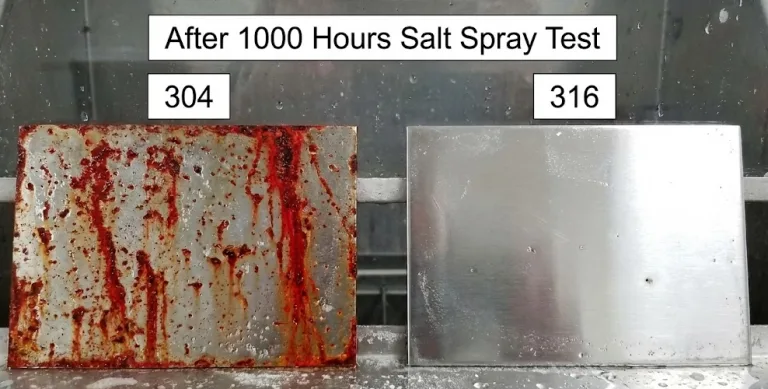
304 offers moderate corrosion resistance, typically 200–400 hours in ASTM B117 salt spray, and suits light washdown with non-chloride cleaners. 316 delivers 500–1,000 hours under the same test. For a heavy door with frequent caustic washdown, the combination of load rating and 316 material is non-negotiable. Always verify the IP rating of the hinge assembly — IP69K indicates full protection against high-pressure, high-temperature washdown jets, which matters for food-grade and pharmaceutical installations.
304 vs 316 – In-Depth Comparison
Corrosion Resistance: The Deciding Factor
The answer to “should I use 304 or 316 for washdown” depends almost entirely on your cleaning chemistry. 304 contains 18% chromium and 8% nickel, giving good oxidation resistance, but it is vulnerable to pitting and crevice corrosion from chlorides — bleach, brine, and saltwater all qualify. 316 adds 2–3% molybdenum to a composition of 16% chromium and 10% nickel, improving chloride resistance by roughly 10×.
In seafood processing plants using frequent sodium hypochlorite washes, 304 hinges have shown visible corrosion within 4 months; 316 units in identical conditions showed no damage after 18 months. The practical threshold: if your cleaning agents contain more than 50 ppm chlorides, 316 is the correct grade. Beyond grade selection alone, design choices like sealed pivots, drainage geometry, and surface passivation also affect lifespan — our reference on corrosion-resistant hinges covers these factors across other industrial environments.
Mechanical Properties and Cost Trade-offs
On tensile strength, the two grades are nearly equivalent — 304 at approximately 72,000 psi and 316 at 75,000 psi. Strength is not the differentiator. Cost is: 316 runs 30–50% more expensive due to its molybdenum and nickel content. A 4-inch 304 hinge typically costs $5–$8; the 316 equivalent runs $10–$15.
The relevant calculation is total cost of ownership. Saving a few dollars per hinge can cost several hundred dollars in labor and line downtime when a corroded hinge requires unplanned replacement. For facilities running daily chlorinated washdowns, 316 pays for itself reliably. For dry cleaning or mild detergent environments without chlorides, 304 is a defensible choice.
Decision Guide for Specific Scenarios
1: Food and Beverage Processing
In food and beverage applications, 316 is the industry standard because it resists corrosion from acidic foods, alkaline CIP cleaners, and the caustic-acid cycles common in brewing and dairy. Installations in meat packing facilities typically specify 316 hinges with sealed bearings and electropolished surfaces to prevent bacterial harborage. Hinges should also use FDA-approved lubricants and present no crevice geometry that could support biofilm formation.
A common and costly error is using 304 in zones where citric acid or peracetic acid washes are used — pitting can begin within months. For breweries running both caustic and acid cycles, 316 is not optional.
2: Pharmaceutical and Cleanroom Environments
Pharmaceutical and cleanroom washdown requirements center on chemical compatibility and zero particulate generation. 316 is preferred because it withstands aggressive disinfectants — bleach, hydrogen peroxide, chlorine dioxide — without releasing metal ions that could compromise sterile environments.
In sterile compounding facilities, 304 hinges have shown microscopic pitting after one year of weekly chlorine dioxide wipes, creating contamination risk and jeopardizing cleanroom certification. 316 hinges with a passivated surface have passed 1,000-hour salt spray tests under the same regime. For dry cleanrooms with no washdown cycles, 304 is acceptable; for any wet environment, 316 is the only compliant choice.
3: Marine and Coastal Facilities
Marine and coastal environments combine heavy chloride loading — salt fog, direct seawater contact — with frequent manual or automated washdowns. In ship galley installations, 304 hinges have seized from crevice corrosion within six months. 316’s molybdenum content resists pitting in seawater up to 40°C. For offshore platforms and desalination facilities, super duplex grades like 2507 may be required, but for standard marine washdown, 316 is the minimum acceptable specification.
Ensure hinges are fully wetted rather than partially submerged to avoid differential aeration corrosion — a common failure mode that 316 alone does not fully prevent without proper drainage design.
Risks, Limitations, and Misconceptions
Common Risks of Using 304 in Washdown
304 stainless steel will rust in washdown environments involving chlorides or strong acids. The consequences extend beyond cosmetics: corrosion causes structural hinge failure, door sagging, and bacterial colonization of corroded pits — a serious food safety and pharmaceutical compliance issue.
In bakery environments using quaternary ammonium sanitizers, 304 hinges have developed black rust within three months, resulting in product contamination events. Galvanic corrosion is an additional risk when 304 contacts dissimilar metals like carbon steel or brass — a 304 hinge on a carbon steel door frame accelerates corrosion in both components. Mitigation requires either upgrading to 316 throughout or isolating dissimilar metals with non-conductive gaskets.
Misconceptions About 316 Being Indestructible
316 is not corrosion-proof. Under extreme conditions — concentrated chlorides above 1,000 ppm, temperatures exceeding 60°C, or stagnant seawater — 316 will fail. In chemical plant applications using chlorine dioxide washdown at 70°C, 316 hinge failures have occurred within two years.
A practical rule of thumb: if operating pH falls below 4 or above 10, or chloride concentration exceeds 200 ppm, consider 316L (low carbon, better for welded assemblies) or a nickel alloy. Never mix 316 with non-stainless fasteners — the resulting crevice geometry reliably initiates corrosion.
Limitations of Standard Hinge Designs
Beyond material grade, hinge geometry matters. Hinges with exposed springs, open pin channels, or internal gaps trap debris and resist effective cleaning. Fully enclosed, sealed hinge designs — conical pins with O-ring seals, smooth external profiles — are the correct specification for washdown environments regardless of grade.
A common procurement hazard: hinges labeled “stainless steel” that are actually 201 or 430 grade, both of which offer substantially lower corrosion resistance and are frequently sold at price points that undercut genuine 304. Always request a PMI (positive material identification) report or EN 10204 3.1 material certificate from the supplier before accepting delivery.
Data, Experiments, and Case Studies
Salt Spray Test Results Comparison
ASTM B117 salt spray testing provides the standard comparative baseline. 304 hinges typically show initial red rust at 200–400 hours; 316 reaches 500–1,000 hours before similar degradation. In controlled testing of 5-inch hinges across three suppliers, 304 units failed at 250 hours (5% surface rust), while 316 reached 600 hours before showing 1% rust. This data maps directly to real-world lifespan: facilities requiring a 3-year hinge lifespan under mild washdown can specify 304 with a 400-hour rating; 5-year lifespan under aggressive chemistry requires 316 at 800+ hours. Request test data from suppliers matched to your specific cleaning chemicals, not generic laboratory conditions.
Case Study: Brewery Hinge Replacement
A craft brewery operating caustic and peracetic acid wash cycles experienced repeated 304 hinge failures on packaging line doors over two years. Corrosion-induced door misalignment caused unplanned downtime across multiple production runs. Replacing with 316 hinges increased the installation cost from roughly $500 to $800 total, but downtime savings recovered the additional spend within one year. 316 hinges also required less frequent lubrication and generated no bacterial contamination events in subsequent operation. For procurement teams, this TCO model — factoring labor, replacement parts, and quality loss — is the correct framework for evaluating stainless steel performance in food processing environments.
Data on Cleanability
Surface roughness directly affects cleanability and bacterial biofilm risk. As-rolled 304 hinges typically measure Ra 0.8–1.2 μm; electropolished 316 can achieve Ra 0.2–0.5 μm. In hygiene studies, electropolished 316 reduced bacterial biofilm adhesion by 90% compared to standard 304. For pharmaceutical applications, specifying Ra <0.8 μm — achievable only through electropolishing on 316 — is the correct approach to meeting regulatory surface standards. Electropolishing is one of several finishing methods that affect both corrosion resistance and hygiene compliance; we cover the trade-offs between surface treatment options in a separate procurement-focused breakdown.
Practical Decision Path and Step-by-Step Guide
1: Assess Your Washdown Chemistry
Begin by cataloging your cleaning agents: chemical names, concentrations, temperatures, and daily exposure duration. Use a chloride test kit or request a water chemistry report from your facility manager. The decision thresholds are: chlorides above 50 ppm → specify 316; pH below 4 → specify 316L; temperature above 70°C with any chloride presence → consult a corrosion specialist before specifying either grade.
A useful corrosion risk score: multiply chloride concentration (ppm) by operating temperature (°C). Results above 5,000 indicate conditions where 316 is mandatory and 316L or duplex grades should be evaluated.
2: Evaluate Mechanical Load and Door Type
Match hinge count and load rating to door weight and cycle frequency. For doors under 50 lbs, two to three hinges in 304 or 316 are adequate depending on chemistry. For doors over 100 lbs with frequent washdown, specify four to five hinges in 316 to distribute load and reduce corrosion stress concentration at fastener points. Continuous-span doors and large enclosures often need a different load model entirely — see our specifications for heavy-duty butt hinges when working with doors above 200 lbs.
Sealed ball bearings are standard specification for high-cycle washdown doors — they prevent ingress of cleaning chemicals into bearing surfaces, which is the primary cause of pivot wear in wet environments.
3: Verify Supplier Certification and Test Reports
Before accepting delivery, request an EN 10204 3.1 material certificate from the supplier. For critical installations, use a portable XRF (PMI) analyzer to verify grade on-site. A basic magnet test provides a quick screen: annealed 316 is non-magnetic, while grades 201 and 430 — commonly substituted by lower-tier suppliers — are distinctly magnetic. This test takes seconds and catches the most common grade fraud. Also request salt spray test data matched to your specific operating conditions, and look for ISO 9001 certification and third-party test reports as baseline supplier qualification criteria.
Advanced Research and Future Trends
Alternatives to Standard 304 and 316
When 316 is not sufficient, the next tier of options includes: 316L (low carbon variant, preferred for welded assemblies to prevent sensitization), 317L (higher molybdenum for extreme chloride resistance), and duplex stainless steels (2205, 2507) offering roughly twice the tensile strength and superior resistance to chloride stress corrosion cracking. In desalination plant washdown where 316 failed within one year, 2507 duplex units lasted five years. Titanium and Hastelloy alloys are available for ultra-hygienic or extreme chemical environments but carry significant cost premiums and sourcing constraints.
Emerging Materials and Coatings
PVD coatings such as titanium nitride can extend the effective corrosion resistance of 304 substrates, but any breach in the coating exposes the underlying metal to accelerated attack. Ceramic-coated 304 hinges have shown acceptable performance for approximately two years before delamination under high-pressure wash conditions. For most washdown installations, selecting the correct base metal grade remains more reliable than relying on surface coatings. Research into antimicrobial stainless steel with copper additions is ongoing but not yet commercially standard for hinge applications.
Limitations of This Guide
This guide addresses typical industrial washdown environments with operating temperatures up to 80°C and chloride concentrations up to 200 ppm. Conditions outside these parameters — concentrated bleach at 90°C, continuous seawater immersion, high-pressure steam — require engineering consultation rather than grade selection from a general reference. Hinge design factors including crevice geometry and weld quality influence corrosion behavior independently of material grade; always evaluate the complete assembly, not the material alone.
Decision Matrix for 304 vs 316 Hinges
| Washdown Environment | 304 Stainless | 316 Stainless |
|---|---|---|
| Light washdown, water only, under 50°C | Acceptable | Acceptable (over-specified) |
| Moderate washdown — dilute detergents, chlorides below 50 ppm | Acceptable for 1–2 year lifespan | Recommended for 2+ year lifespan |
| Aggressive washdown — bleach, seawater, chlorides above 100 ppm | Not recommended | Required |
| Food processing — acidic or alkaline cleaners, elevated temperatures | Not recommended (pitting risk) | Standard specification |
| Pharmaceutical / cleanroom — disinfectants, strict cleanability requirements | Not suitable | Required — specify electropolished 316 |
Cost Comparison Table (per 4-inch hinge)
| Material | Initial Cost | Expected Life in Aggressive Washdown* | Total Cost of Ownership (5 years) |
|---|---|---|---|
| 304 | $6 | 1 year | $36 (5× replacement) |
| 316 | $12 | 3–5 years | $18 (1–2× replacement) |
| 316L (electropolished) | $18 | 5+ years | $18 |
*Aggressive washdown defined as 3× daily at 200 ppm chlorine, 70°C
Risk Assessment Table
| Risk | Trigger Conditions | Mitigation |
|---|---|---|
| Pitting / crevice corrosion | Chlorides >50 ppm, stagnant water | Specify 316; rinse after washdown; design for full drainage |
| Galvanic corrosion | Contact with carbon steel or brass | Isolate with non-conductive washers; maintain single-metal assemblies |
| Stress corrosion cracking | Chlorides + tensile stress at temperatures >60°C | Specify 316L or duplex; avoid stress concentrations from machining |
| Bacterial biofilm | Surface roughness Ra >0.8 μm | Specify electropolished 316; maintain smooth finish through service life |
For 90% of washdown applications, 316 is the correct specification — it provides the corrosion resistance margin that eliminates most unplanned replacement and compliance risk. If your environment involves conditions at the extremes described in this guide, the appropriate next step is a site assessment with a corrosion engineer, not a grade upgrade selected from a table.
FAQ
Can I use 304 stainless steel hinges if I only wash with water?
For water-only washdown at room temperature, 304 is adequate. If the water is chlorinated — as most municipal tap water is — or heated above 50°C, pitting can still develop over time due to residual chloride impurities. For pure steam or distilled water, 304 is reliable. Repeated hot-water exposure at 80°C has produced discoloration and minor surface pitting in 304 units after two years in practice. 316 eliminates this risk across all water-only scenarios.
What is the main difference between 304 and 316 stainless steel hinges for washdown?
The operative difference is molybdenum: 316 contains 2–3%, which substantially improves resistance to chlorides and reducing acids. This makes 316 far more resistant to pitting and crevice corrosion in bleach, brine, and acidic cleaner environments. In direct field comparison, 304 typically lasts 1–2 years in aggressive washdown; 316 commonly exceeds 5 years under the same conditions.
Do food processing and pharmaceutical plants require 316 stainless steel hinges?
In most cases, yes. Food processing facilities using CIP cleaners, peracetic acid, or sodium hypochlorite washes specify 316 as the minimum grade — 304 pits within months in these chemical environments, creating bacterial harborage and contamination risk. Pharmaceutical and cleanroom installations additionally require electropolished 316 (Ra ≤ 0.5 μm) to meet particulate control and surface hygiene standards. Dry cleanrooms with no washdown cycles are the exception where 304 may be acceptable.
When should I choose 316L instead of standard 316 for washdown hinges?
316L becomes the correct specification in two situations: when the hinge assembly involves welding, and when operating conditions push to the extremes — pH below 4, chloride concentration above 200 ppm, or sustained temperatures above 70°C. Standard 316 can undergo carbide precipitation at heat-affected zones during welding, reducing local corrosion resistance; 316L’s lower carbon content prevents this. For most bolted or pinned hinge installations in standard washdown, regular 316 is sufficient.
How do I verify that a supplier’s hinges are genuinely 316 stainless steel?
Request an EN 10204 3.1 material certificate before accepting delivery — this is the baseline document for grade verification. For on-site confirmation, a portable XRF (PMI) analyzer gives definitive results in seconds. A quick magnet test provides a fast first screen: annealed 316 is non-magnetic, while grades 201 and 430 — the most common substitutions — respond clearly to a magnet. Strong magnetic attraction means the hinge is not austenitic 316. Also require ISO 9001 certification and salt spray test reports matched to your operating conditions, not generic lab benchmarks.