HTAN is one of the leading manufacturers of industrial hinges, handles and latches in China.


Once you have chosen a handle’s shape and size, there is still a quieter decision to make: how it fastens to the sheet metal. Through-hole and threaded-stud mounting both fix a handle to a panel, but they put the fastener in different places and ask different things of the panel and the people installing it. The choice affects whether you can reach behind the panel, whether the front face stays clean, and how easily the handle can be replaced later. On sheet metal, where there is rarely much thickness to work with, that decision matters more than it first appears.
This guide compares through-hole and threaded-stud handle mounting for sheet metal panels across back access, appearance, sealing, serviceability, and panel strength. It focuses on the fastening method, not the handle’s shape or material — a protruding, recessed, or folding handle can use either mounting style.
Quick Answer: Through-Hole or Threaded-Stud?
| If the panel… | Better choice | Why |
|---|---|---|
| Has open access to the back during assembly | Through-hole | Bolt and nut can be reached from behind |
| Cannot be reached from behind at all | Panel-fixed stud, captive nut, or blind insert | Avoids loose nuts behind the panel |
| Must show a clean front with no visible fasteners | Threaded-stud | No bolt heads on the face |
| Needs the handle replaced easily in the field | Through-hole | Bolts come out without special tools |
| Is thin and needs load spread over a wide area | Weld stud or backing plate | Spreads load into the panel |
In short, through-hole mounting wins when you can reach the back of the panel and want easy field service, while threaded-stud mounting wins when access is one-sided or the front must stay clean. Whether you can get behind the panel is usually the first thing that decides it — but, as the next section explains, a clean front and one-sided installation are not automatically the same thing.
The Practical Rule: Separate Clean Front From One-Sided Installation
A clean front face and one-sided installation are two different things, and confusing them is the most common mistake on sheet metal panels. A handle with hidden threaded studs looks clean from the front — no bolt heads on the visible surface — but if those studs are part of the handle, an installer still has to fit nuts on the back. The front looks finished; the assembly is still two-sided.
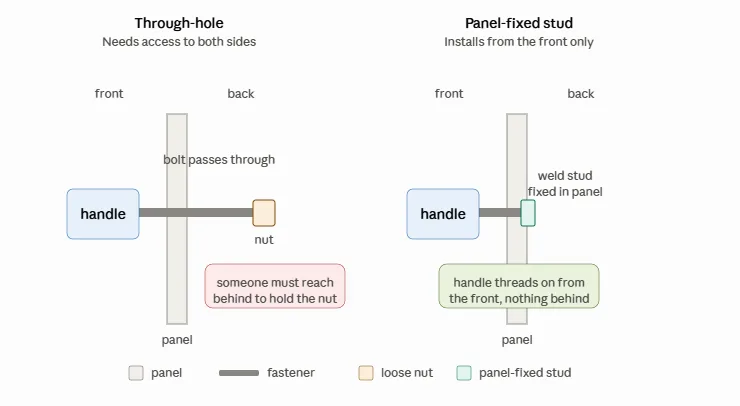
If the back of the panel genuinely cannot be reached, you need a panel-fixed solution: weld studs, self-clinching studs, captive nuts, or blind threaded inserts (rivnuts) installed into the sheet before the handle goes on. Only then does the handle attach from the front with nothing required behind it. The practical rule is to decide the two questions separately — does the front need to look clean, and can anyone reach the back — and then specify the fastener system that satisfies both, rather than assuming a stud-mounted handle automatically means one-sided installation.
What Each Mounting Method Means
Through-hole mounting passes a bolt or screw through a clearance hole in the panel, with a nut on the other side. The fastener goes all the way through, so both faces of the panel are involved: the bolt head sits on one side and the nut on the other. This is simple, strong, and uses standard hardware, but it requires access to both sides of the panel to install and to tighten.
Threaded-stud mounting puts the thread on a stud rather than a loose bolt through the face. In the most common form, studs project from the back of the handle, pass through holes in the panel, and are secured with nuts from behind — so the front face stays clean, but an installer still needs rear access to fit the nuts. True one-sided installation comes from a different setup: a weld stud, self-clinching stud, captive nut, or blind threaded insert fixed into the panel itself, into which the handle threads from the front. The key point is that a clean front face and one-sided installation are not the same thing — only panel-fixed fasteners remove the need to reach behind.
Back Access: The First Question
The most practical difference is whether you need to reach behind the panel. Through-hole mounting needs access to both sides: someone has to hold or place the nut behind the panel while the bolt is driven from the front. On an open panel during assembly that is easy. On a closed enclosure, a panel backed by components, or a confined cavity, reaching the back to fit and tighten a nut can be difficult or impossible.
Threaded-stud mounting can be designed around one-sided access, but only when the stud is fixed to the panel rather than the handle. With a weld stud or self-clinching stud already in the panel, the handle threads on from the front and is tightened without anyone reaching behind. If instead the studs project from the handle, nuts still go on at the back — the front simply looks cleaner. So stud mounting is the natural choice where the back is sealed, crowded, or unreachable, provided you specify a panel-fixed stud or insert rather than a handle whose own studs still need rear nuts. When you cannot get behind the panel, that distinction is what actually settles the decision.
Appearance and Sealing
Threaded-stud mounting gives a cleaner front face. Because the fastener does not pass through from the front, there is no bolt head on the visible surface — just the handle and a smooth panel. For equipment where appearance matters, or where a protruding bolt head would catch or look unfinished, this is a clear advantage. Through-hole mounting leaves a bolt head on the face, though that can be reduced with countersunk or low-profile fasteners.
Sealing follows the same logic. A through-hole puts an open clearance hole right through the panel at each fastener, which must be sealed with a gasket or sealed fastener if the enclosure needs to keep out dust or water. A welded or self-clinching stud closes the panel hole as part of the joint, leaving fewer open paths through the sheet. For sealed sheet metal enclosures, stud mounting can mean fewer points to seal, though any plain through-hole in the design still needs attention.
Serviceability and Panel Strength
Through-hole mounting is easier to service. Because it uses standard bolts and nuts, the handle can be removed and replaced in the field with common tools, and a stripped fastener is simply swapped out. Threaded-stud mounting is less forgiving here: if a weld stud shears or its thread strips, repair is harder because the stud is fixed to the panel, sometimes needing rework of the panel itself. Where handles are expected to be replaced periodically, through-hole mounting keeps that simple.
On panel strength, thin sheet metal is the key constraint. A through-hole concentrates load on the small ring of metal around each hole, which on thin or soft sheet can deform or pull through under a heavy or frequently pulled handle, unless backing washers or a reinforcing plate spread the load. A weld stud spreads its load into the panel through the weld area rather than a single hole edge, which can be gentler on thin sheet. So for a heavy handle on thin metal, the way each method loads the panel is worth checking before deciding. The other mounting choices that shape a handle’s fit are covered in the guide to handle installation methods.
How to Decide
Start with access to the back of the panel, then weigh appearance, service, and sheet thickness:
| Question | Points to… |
|---|---|
| Can you reach behind the panel to fit a nut? | Through-hole works; if not, threaded-stud |
| Must the front face be clean and fastener-free? | Threaded-stud |
| Will the handle be replaced periodically in the field? | Through-hole |
| Is the sheet thin and the handle heavy? | Threaded-stud (welded) to spread load |
| Does the panel need to stay sealed? | Threaded-stud closes fewer open holes |
The same handle can often be ordered for either mounting style, so this is usually a panel-and-access decision rather than a handle-shape one. If you are also weighing whether the handle should sit flush or protrude, that profile choice is covered in the comparison of surface-mount versus recessed handles.
FAQ
What is the difference between through-hole and threaded-stud handle mounting?
Through-hole mounting passes a bolt through a clearance hole in the panel with a nut on the back, so it needs access to both sides. Threaded-stud mounting puts the thread on the handle or uses a stud fixed in the panel, so the handle is secured from one side with no bolt head on the front face. The core difference is two-sided versus one-sided access and whether the front stays fastener-free.
When should I use threaded-stud mounting?
Use threaded-stud mounting when the front face must stay clean with no visible fasteners. If you also cannot reach behind the panel, be specific: only a panel-fixed solution — weld studs, self-clinching studs, captive nuts, or blind threaded inserts — gives true one-sided installation. A handle whose studs project from its own back still needs nuts fitted from behind, so a clean front does not by itself mean one-sided assembly. The trade-off with stud mounting is that field replacement is harder than with through-bolts.
Which mounting method is easier to replace in the field?
Through-hole mounting is easier to service because it uses standard bolts and nuts that come out with common tools, so a handle or a stripped fastener can be swapped quickly. Threaded-stud mounting is less forgiving, because a sheared or stripped weld stud is fixed to the panel and can require rework. Where handles are expected to be replaced periodically, through-hole mounting keeps it simple.
Is threaded-stud mounting better for thin sheet metal?
It can be, because a weld stud spreads its load into the panel through the weld area rather than concentrating it on the edge of a single hole. On thin or soft sheet, a through-hole can deform or pull through under a heavy, frequently pulled handle unless backing washers or a reinforcing plate are added. For a heavy handle on thin metal, check how each method loads the panel before deciding.
Does the handle’s shape decide the mounting method?
No. The mounting method and the handle’s shape are separate choices — a protruding, recessed, or folding handle can usually be ordered for either through-hole or threaded-stud mounting. The mounting decision is driven by panel access, appearance, serviceability, and sheet thickness, not by the handle’s profile. Pick the shape for the application, then the mounting for the panel.
Bottom Line
Through-hole versus threaded-stud is a fastening decision driven mostly by panel access. Choose through-hole when you can reach behind the panel and want standard hardware and easy field replacement. Choose threaded-stud when access is one-sided, the front face must stay clean, or a welded stud is needed to spread load on thin sheet. Because the same handle can usually be ordered either way, decide based on the panel — how you reach it, how it seals, and how thick it is — and the mounting method follows.
If you can describe the panel thickness, the access behind it, and how the handle will be serviced, HTAN can supply the handle in the right mounting style. Browse the industrial pull handle range or send your panel details for a recommendation.