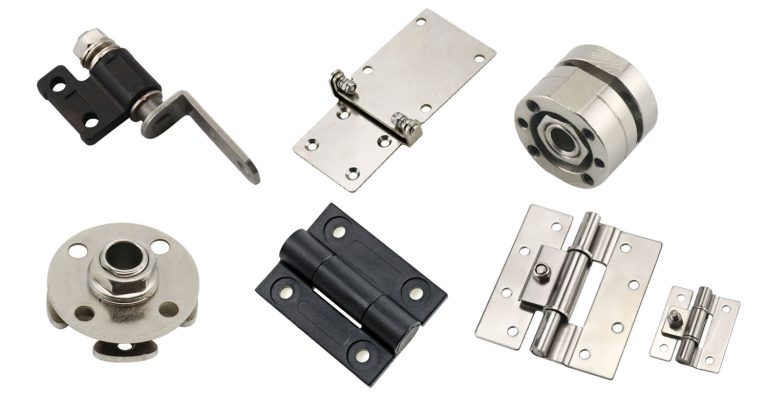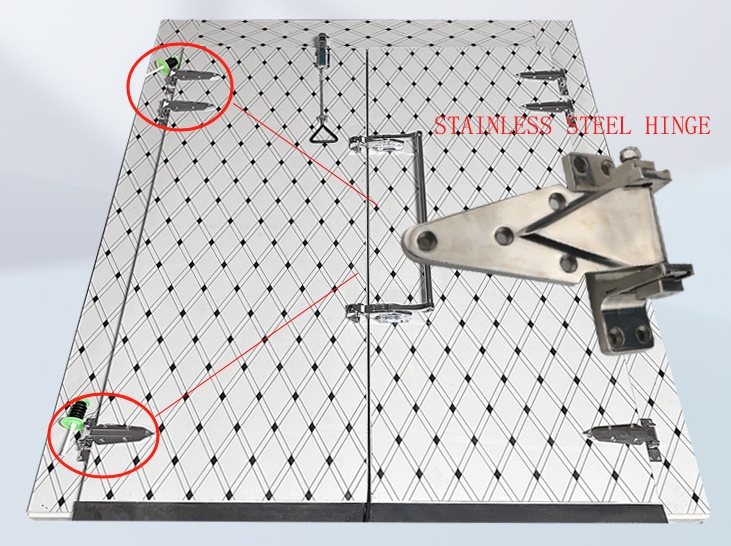







Industrial hinges, handles and latches for OEM equipment.
- +86 13720060320


Ergonomic Industrial Handle: Design, Materials & Applications
An ergonomic industrial handle is designed to improve grip comfort, reduce hand and wrist strain, and support safe repeated operation on equipment doors, machine covers, cabinets, and enclosures.
Compared with standard handles, ergonomic designs provide better palm fit, more secure control, and improved operating comfort, especially in environments involving gloves, moisture, oil, vibration, or frequent opening and closing.
For engineers, equipment manufacturers, and procurement teams, selecting the right handle is not only about appearance. It affects operator safety, fatigue, service life, and overall equipment usability. This guide explains what makes a handle ergonomic, which materials are suitable for different environments, and how to choose the right solution for industrial applications.
What Is an Ergonomic Industrial Handle?
An ergonomic industrial handle is a handle engineered to match the natural grip of the human hand while maintaining the strength, durability, and environmental resistance required in professional equipment. It is commonly used on industrial handles for machinery, electrical cabinets, transport equipment, medical devices, and access panels where repeated manual operation is required.
The goal of ergonomic handle design is to reduce localized pressure, improve grip stability, and minimize fatigue during repeated pushing, pulling, lifting, or opening movements. In practical terms, a well-designed ergonomic handle helps operators work more safely and more efficiently.
What Makes a Handle Ergonomic?
Grip Diameter
Handle diameter has a major effect on grip comfort. If the diameter is too small, users need to squeeze harder. If it is too large, grip control becomes less stable. In many industrial applications, a diameter in the range of 30 to 50 mm is suitable, with around 35 to 45 mm often providing a good balance for general hand use.
Finger Clearance
Proper clearance between the handle and the mounting surface allows fingers to wrap naturally around the grip. This is especially important when operators wear gloves. Insufficient clearance makes the handle harder to use and increases the chance of awkward hand posture.
Surface Texture and Slip Resistance
Industrial handles should provide secure control in clean, wet, oily, or dusty conditions. Fine textures, soft-touch coatings, or shaped grip areas help reduce slippage and improve confidence during operation.
Wrist-Neutral Positioning
A good ergonomic handle supports a more natural wrist angle during use. This is particularly important on frequently opened machine doors, access panels, and service covers where repeated awkward movement can lead to discomfort or reduced efficiency over time.
Ergonomic Handle vs Standard Handle
| Feature | Ergonomic Handle | Standard Handle |
|---|---|---|
| Grip comfort | Designed to fit the hand more naturally | Often generic in shape |
| Fatigue during repeated use | Lower fatigue in frequent operation | Higher chance of discomfort over time |
| Slip resistance | Usually improved through shape or texture | May be smooth or less secure |
| Glove compatibility | Often designed with better clearance | May feel cramped with gloves |
| Control in wet or oily conditions | More stable and predictable | Greater risk of slippage |
| Typical applications | Industrial equipment, enclosures, medical devices, transport systems | General low-demand applications |
Recommended Ergonomic Handle Dimensions
Exact dimensions depend on the application, mounting space, and expected operating force, but the following ranges are often useful as starting points during product selection and design review.
- Grip diameter: approximately 30 to 50 mm for most hand-operated industrial handles
- Grip length: approximately 100 to 150 mm for one-hand operation, depending on glove use and required force
- Finger clearance: enough space to allow a full grip without knuckle contact against the panel or door
- Glove allowance: extra clearance and slightly larger grip profiles for operators wearing work gloves
- Two-hand operation: longer or heavier-duty handle formats may be preferred for large doors or high-force pulling tasks
These dimensions should always be checked against the real use environment, panel thickness, access direction, and mounting layout.
Key Design Elements for Ergonomic Industrial Handles
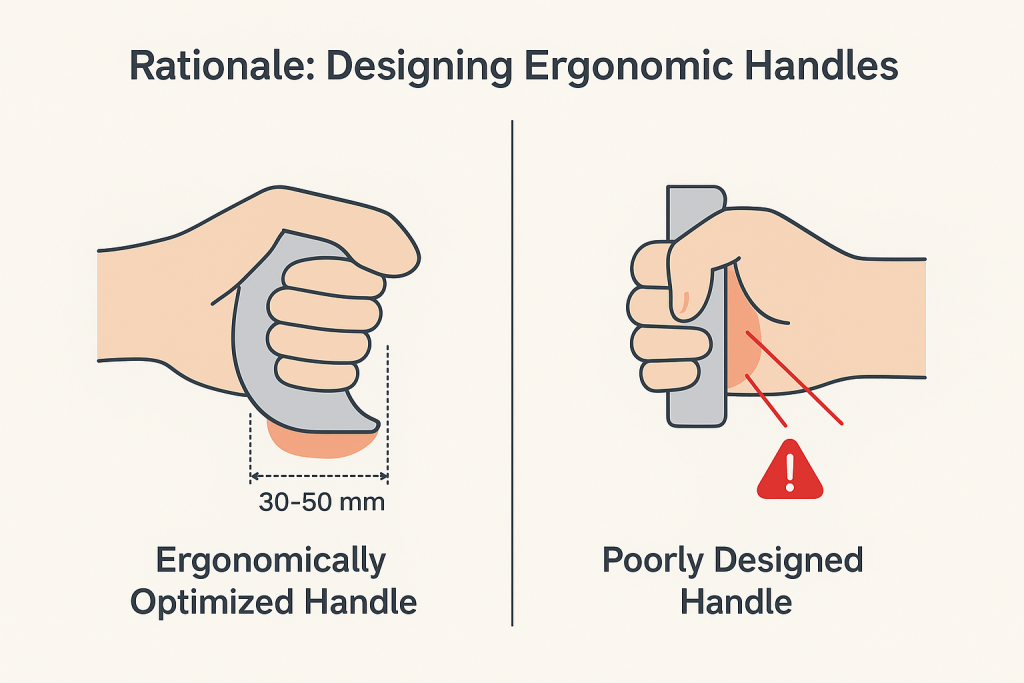
Designing Ergonomic Industrial Handles
- Shape and contour: Rounded or softly contoured profiles distribute pressure more evenly across the hand and reduce discomfort during repeated use.
- Edge treatment: Sharp edges or abrupt transitions should be avoided because they increase pressure points and reduce operating comfort.
- Grip surface: Fine textures, coated finishes, or shaped grip zones can improve control without making cleaning difficult.
- Mounting stability: Even a well-shaped handle performs poorly if the mounting structure flexes, loosens, or fails under repeated force.
- Application-specific geometry: The ideal handle profile for a medical cart is different from that of a heavy machine access door or a folding handle on a transport case.
Common Problems Caused by Poor Handle Design
- Hand fatigue: Undersized or poorly shaped handles force operators to grip harder than necessary.
- Grip slippage: Smooth or poorly contoured handles can become unsafe in oily, wet, or dusty environments.
- Reduced efficiency: Awkward handles slow routine operation on equipment doors, drawers, lids, and access covers.
- Higher maintenance and safety risk: Poor grip control can contribute to misuse, impact damage, and unnecessary strain on connected hardware.
Best Materials for Ergonomic Industrial Handles
| Material | Main Advantages | Main Limitations | Typical Uses |
|---|---|---|---|
| Stainless Steel | Excellent corrosion resistance, durable, easy to clean | Higher cost, heavier weight | Food equipment, medical devices, outdoor enclosures |
| Aluminum Alloy | Lightweight, strong, good corrosion resistance | Can scratch more easily than stainless steel | Machinery, transport equipment, cabinet doors |
| Engineering Plastics | Lightweight, electrically insulating, cost-effective | Lower structural strength than metal | Light-duty equipment, electronics, insulated applications |
| Die-Cast Zinc Alloy | Strong, precise, suitable for complex shapes | Heavier than aluminum | High-load handles, equipment covers, robust access points |
Material selection should always match the operating environment, expected load, cleaning method, and service life target. If your project requires a deeper material comparison, you can also review zinc alloy vs stainless steel hinges for related material logic used in industrial hardware selection.
How to Choose Handle Materials by Environment
| Environment | Recommended Material | Why | Typical Applications |
|---|---|---|---|
| Wet or washdown areas | Stainless steel | Better corrosion resistance and easier cleaning | Food equipment, outdoor cabinets, sanitary systems |
| Lightweight equipment | Aluminum alloy | Good strength-to-weight balance | Portable devices, machine covers, transport equipment |
| Electrical insulation required | Engineering plastics | Non-conductive and lightweight | Electrical equipment, electronics housings |
| High-load manual operation | Zinc alloy or steel-based designs | Higher structural strength | Heavy access doors, industrial machinery, service panels |
| Chemical exposure | Chemically suitable stainless steel or plastics | Depends on the cleaning agents and chemicals involved | Medical, laboratory, and process environments |
Surface Treatment and Grip Performance
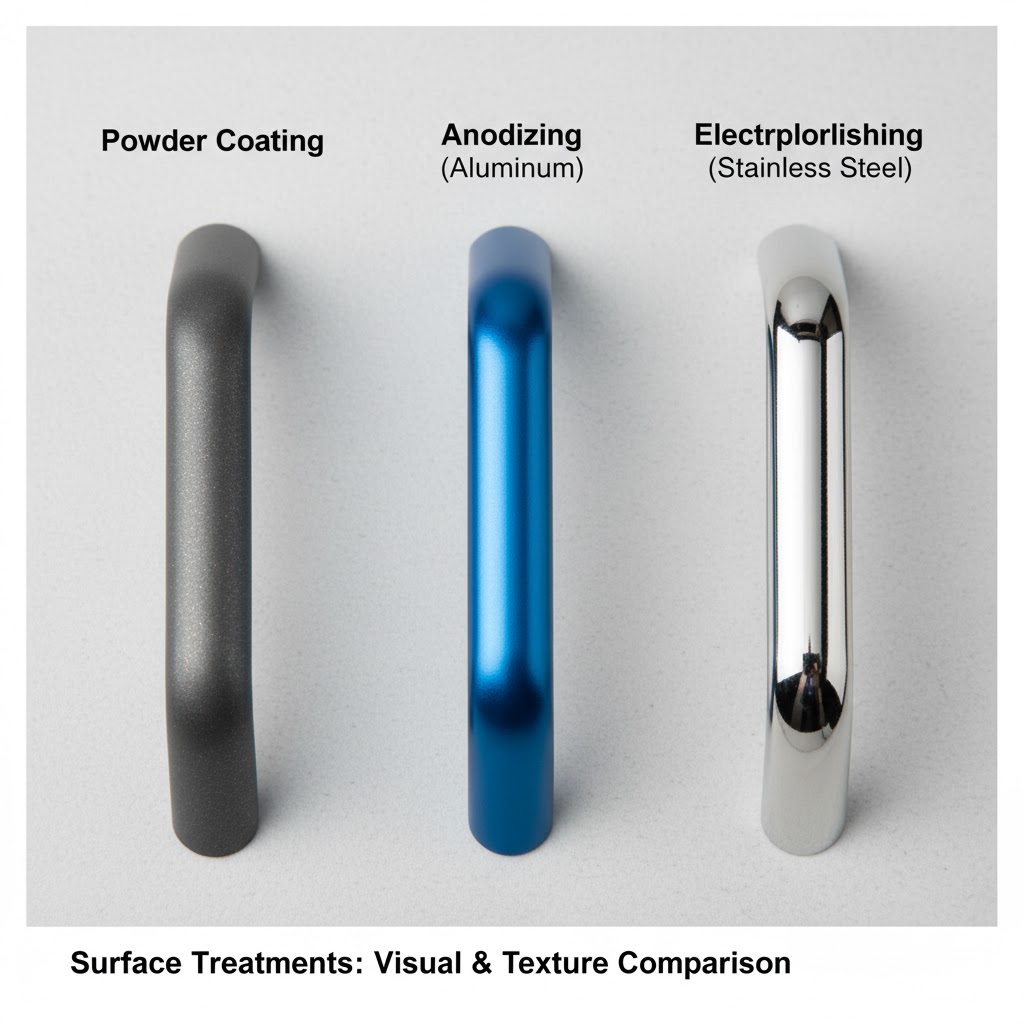
Comparison of Surface Treatments for Industrial Handles
- Powder coating: Improves corrosion resistance and appearance while providing a durable finish for many industrial environments.
- Anodizing: Common for aluminum handles where improved surface hardness and corrosion resistance are needed.
- Electropolishing: Often used on stainless steel handles where smooth cleanable surfaces are important.
- Textured or coated grip zones: Useful for improving handling in wet, oily, or gloved conditions.
Common Applications of Ergonomic Industrial Handles
Industrial Machinery and Equipment Doors
Industrial machinery often requires handles that can withstand repeated pulling, vibration, dust, and oil exposure. In these environments, grip security and structural strength are critical. Tubular and heavy-duty handles are commonly used on machine covers, service doors, and equipment housings.
Electrical Cabinets and Enclosures
Electrical enclosures and industrial cabinets often require stable, easy-to-grip handles that work well in limited mounting space. Depending on the application, designers may choose tubular, recessed, or rear-mount options to improve access and reduce protrusion risk.
Medical and Laboratory Equipment
Medical and laboratory devices often prioritize smooth surfaces, reliable cleaning performance, and comfortable manual control. In these environments, ergonomic handles can improve equipment usability while supporting frequent cleaning and repeated daily operation.
Outdoor and Harsh Environments
Outdoor equipment, transport systems, and exposed industrial enclosures require handles with good corrosion resistance, stable finishes, and dependable grip performance under moisture, temperature variation, and contamination.
Common Handle Types for Industrial Applications
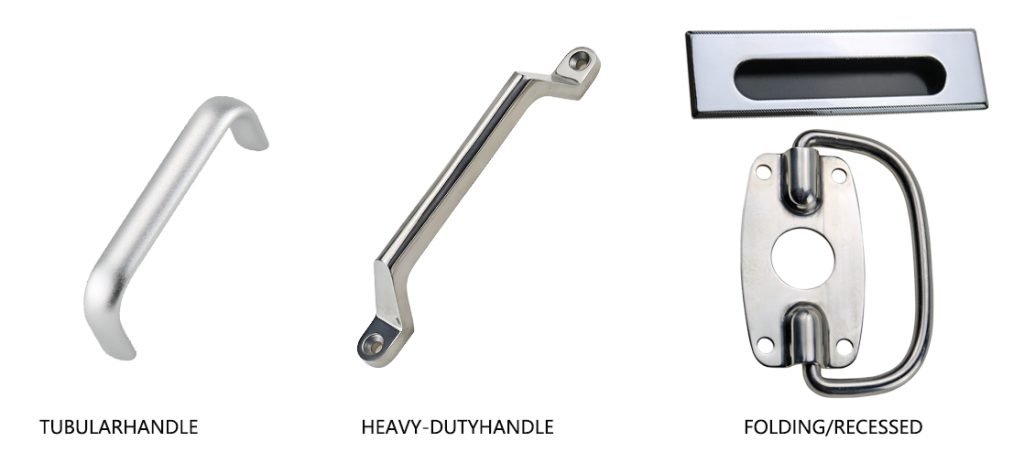
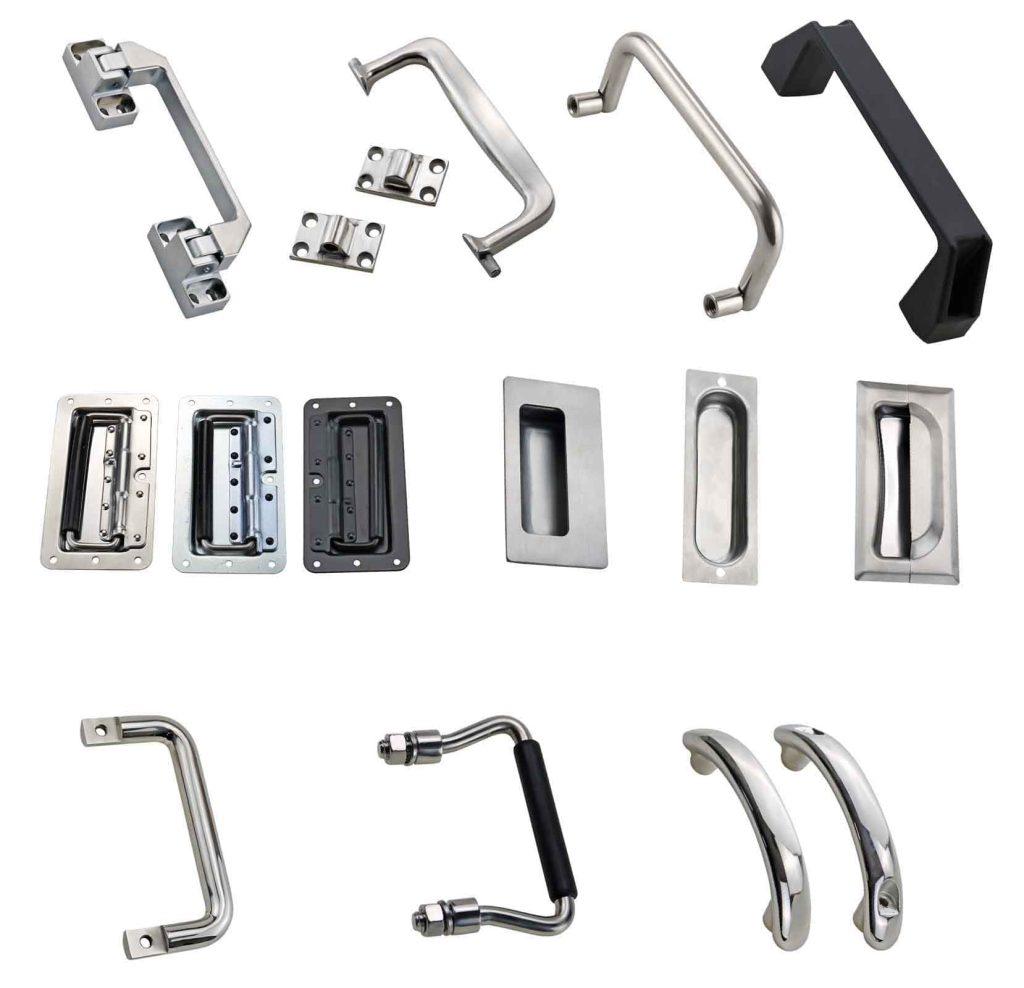
Common Industrial Handle Types
- Tubular handles: Widely used where strong grip points and straightforward mounting are needed.
- Heavy-duty handles: Suitable for high-load manual operation on larger equipment doors and service panels.
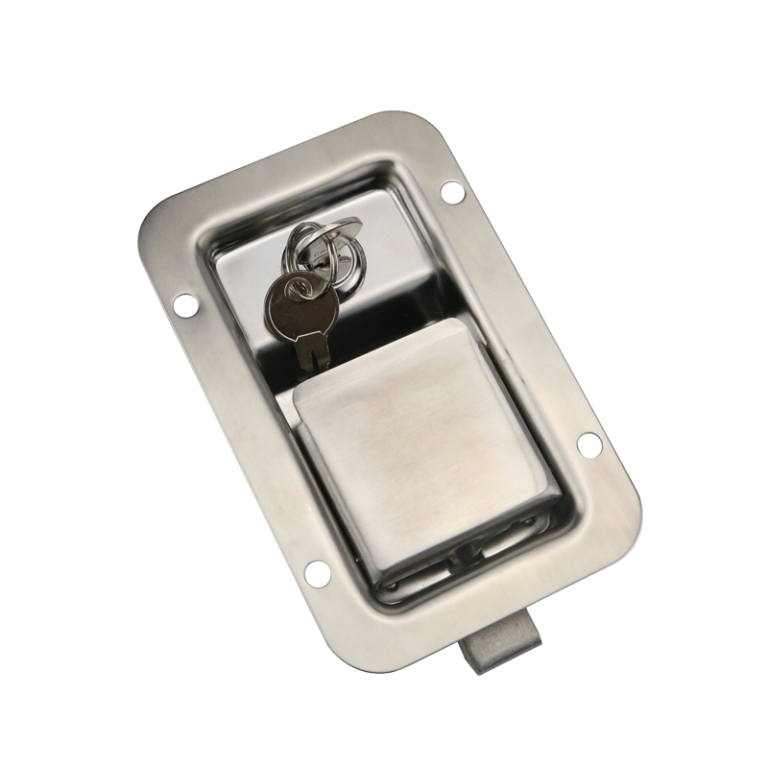
- Folding and recessed handles: Useful where space is limited or where protruding hardware could be damaged during transport or operation.
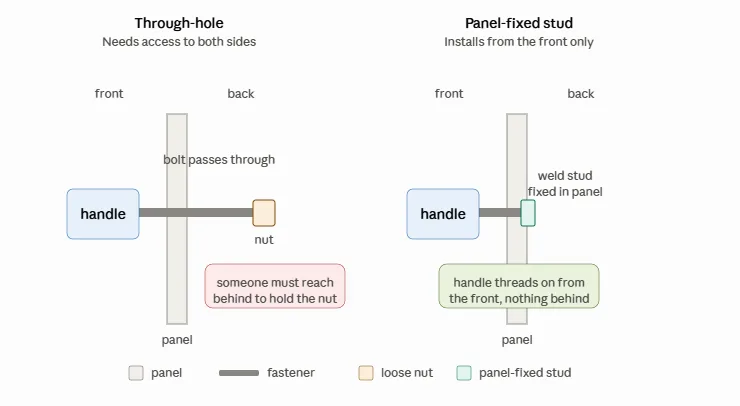
- Rear-mount handles: Often selected when a cleaner front appearance or concealed fastener design is preferred.
How to Choose the Right Ergonomic Industrial Handle
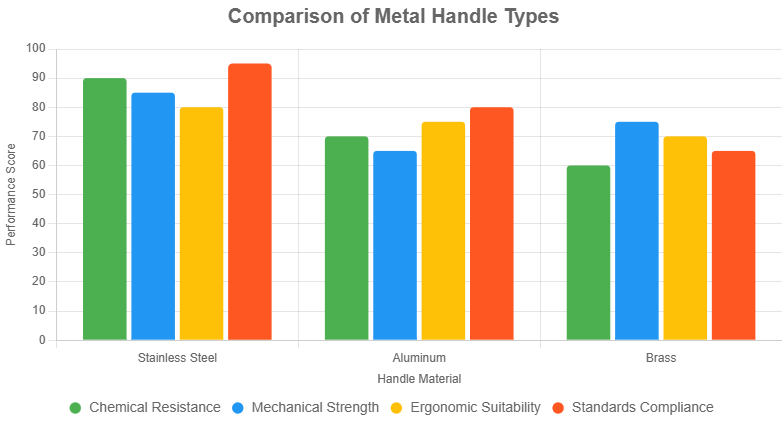
Performance Comparison of Common Industrial Handle Materials
- Assess the operating environment: Consider moisture, chemicals, temperature, UV exposure, and cleanliness requirements.
- Define the operating load: Estimate the push, pull, or lifting force the handle must withstand during normal use.
- Check user conditions: Determine whether operators wear gloves, use one hand or two hands, and need fast repeated operation.
- Confirm installation constraints: Review mounting hole spacing, panel thickness, rear clearance, and allowable projection.
- Match the handle type to the application: Choose between tubular, recessed, folding, rear-mount, or heavy-duty formats based on use conditions and equipment layout.
- Review long-term durability: Material, finish, and mounting design should all match the expected service life and maintenance conditions.
Conclusion
An ergonomic industrial handle is more than a simple accessory. It is a functional connection point between the operator and the equipment. The right design improves comfort, grip security, efficiency, and long-term reliability across industrial, enclosure, transport, medical, and equipment applications.
When selecting a handle, engineers and buyers should evaluate grip shape, dimensions, materials, mounting method, and environmental resistance together rather than focusing on appearance alone. For OEM equipment, custom machinery, and enclosure systems, the right handle choice can improve both user experience and equipment performance.
FAQ
What is an ergonomic industrial handle?
An ergonomic industrial handle is a handle designed to reduce strain, improve grip comfort, and support safer repeated operation on equipment, cabinets, machine doors, and enclosures.
What handle diameter is considered ergonomic?
In many industrial applications, a handle diameter between 30 and 50 mm is a practical range. The exact best size depends on the operator, glove use, required force, and available mounting space.
Are ergonomic handles better for gloved operation?
Yes. Ergonomic handles are often more suitable for gloved use because they provide better grip shape, improved clearance, and more stable control during repeated operation.
Which material is best for industrial handles?
There is no single best material for every application. Stainless steel is often preferred for corrosion resistance and hygiene, aluminum for lightweight strength, engineering plastics for insulation and lower weight, and zinc alloy for robust structural designs.
How do I choose a handle for wet or oily environments?
Choose a handle with corrosion-resistant material, appropriate surface texture, and reliable grip geometry. Stainless steel and textured coated surfaces are often suitable choices for these conditions.
What is the difference between an ergonomic handle and a standard handle?
An ergonomic handle is designed around hand comfort and control, while a standard handle may only provide basic function. Ergonomic designs usually perform better in repeated, high-frequency, or demanding industrial use.
Which handle type is best for equipment doors and enclosures?
The best handle type depends on the available space, operating force, and required projection. Tubular, recessed, folding, and heavy-duty formats are all commonly used for equipment doors and industrial enclosures.