






Industrial hinges, handles and latches for OEM equipment.
- +86 13720060320


Food Processing Equipment Hinges by Access Zone
A hinge that works well on an external service cover may be unsuitable beside an exposed food path or inside a frequently washed equipment area. The difference is not determined by stainless steel grade alone. Hinge location, door function, cleaning exposure, gap geometry, fastener placement, drainage, and removal requirements all affect whether the finished assembly is practical to inspect and clean.
This guide explains how to select hinges for food processing equipment according to the location of the access door and the way that door is used. It focuses on matching the hinge structure to the equipment zone rather than repeating detailed material comparisons, corrosion theory, or maintenance procedures covered in separate guides.
The three access-zone categories used below are practical project-review categories, not official regulatory classifications. Final approval should follow the equipment manufacturer’s hygiene risk assessment, customer requirements, cleaning procedure, and complete assembly review.
Quick Answer: Do All Food Equipment Doors Need the Same Hinge?
No. A hinge close to exposed product must minimize inaccessible gaps and contamination traps. A hinge in a splash or washdown area must allow drainage and remain compatible with the actual cleaning exposure. A hinge on an external service panel may place more emphasis on door support, alignment, fastener retention, and service access.
The correct starting question is therefore not simply, “Which stainless steel hinge should we use?” It is:
Where is the hinge located, what can reach it, how is the area cleaned, and what must the door do during operation and service?
Start With the Hinge Location
Two doors on the same food processing machine may require different hinge structures. A small inspection cover near an open conveyor is exposed to different risks than a rear electrical enclosure door, even when both are manufactured from stainless steel.
| Project review category | Typical location | Primary hinge concern |
|---|---|---|
| Product-adjacent access | Near exposed food, filling, cutting, mixing, transfer, or inspection areas | Residue traps, loose components, lubricant migration, and inspection access |
| Splash or washdown access | Areas regularly contacted by water, foam, detergent, sanitizer, or process splash | Drainage, trapped liquid, mounting interfaces, and exposure compatibility |
| External service access | Rear guards, electrical boxes, drive covers, utility panels, and outer machine doors | Door support, alignment, opening clearance, fastener security, and service access |
These categories help narrow the structural decision. They do not replace verification of the exact material, finish, load, cleaning chemical, or customer specification.
1. Hinges for Product-Adjacent Access
Product-adjacent doors and covers require the most careful review because hinge features may sit close to exposed food, food-contact components, or areas where residue can be transferred during operation or cleaning.
The hinge should be evaluated as part of the complete door assembly. A smooth hinge body does not solve the problem if the installation creates an inaccessible gap behind the leaf or exposes threads directly above the product path.
Structural priorities
- Avoid deep recesses that cannot be visually inspected.
- Reduce exposed threads and loose removable parts near the product path.
- Check whether the hinge knuckle, pin ends, leaf edges, and mounting interface can be reached during cleaning.
- Avoid horizontal ledges that allow residue or liquid to remain around the hinge.
- Confirm that any required lubricant cannot migrate toward the product area.
- Ensure that door removal does not introduce loose pins, washers, or fasteners into the processing area.
A concealed hinge is not automatically the best solution for this location. Concealment may improve the external surface, but it can also create a hidden cavity behind the door. The cavity must either be isolated from the product area or remain accessible for inspection.
2. Hinges for Splash or Washdown Access
In a splash or washdown area, the hinge is repeatedly exposed to liquid that can enter gaps, collect behind mounting plates, remain around pin interfaces, or reach dissimilar fasteners. The design review should therefore look beyond the visible hinge surface.
Structural priorities
- Provide a path for liquid to drain instead of collecting behind or beneath the hinge.
- Check whether overlapping leaves create a narrow gap that is difficult to rinse and inspect.
- Review the interface between the hinge, fasteners, door skin, and supporting frame.
- Ensure that welding, drilling, or installation does not leave damaged or unfinished areas around the hinge.
- Confirm that the pin orientation does not create an upward-facing pocket.
- Evaluate the actual cleaning liquid and exposure conditions before approving the material specification.
Where chlorinated cleaners, acidic sanitizers, persistent moisture, or other demanding exposure is involved, review the separate guide to 316 stainless steel hinges for washdown. That article covers material-grade and cleaning-exposure decisions; the present guide remains focused on hinge location and structure.
Documented stainless steel hinge options are a logical starting point for many wet food-equipment areas, but a stainless hinge can still create a poor assembly if liquid becomes trapped behind it or the mounting geometry cannot be cleaned.
3. Hinges for External Service Access
External service doors are usually farther from exposed product, but their hinges still affect machine access, enclosure alignment, gasket contact, operator safety, and the time required to reach internal components.
Examples include rear drive covers, electrical cabinet doors, utility compartments, outer guards, and service panels that maintenance personnel open during inspection or component replacement.
Structural priorities
- Support the door without progressive sagging.
- Maintain latch engagement and gasket contact where sealing is required.
- Provide enough opening clearance for tools, replacement parts, and technician access.
- Avoid interference with adjacent guards, piping, frames, or another open door.
- Use a removal method appropriate for the door weight and service procedure.
- Ensure that fasteners remain secure in the available sheet-metal or frame structure.
The initial hinge layout should support the facility’s existing food processing equipment hinge maintenance procedure rather than creating additional disassembly steps. Detailed cleaning schedules, lubrication controls, preventive maintenance intervals, and downtime planning belong in that maintenance-focused guide rather than this selection page.
Match the Hinge Structure to the Door Function
After identifying the access zone, determine what the door must do. A fixed inspection door, a removable sanitation panel, an offset cabinet door, and a heavy service cover should not be specified from the same checklist.
Surface-Mounted Hinges
Surface-mounted hinges provide visible mounting points and are usually straightforward to install and inspect. They may suit external doors or locations where both hinge leaves and fasteners remain accessible.
The main review point is the interface behind the hinge leaf. A flush-looking installation can still create a narrow gap where liquid or residue remains. Fastener heads, countersinks, leaf edges, and the surrounding door surface should all be included in the cleaning-access review.
Weld-On Hinges
Weld-on hinges can eliminate exposed mounting screws and provide a compact attachment method. They may be useful where the supporting frame allows welding and where later hinge replacement is not expected to be frequent.
The result depends heavily on fabrication quality. Intermittent welds, rough weld beads, distortion, incomplete finishing, or inaccessible gaps behind the hinge can make the final assembly harder to inspect than a properly installed bolted hinge.
Lift-Off and Removable Hinges
A lift-off or removable design can provide full access when a door must be taken away from the machine. It may be useful for removable guards, panels that obstruct internal inspection, or doors that must be separated from the frame before another component can be removed.
Removal must still be controlled. Review the lifting direction, available overhead clearance, door weight, pinch points, loose components, and the ability to return the door to its original alignment.
For a broader mechanical comparison of load behavior, installation, access, and service consequences, see the guide to removable and fixed hinges. This page only uses that distinction as part of the food-equipment access-zone decision.
Concealed and Offset Hinges
Concealed and offset hinges can keep hardware away from the external face or allow a door to clear a frame, gasket, insulation layer, or overlapping panel. This may improve access geometry, but concealed hardware should not be selected for appearance alone.
Confirm where liquid or residue can travel when the door is closed, whether the hidden space can be inspected, and whether the hinge can be replaced without opening a sealed equipment cavity.
Door Alignment Is Part of the Selection Decision
A food-equipment hinge must do more than allow rotation. It must keep the door in the intended position relative to the frame, latch, gasket, guard opening, and adjacent equipment.
Progressive door movement can create several assembly problems:
- Uneven gasket contact around a sealed access door
- A door edge that rubs against the frame
- A latch that requires extra force to engage
- A growing gap that allows liquid or residue to reach a hidden area
- A removable door that no longer returns to the same position
- Fastener holes that begin to deform in thin sheet metal
Before approving the hinge layout, review the complete door mass, center-of-gravity position, door width, hinge spacing, supporting material, fastener engagement, opening direction, and any gasket compression. Do not approve a hinge solely from its overall dimensions or material description.
Food Equipment Hinge Decision Matrix
| Equipment condition | Prioritize | Avoid |
|---|---|---|
| Hinge is close to exposed product | Visible interfaces, controlled fasteners, minimal inaccessible gaps, no loose pin above product | Deep recesses, exposed springs, loose hardware, hidden residue paths |
| Hinge receives repeated splash or washdown | Drainable geometry, accessible interfaces, verified exposure compatibility | Upward-facing pockets, trapped liquid, unfinished mounting damage |
| Door must be removed for access | Controlled lift-off direction, safe handling, repeatable alignment | Unsecured pins, inadequate lifting clearance, unsupported heavy door |
| Door carries a gasket | Stable axis, rigid mounting, consistent door position | Flexible mounting surface, poor hinge spacing, progressive sag |
| Door is an external service panel | Load support, opening clearance, secure fasteners, technician access | Architecture chosen only for appearance |
| Hinge back surface cannot be reached | Relocate the hinge, isolate the cavity, or redesign the attachment | Assuming high-pressure cleaning will compensate for poor access |
Three Hinge Structures From the Existing Product Range
The following products illustrate three different hinge structures. They are not automatic approvals for every food processing application. Final suitability depends on the exact material specification, door geometry, cleaning exposure, installation method, and customer requirements.
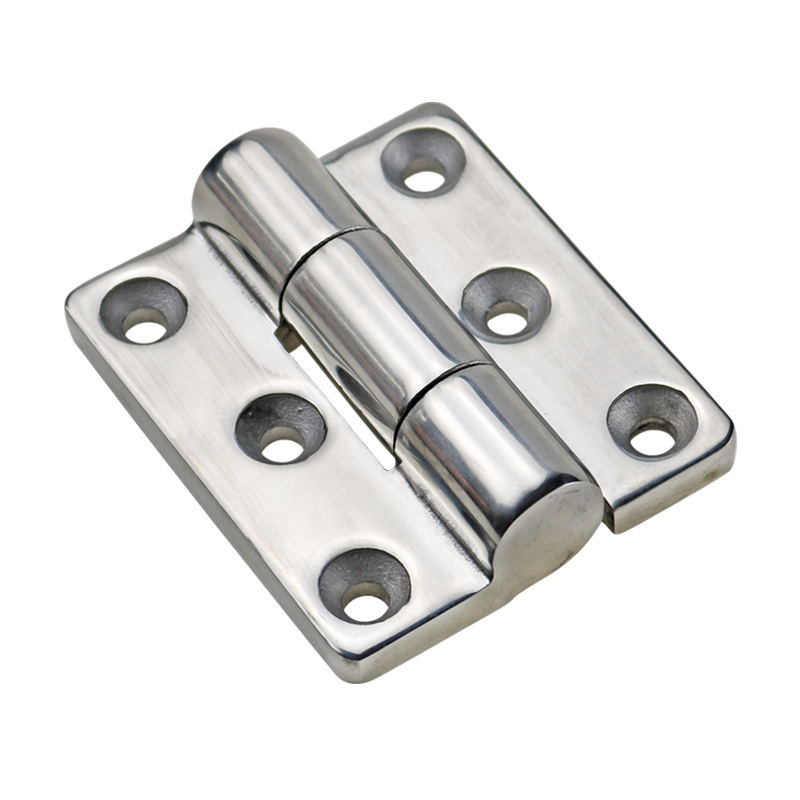
Heavy-Duty Equipment Hinge CL233
This surface-mounted stainless steel hinge uses a substantial 80 × 69 mm body with an 8 mm stated thickness. Its structure may be considered for heavier external access doors where mounting rigidity and door support are important.
For food equipment, verify the exact material grade, fastener arrangement, knuckle accessibility, clearance behind the leaves, and whether the mirror-finished surface matches the cleaning and inspection requirements of the intended zone. A mirror appearance alone does not establish suitability.
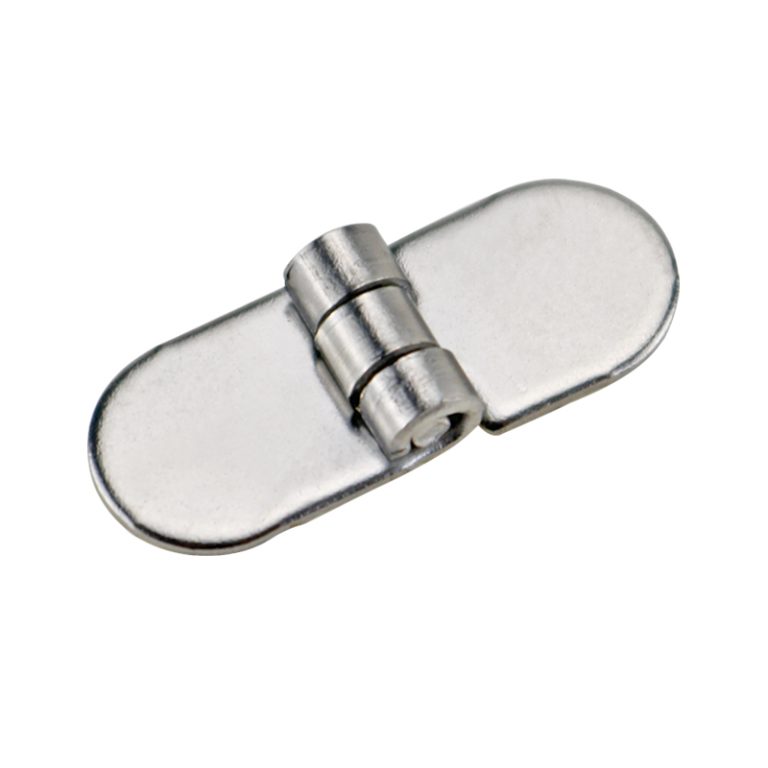
Compact Weld-On Hinge CL253-10
This compact round weld-on hinge has no mounting holes and is listed at 25.4 × 9.7 mm with a 1 mm stated thickness. The absence of exposed mounting screws may be useful on a small cover or light access panel where welding is appropriate.
Its food-equipment suitability depends on the actual door load, weld design, weld finishing, hinge-knuckle gap, pin retention, and access to the area surrounding the hinge. It should not be treated as a heavy-door hinge without application-specific load verification.
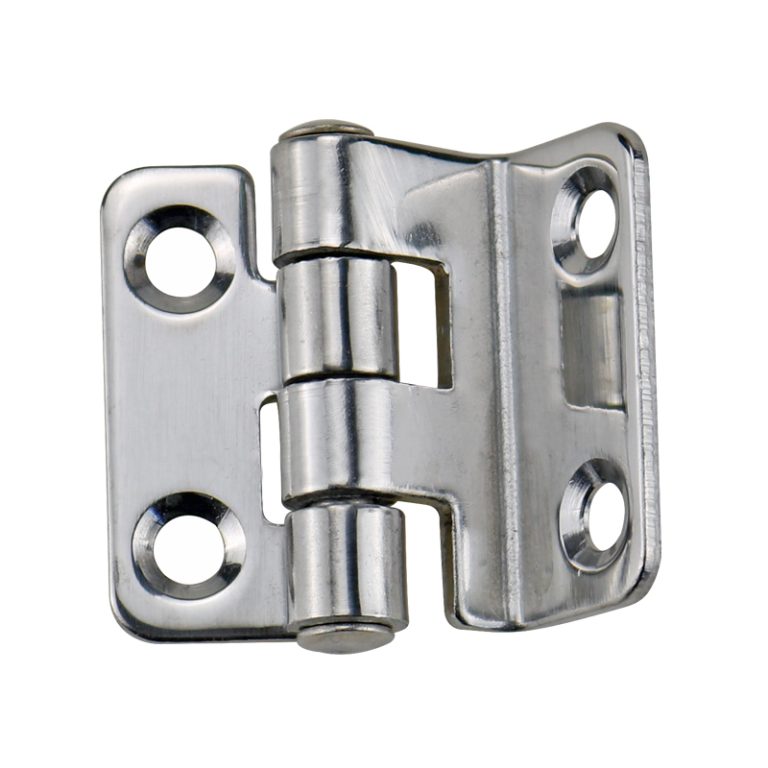
Three-Fold Hinge CL252
This three-fold hinge provides an offset geometry and uses M5 through-hole mounting. It may help when a door must clear a frame edge, overlapping panel, gasket arrangement, or recessed mounting surface.
The hidden or offset portion should be reviewed carefully. Confirm whether the closed-door geometry creates an inaccessible cavity, whether the mounting hardware remains secure, and whether the hinge can be inspected from the appropriate side of the equipment.
Pre-Production Hinge Review
A product drawing and material name are not enough to approve a food-equipment hinge. Review a representative door assembly before production.
Location and exposure
- Is the hinge product-adjacent, splash-exposed, or on an external service door?
- What liquid, residue, dust, or process material can reach it?
- Can liquid remain behind the hinge after the area is rinsed?
- Can the hinge and mounting interface be seen during inspection?
Door function
- Is the door opened during production, sanitation, inspection, or major service?
- Must the door remain attached, lift off, or be completely removed?
- Does the hinge provide enough opening clearance?
- Can one person handle the door safely?
Mounting and alignment
- Are the supporting door and frame surfaces rigid enough?
- Are fasteners accessible and retained appropriately?
- Can welds be completed and finished without leaving inaccessible gaps?
- Does the door return to the same position after removal?
- Does the latch engage without lifting or forcing the door?
Supplier documentation
- Exact hinge model and drawing
- Specified material grade and finish
- Pin, leaf, and fastener material where applicable
- Recommended mounting method
- Relevant load or cycle-test conditions when available
- Any restriction related to cleaning exposure or temperature
Information to Send With an RFQ
Providing the hinge supplier with only a door weight or a product photo often leads to additional revisions. Include the following information when possible:
| Required input | What to provide |
|---|---|
| Hinge location | Product-adjacent, splash/washdown, or external service area |
| Door drawing | Overall dimensions, thickness, bends, cutouts, and mounting surfaces |
| Door mass | Complete assembled mass, not only the sheet-metal skin |
| Opening requirement | Required angle, opening direction, and nearby interference |
| Removal requirement | Fixed, lift-off, removable pin, or tool-assisted removal |
| Cleaning exposure | Cleaning method and liquids expected to reach the hinge |
| Sealing requirement | Gasket position and required door alignment |
| Mounting preference | Bolted, screwed, welded, concealed, or offset |
| Use frequency | Expected opening frequency or project cycle requirement |
| Project restrictions | Loose-part control, exposed fasteners, available clearance, or customer-specific requirements |
FAQ
Are all stainless steel hinges suitable for food processing equipment?
No. Stainless steel grade is only one part of the decision. The hinge location, mounting gaps, fasteners, drainage, door load, cleaning exposure, and ability to inspect the complete assembly must also be reviewed.
When should a lift-off hinge be used on food equipment?
A lift-off hinge may be useful when removing the complete door materially improves access. The lifting clearance, door weight, loose-part risk, handling safety, and ability to restore alignment must be checked before selection.
Is a concealed hinge always easier to clean?
No. A concealed hinge can create a smooth external appearance, but it may also form a hidden cavity. The hidden area must be isolated from sensitive zones or remain accessible for inspection and cleaning.
What is the first question to ask when selecting a food equipment hinge?
First identify where the hinge is located and what can reach it. Then define the door function, cleaning exposure, removal requirement, mounting structure, load, opening clearance, and alignment requirement.
Can a food equipment hinge be selected from door weight alone?
No. Door width, center of gravity, hinge spacing, frame rigidity, mounting method, opening direction, gasket load, vibration, and removal method can all affect the finished assembly.
Conclusion
Selecting hinges for food processing equipment should begin with the access zone and door function, not with a generic material label. A hinge near exposed product, a hinge in a washdown area, and a hinge on an external service door face different structural risks even when all three are made from stainless steel.
Identify what can reach the hinge, whether the mounting interface can be inspected, how the door must open or be removed, and whether the assembly can maintain alignment. Then verify the exact material, finish, mounting method, and load conditions for the selected model.
HTAN can review the door drawing, hinge position, access-zone description, cleaning exposure, opening requirement, and mounting structure for a project-specific recommendation. Send your food equipment hinge requirements together with the available drawings and operating conditions.