HTAN is one of the leading manufacturers of industrial hinges, handles and latches in China.


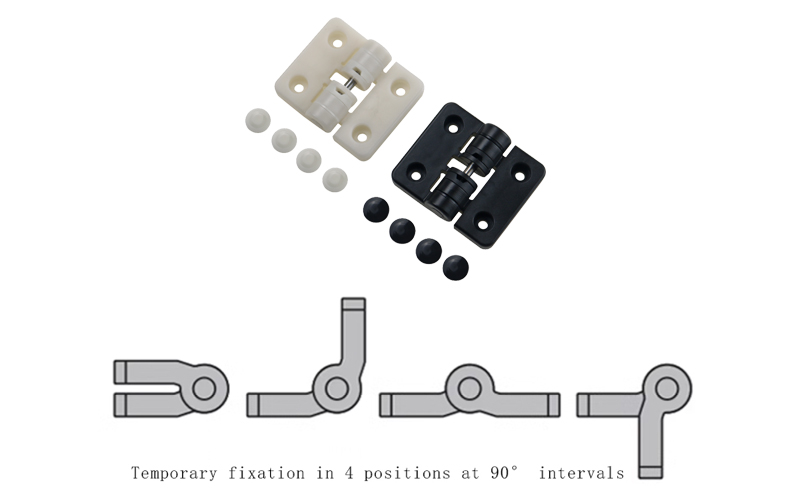
Positioning hinges are specialized mechanical components designed to control rotation angles and hold connected parts at defined positions. Unlike ordinary free-swing hinges, they provide repeatable angle control and stable stopping points, which makes them useful in industrial automation, medical devices, monitor support systems, control cabinets, and other applications where controlled movement is more important than simple opening and closing.
In practical engineering use, a positioning hinge helps maintain accuracy, improve user control, and reduce the need for separate supports or locking parts. This is especially important in equipment that must stop at a defined angle, remain stable during operation, or support repeated angle adjustment over time.
What Is a Positioning Hinge?
A positioning hinge is a hinge mechanism engineered to control rotational movement and hold a component at one or more preset or resistance-based positions. It allows two connected parts to rotate while maintaining structural stability and controlled angle behavior. In many applications, it functions as a motion-control component rather than a simple connection part.
Typical examples include display angle adjustment, equipment access panels, industrial robotic arms, cabinet doors requiring controlled stopping, and instrument supports that must remain fixed after repositioning.
Comparison with Ordinary Hinges
Positioning hinges differ from ordinary hinges in several important ways. Standard hinges usually allow free movement and rely on external stops, friction, or supports to hold a part in place. Positioning hinges, by contrast, integrate internal mechanisms that create repeatable stopping behavior or controlled angular resistance.
- Internal Mechanism: Many positioning hinges use detent, spring, ball, groove, or torque-resistance structures to create defined stopping behavior.
- Adjustability: Some designs allow engineers to customize rotational resistance or fixed-angle behavior for different applications.
- Functional Precision: They are used when angle control, repeatability, and stable positioning matter more than unrestricted rotation.
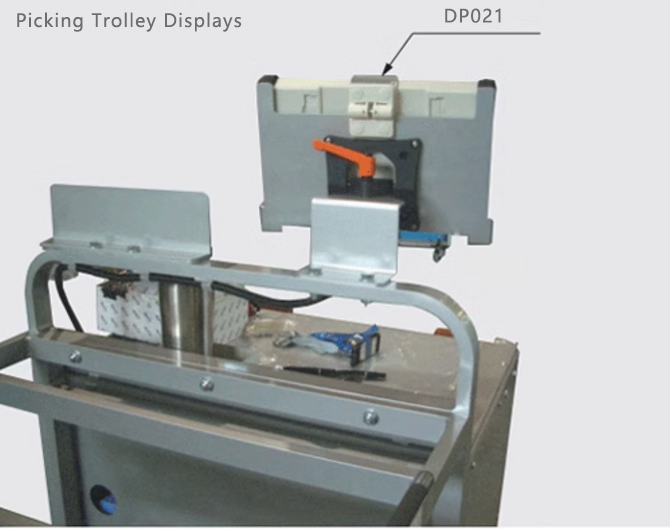
Positioning hinge application case
When a 90-Degree Positioning Hinge Is the Right Choice
A 90-degree positioning hinge is especially useful when a panel, support arm, or door must open and hold at a precise right angle instead of moving freely through a wide range. This type of hinge is commonly selected when repeatable right-angle stopping is necessary for usability, inspection, maintenance access, or equipment positioning.
- Use it when: a component must stop reliably at 90° for repeatable access or operation.
- Use it when: the application requires a compact hinge solution without separate stays or support arms.
- Use it when: right-angle positioning improves ergonomics, visibility, or servicing convenience.
This is often the case in medical support arms, folding equipment stands, compact industrial cabinets, and selected control-panel structures where a defined open position is part of the product function.
Components of a Positioning Hinge
Hinge Piece
- Typically made from stainless steel, aluminum alloy, zinc alloy, or engineered materials depending on application needs.
- Upper and lower pieces are connected by a spindle or pivot structure and include mounting points for screw fixing or embedded installation.
Positioning Tube
- An internal precision-machined element with grooves or defined contact positions.
- Works with balls, springs, or internal detent structures to create angle positioning behavior.
Steel Ball and Spring
- These parts create the snapping or holding effect in many detent-style hinges.
- The precision of the steel ball, spring force, and groove spacing affects positioning feel and angle consistency.
Spindle
- The spindle acts as the structural pivot and may be solid or hollow depending on the hinge design.
- Material options vary according to strength, weight, and environment requirements.
Auxiliary Components
- May include washers, end caps, lubrication, anti-loosening elements, and protective components.
- These parts improve service life, stability, and assembly reliability.
Working Principle
When rotational force is applied, the internal mechanism temporarily disengages from its current position, allowing movement to the next angle or through the resistance range. Once a new angle is reached, the spring-driven ball or detent element re-engages with the next groove or defined position. This creates the tactile and functional positioning effect that distinguishes these hinges from ordinary hinges.
- The spring compresses and allows the positioning element to move out of the current stop point.
- The spindle and hinge body rotate to the new angle.
- The spring force pushes the ball or detent element into the next groove or stop feature.
- The hinge then holds the new angle until further force is applied.
Depending on the design, this process can create fixed-angle steps, soft positioning, one-way control, or multi-axis movement.
Features of Positioning Hinges
High Positioning Accuracy
- Precision-machined internal structures help maintain repeatable angle stopping performance.
- This is important in optical devices, medical supports, and technical equipment where angle deviation affects usability.
Robust Structural Design
- Positioning hinges are often designed with reinforced bodies and internal parts to support repeated controlled movement.
- In industrial use, structural stability matters as much as angle precision.
Versatile Mounting Options
- Common mounting methods include surface mounting, flush mounting, and through-axis connection.
- Selection should match panel structure, access requirements, and the available installation space.
Environmental Adaptability
- Material and finish options can be chosen for different humidity, corrosion, and cleaning requirements.
- For equipment exposed to more demanding environments, designers should verify corrosion performance and lifecycle data before selection.
Selection Guide
Choosing the right positioning hinge requires matching the hinge mechanism to the real movement requirement. Engineers should define whether the application needs fixed-angle stops, directional control, multi-axis movement, cable routing, or simple right-angle holding before selecting a model.
One-Way Positioning Hinge
- Provides rotation in one primary direction with defined stopping behavior.
- Suitable for laptop screens, medical monitors, and selected equipment covers.
- For related motion-control applications, you can also review our one-way torque hinge product direction.
Multi-Axis Positioning Hinge
- Supports more complex angular adjustment in multiple directions.
- Used where movement flexibility and controlled positioning are both required.
Hollow Shaft Positioning Hinge
- Allows wires, tubing, or routing paths to pass through the hinge center.
- Useful in medical devices, precision electronics, and compact equipment design.
Customization Options
Positioning hinges can often be customized by stop angle, material, size, mounting style, and required torque or detent behavior. For example, some projects need fixed 15°, 30°, or 90° intervals, while others require a specific right-angle stop combined with compact dimensions for small equipment. This makes early parameter definition important during product development.
Application Cases
Industrial Automation
- Robotic arm end-effectors
- CNC machine guard doors
- Welding transposition or controlled rotary structures
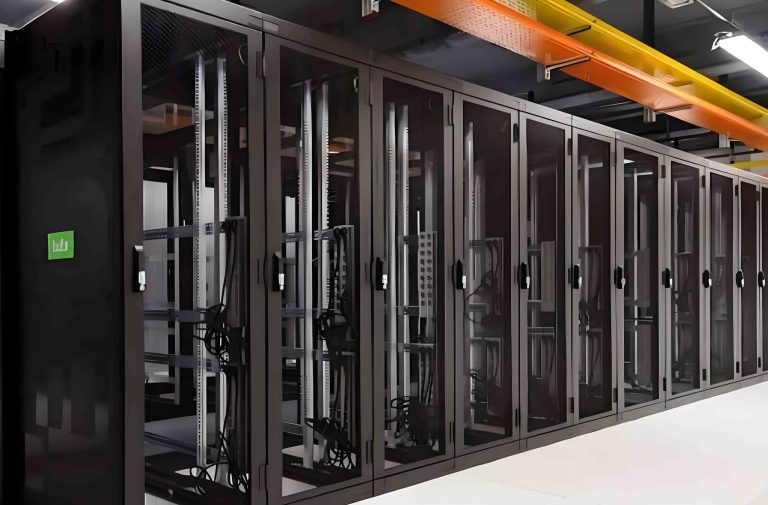
- Compact control cabinets and switchgear cabinet doors requiring defined stopping angles
Medical and Laboratory Equipment
- Microscope cantilever arms that must stop at stable working angles
- Portable X-ray machine folding stands
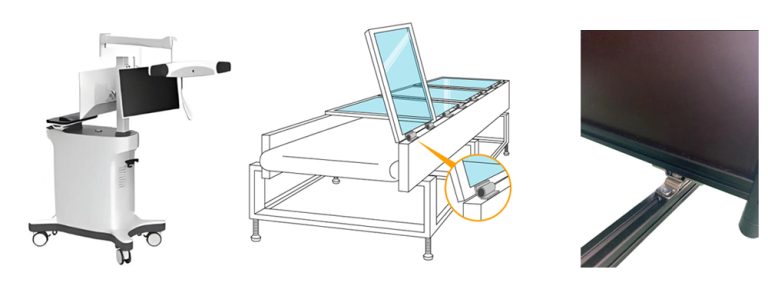
- Medical display supports and instrument arms requiring repeatable right-angle positioning
Consumer Electronics
- Tablet stands
- Smart mirror adjustment mechanisms
- Compact display and foldable device supports
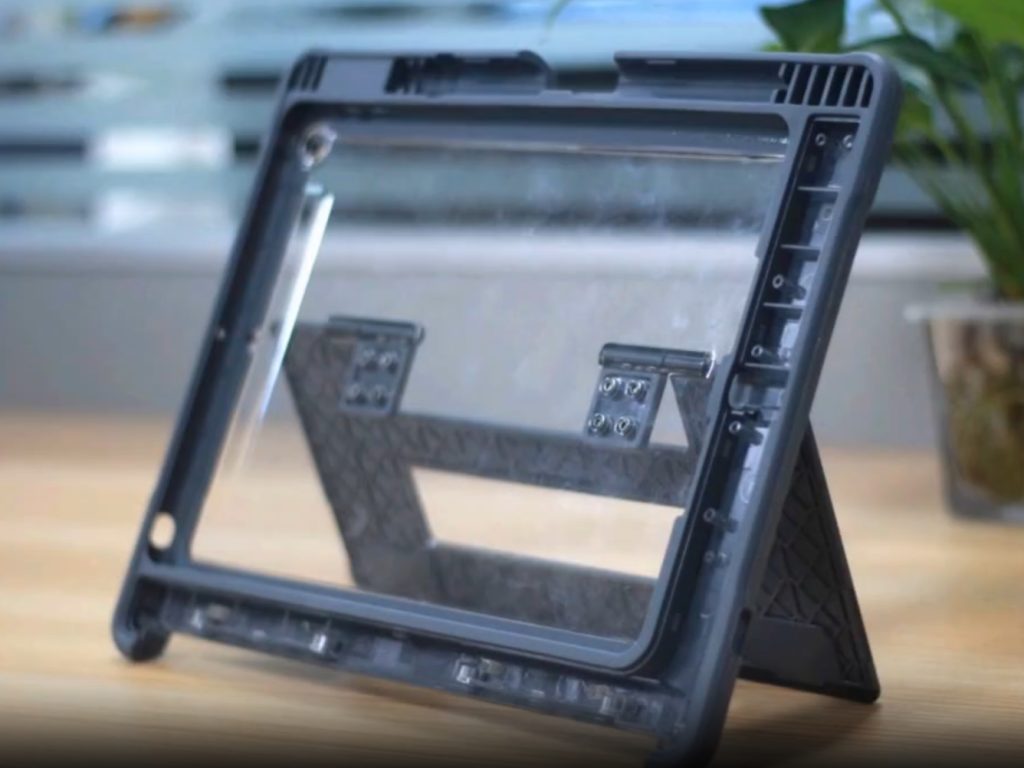
Positioning hinge in tablet stand application case
Furniture and Architecture
- Liftable desks
- Display stands
- Selected concealed or no-handle structures where controlled stopping improves use experience
Compact Equipment Integration
In many compact devices, 90-degree positioning hinges are favored because they combine controlled angle holding with relatively simple integration into space-limited assemblies. This makes them useful in smaller cabinets, portable equipment, and instrument housings where designers want repeatable opening behavior without adding separate support mechanisms.
Purchase Suggestions
Define Required Parameters
- Load weight
- Rotation angle range
- Required stop angles or torque behavior
- Environmental conditions such as temperature, humidity, and corrosion exposure
Select the Appropriate Type Based on the Scenario
- Heavy-duty industrial systems may need stronger multi-axis or reinforced positioning hinges.
- Precision electronics may benefit from hollow shaft designs for routing integration.
- High-frequency positioning applications often require stronger internal detent or torque stability.
Verify Supplier Qualifications
- Request material information, lifecycle data, and structural test evidence.
- Check supplier manufacturing capability and system reliability, especially for customized projects.
- You can review our about us page for manufacturing background and engineering support information.
Frequently Asked Questions
Q1: Can positioning hinges replace ordinary hinges?
Yes, in functional terms they can replace ordinary hinges in some applications, but that does not always make them the best choice. Positioning hinges are usually selected when angle control or hold-in-place performance is necessary. For simple free-swing doors, ordinary hinges are often more economical.
Q2: Are specialized tools needed for installation?
Basic installation usually requires only common assembly tools such as a screwdriver and wrench. For more precise commissioning, engineers may also use a torque wrench or angle gauge depending on the project requirements.
Q3: What should I do if positioning becomes inaccurate?
Start by checking for contamination, spring fatigue, internal wear, or incorrect preload. In many cases, cleaning, adjustment, or replacement of the worn positioning element can restore performance. If the hinge is part of a critical device, it is better to verify the cause before continued use.
Q4: How often should positioning hinges be maintained?
Maintenance interval depends on cycle frequency, environment, and load. As a practical baseline, periodic inspection every six months and lubricant review once a year can help extend service life in many industrial and equipment applications.
Q5: Where are 90-degree positioning hinges most commonly used?
They are commonly used in medical support arms, compact equipment stands, control cabinets, instrument housings, and other applications where a stable right-angle stop improves operation, maintenance access, or user control.
Conclusion
Positioning hinges are important motion-control components in precision equipment, industrial systems, and compact mechanical assemblies. Their value lies in their ability to provide controlled angular movement, stable stopping behavior, and repeatable positioning in applications where ordinary hinges cannot deliver the same functional result.
For the best result, engineers should begin with the real application requirements: required angle, load, environment, installation structure, and whether the hinge must hold at 90 degrees or support more complex controlled movement. With the right model and periodic maintenance, positioning hinges can improve usability, reliability, and long-term equipment performance.
For customized solutions or engineering support, please contact our engineering team.