HTAN is one of the leading manufacturers of industrial hinges, handles and latches in China.


A folding handle can fit the drawing and still fail on the equipment.
That usually happens because the selection started with material and appearance instead of the handle’s actual job. Pulling a cabinet door, lifting a removable panel, and carrying a complete equipment case are three different load cases. They place different demands on the grip, pivot, mounting base, fasteners, panel, and operator.
This industrial stainless steel folding handle selection guide follows one task: determine whether a specific handle model, mounting interface, and operating envelope are suitable for the real application before sample approval.
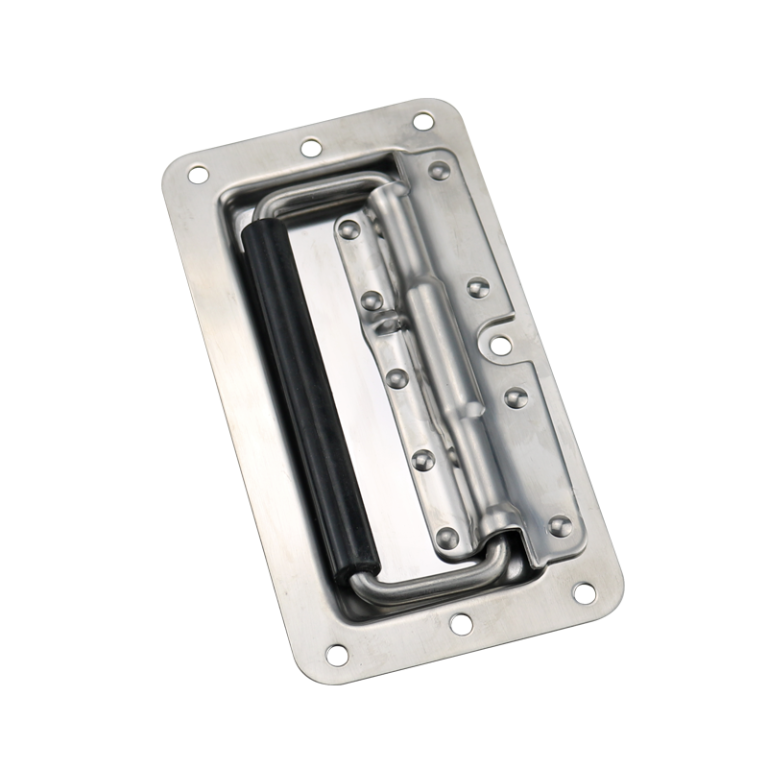
this page covers function, load direction, mounting geometry, folded clearance, glove access, return behavior, material exposure, and representative sample checks. Use the linked specialist pages for a full material comparison, detailed heavy-duty mounting design, toolbox-specific requirements, or the folding-versus-fixed architecture decision.
Start With the Handle’s Job
A catalog image rarely tells you whether a handle is intended to pull, lift, or carry. The distinction matters because the same stainless steel body can be acceptable in one role and unsafe in another.
| Handle Function | Primary Inputs | Failure Risk if Misclassified |
|---|---|---|
| Pull a door or drawer | Opening force, gasket compression, latch release, pull direction, operating frequency, glove use | The handle may feel uncomfortable, loosen, or overload a thin panel even though it never carries the door weight. |
| Lift a removable panel or cover | Panel mass, center of gravity, lifting angle, number and position of handles, panel stiffness | The panel may rotate unexpectedly, one handle may take most of the load, or the mounting area may deform. |
| Carry complete equipment | Loaded equipment mass, center of gravity, single- or two-person handling, acceleration, impact, transport orientation | A static pull rating may be mistaken for a carrying rating, leaving the pivot, fasteners, or enclosure wall as the weak link. |
| Temporary control or positioning grip | Side load, push-pull direction, alignment force, operator posture | The handle may be loaded sideways even though the supplier tested only a straight pull. |
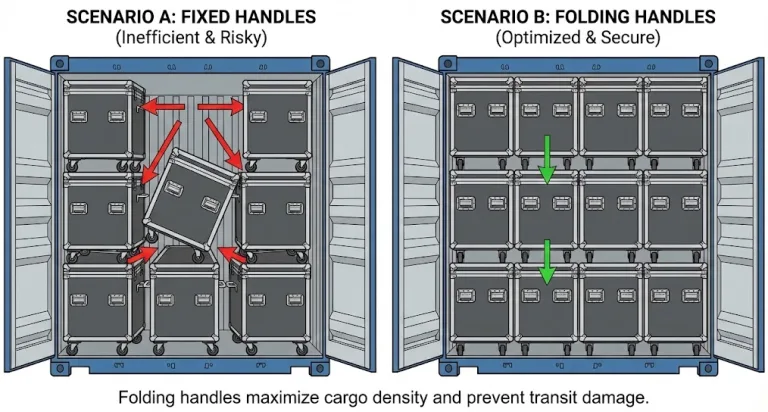
A folding profile is valuable when protrusion must be reduced after use. It is not automatically better than a fixed handle. Where the unresolved decision is the handle architecture itself, use the folding-versus-fixed handle comparison and return to this page after the folding family has been selected.
Load Direction and Load Sharing
A supplier’s “rated load” is usable only when the test direction, fixture, number of mounting points, and acceptance limit are known. A straight pull on a rigid test plate does not automatically represent lifting a wide cover, carrying a case over uneven ground, or pulling at an angle while wearing gloves.
Use model-specific data: A catalog load, return force, opening angle, or cycle-life value is meaningful only when it belongs to the selected handle model and matches the actual loading direction and mounting arrangement. Confirm the test fixture, panel, fasteners, acceptance limit, cycle conditions, and document revision before using the value for release.
Two handles also do not guarantee equal load sharing. A shifted center of gravity, flexible enclosure, uneven hand height, or one operator lifting first can place most of the load on one side. The drawing may be symmetrical. The loading may not be.
Two Handles, One Uneven Load
Consider a portable enclosure with one folding handle on each side. Its total mass appears low enough when divided by two. During actual lifting, the battery and transformer shift the center of gravity toward the left handle. The left panel also flexes more than the right, so that handle engages first and takes a larger share of the load. Both handles match the drawing, yet the left mounting holes begin to elongate.
The correction is not a larger safety factor applied to the catalog number. The team must locate the loaded center of gravity, define the lifting sequence, review panel stiffness, and test the complete enclosure with production mounting hardware.
This is an illustrative engineering scenario, not a customer project record or product test claim.
| Supplier Data | Clarification Required | Release Evidence |
|---|---|---|
| Rated load | Pull, lift, carry, side load, or proof load? What direction and fixture were used? | Model-specific test description or report |
| Capacity for two handles | Was equal sharing assumed? Was the complete enclosure tested? | Assembly test with the actual center of gravity |
| Cycle rating | What load, opening angle, speed, and acceptance limit applied? | Cycle-test conditions and post-test inspection |
| Permanent deformation limit | Which dimension or function was checked after loading? | Before-and-after measurements and functional check |
| Fastener recommendation | Which panel material, thickness, washer, nut, or backing plate was used? | Mounting drawing and tested interface |
Mounting Geometry and Panel Support
Mounting-center distance is model-specific. So are the hole diameter, stud thread, flange footprint, cutout, edge distance, and rear-access requirement. There is no universal 32, 40, or 50 mm center that can be applied to all industrial folding handles.
The handle drawing must be checked against the panel drawing, not copied into an isolated hole pattern. The mounting area has to transfer load from the handle base into the panel, frame, rib, or backing plate without local bending or pull-through.
- Center-to-center dimension: use the selected model drawing and its revision.
- Hole and thread definition: distinguish clearance holes, threaded inserts, welded studs, handle-mounted studs, and through-bolts.
- Base footprint: confirm that the full flange sits on a flat surface and does not bridge a bend, bead, embossment, or gasket.
- Panel thickness and material: thin steel, aluminum, plastic, and composite panels fail differently.
- Rear reinforcement: check washer size, backing plate area, rib location, and access for assembly tools.
- Edge distance: leave enough material around every opening to avoid tearing or distortion.
- Service access: confirm that nuts, washers, and replacement parts remain reachable after the enclosure is assembled.
This page stops at the mounting inputs needed to select a handle. Detailed backing-plate design, fastener load transfer, and thin-panel reinforcement belong to the heavy-duty folding handle mounting guide.
Drawing release check: confirm the handle model, mounting-center dimension, hole or stud specification, panel material, panel thickness, edge distance, reinforcement, and rear access on the same assembly drawing.
Folded and Operating Envelope
A folding handle saves space only when both positions are reviewed. The folded position controls projection, stacking, aisle clearance, and snag risk. The open position controls finger entry, wrist angle, pivot sweep, and interference with doors, cables, latches, labels, and neighboring hardware.
The relevant dimensions are more than the mounting centers. At minimum, the drawing should show folded projection, open height, grip opening, handle width, pivot location, operating angle, and the swept path between the two positions.
Check the envelope in the complete equipment model. A handle can clear the panel by itself and still hit an open door, interfere with a latch, cover a label, block a drawer, or prevent cases from stacking. Releasing the handle adds another question: does it return gently, or strike the panel?
Grip Clearance With Real Gloves
Catalog grip dimensions do not represent every operator. A bare hand, winter glove, welding glove, and chemical-resistant glove need different entry space and produce different control at the pivot.
Do not release the design from a generic hand-clearance value alone. Fit the sample to the real panel, then test the actual glove used at the workstation.
NIOSH guidance for manual material handling supports reducing physical demands through task-specific ergonomic evaluation. It does not provide one universal folding-handle clearance, which is why the real glove, grip, posture, operating force, and panel geometry still need sample validation.
- Can the operator get fingers behind the grip without scraping the panel?
- Is there room for the knuckles through the full pull or lifting motion?
- Does the handle pinch the glove near the pivot or mounting base?
- Can the operator open the handle with one hand?
- Does the grip remain controllable when wet, oily, cold, or contaminated?
- Are the bar diameter, edge radius, and surface condition comfortable under the real force?
- Can the operator release the handle without the grip snapping onto the fingers or panel?
The correct answer may be a larger grip, more open clearance, a different pivot position, or another handle family. Finish alone does not solve poor hand geometry.
Return Action, Rattle, and Pinch Risk
Folding handles do not all move the same way. The mechanism affects whether the grip stays open, returns automatically, rattles under vibration, traps contamination, or creates a pinch point.
| Mechanism | Behavior to Confirm | Application Risk |
|---|---|---|
| Free-swing | The grip moves freely between positions with little retention. | May rattle, fall open under orientation changes, or strike the panel. |
| Spring-return | The grip returns toward the folded position after release. | Return force can create pinch or impact risk; the spring material and retained force need evidence. |
| Detent | The grip holds at one or more defined positions. | Release force may be too high with gloves or may decrease after cycling. |
| Friction or damped action | Motion is resisted or slowed through the travel. | Contamination, temperature, lubricant, and wear can change the feel. |
| Latched folding handle | A separate latch retains the grip or integrates another function. | More parts add clearance, service, and verification requirements. |
Do not assume that a “hydraulic” description means longer life or smoother operation without model-specific evidence. Ask what creates the resistance, how the mechanism is sealed, what temperature range applies, and what changed after cycling.
Stainless Grade and Surface Exposure
Stainless steel is selected after the mechanical function is defined. Grade 304 can be a reasonable starting point for many controlled indoor environments. Chlorides, coastal exposure, road salt, aggressive cleaning chemicals, wet crevices, or retained deposits may justify reviewing 316 or another material system.
The visible grip is only part of the assembly. The pivot pin, spring, rivets, washers, studs, nuts, and backing hardware may use different materials. One carbon-steel spring or plated washer can become the first corrosion point even when the handle body is stainless.
Brushed, polished, and blasted finishes change appearance, roughness, cleanability, and grip feel. They do not convert one stainless grade into another. When material selection between stainless steel, aluminum, and reinforced plastic is the main task, use the folding handle materials comparison.
Environmental boundary: define the actual chemical, concentration, temperature, contact time, rinsing, condensation, chloride exposure, and water traps. “Stainless” is not an environmental acceptance criterion by itself.
Sample Inspection on the Actual Panel
A loose handle sample proves very little. Install the candidate model on a representative panel using the production fasteners, reinforcement, finish, and access conditions. Then operate it the way the equipment will actually be used.
- Measure the folded projection and open envelope against the current drawing revision.
- Check that the grip opens fully without contacting the panel, latch, cable, door, or neighboring hardware.
- Use the actual gloves and repeat the real pull, lift, or carrying motion.
- Inspect for pinch points at the pivot, base, and return path.
- Apply the defined load direction to the complete mounting interface.
- Watch for panel oil-canning, hole elongation, washer pull-through, base rotation, or fastener movement.
- Check free play, binding, rattle, return action, and detent behavior before and after loading.
- Inspect edges, burrs, welds, rivets, surface contamination, and trapped-water locations.
- Confirm that the sample materials match the proposed production bill of materials.
- Record the acceptance criteria before testing; do not invent them after a failure appears.
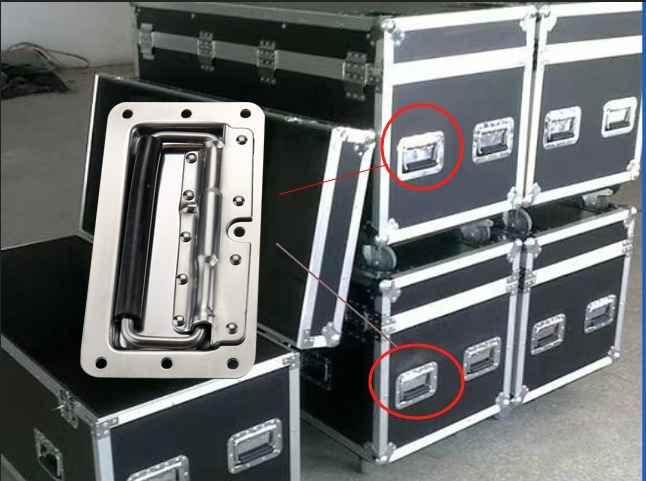
Transport cases add a specific carrying and stacking problem. Keep that application on the dedicated folding handles for toolboxes and cases page rather than expanding it into a second guide here.
Folding Handle Release Checklist
Release the handle only when the application definition, supplier data, drawing geometry, and representative sample describe the same installation.
| Review Item | Project Question | Required Action |
|---|---|---|
| Function | Is the handle pulling a door, lifting a panel, carrying equipment, or positioning a part? | Write one primary load case on the specification. |
| Load direction | Does the supplier rating match the real direction and fixture? | Request the model-specific test condition. |
| Mass and center of gravity | Can one handle take more than the nominal equal share? | Locate the loaded center of gravity and define the handling sequence. |
| Mounting centers | Does the selected model drawing match the panel holes or cutout? | Release one drawing revision for handle and panel. |
| Panel support | Can the panel, fasteners, washers, and backing structure carry the load? | Inspect the full load path and add reinforcement where required. |
| Folded envelope | Does the handle clear stacking, aisles, doors, labels, latches, and cables? | Check the folded projection in the complete assembly model. |
| Operating envelope | Is there room for pivot sweep, finger entry, and wrist movement? | Use the actual panel and glove in the sample review. |
| Return mechanism | Must the handle stay open, return, detent, or move with damping? | Define the required behavior and inspect it after cycling. |
| Material system | Are body, pin, spring, rivets, studs, and fasteners suitable for the exposure? | Request a component-level material list. |
| Representative sample | Does it use production materials, hardware, reinforcement, and finish? | Approve the complete installation, not a loose handle. |
Request a Folding Handle Model Review
Send the application function, loaded mass or opening force, center of gravity, mounting orientation, panel material and thickness, hole pattern or cutout, available folded envelope, glove requirement, environment, and expected return action. HTAN can use those inputs to identify relevant models and confirm which drawing and sample information still require project approval.
FAQ
Can I choose a folding handle from the door or equipment weight alone?
No. Weight is only one input. The handle function, load direction, center of gravity, number and position of handles, dynamic handling, mounting panel, fasteners, reinforcement, and supplier test fixture all affect the selection.
Do two folding handles always share the load equally?
No. A shifted center of gravity, flexible enclosure, uneven lifting sequence, or different mounting stiffness can make one handle carry more load. Review the complete assembly and test the real handling condition.
Is there a standard mounting-center distance for industrial folding handles?
There is no universal mounting center that applies to every model. Use the selected handle drawing for center distance, hole diameter or stud thread, flange size, cutout, panel thickness, and rear-access requirements.
How much grip clearance is needed for gloved operation?
The required clearance depends on the actual glove, hand approach, grip diameter, panel geometry, operating force, and pivot path. Test the production-intent sample with the glove used at the workstation instead of relying on one universal dimension.
Does a stainless steel body make the complete folding handle corrosion resistant?
Not by itself. The pivot pin, spring, rivets, washers, studs, nuts, surface condition, crevices, and cleaning exposure also matter. Request component-level material information and review the actual environment.
Does a folding handle determine the enclosure IP rating?
No. The complete enclosure determines the rating. Review the handle cutout, fastener penetrations, gaskets, drainage, panel deformation, and installation method with the enclosure test plan.
A reliable industrial stainless steel folding handle selection links one real function to one load direction, one mounting drawing, one operating envelope, and one representative assembly. A material name or catalog load value cannot replace that connection.