HTAN is one of the leading manufacturers of industrial hinges, handles and latches in China.


A hinge can be labeled “316 stainless steel” and still be wrong for the door. The leaves may resist the environment while an unspecified pin corrodes, an incompatible fastener stains the mounting zone, or a thin panel lets the hinge axes move out of line. Material grade matters. It is only one part of the selection.
Industrial stainless steel hinges should be selected as a complete pivot and mounting system. Start with the actual exposure, then choose the hinge structure, load path, mating hardware, surface condition, and evidence required for the project. That sequence prevents a common procurement shortcut: treating “stainless” as if it automatically defines corrosion resistance, load capacity, cleanability, and service life.
Selection rule: use the environment to select the material system, and use the door task to select the hinge structure. Neither decision can replace the other.
Start With Exposure, Not the Grade
“Indoor,” “outdoor,” and “washdown” are not complete environments. An indoor machine can be exposed to coolant mist or chlorine-bearing cleaner. An outdoor enclosure may stay relatively dry under a shelter or hold moisture around an unsealed mounting hole. A food-processing door can see several cleaners at different concentrations and temperatures during one sanitation sequence.
The first useful input is an exposure description tied to the hinge location. Record direct wetting, condensation, airborne salt, cleaning agents, contact time, temperature, rinse practice, drying opportunity, abrasive debris, and whether the pivot is accessible for inspection. Also identify the adjoining materials. Stainless steel mounted directly to aluminum, carbon steel, or a plated fastener can create a different corrosion problem than a stainless assembly mounted to stainless sheet.
The exposure at the hinge pin may differ from the exposure on the visible leaf. Water can enter a knuckle and remain there after the outside surface dries. Cleaner can collect behind a hinge leaf. A polished face may look clean while the pin, washer, or mounting interface deteriorates out of sight.
Before selecting a grade: record the cleaning chemistry, temperature, mating metals, drainage condition, and materials of the pin and mounting hardware. Without those inputs, 304 or 316 is only a preliminary direction.
Material Grade Is One Specification Line
304 and 316 are the most common starting points for industrial stainless steel hinges, but a grade name does not define the whole hinge. The selection still depends on the exposure and on which components actually use that alloy.
| Grade route | Useful starting position | Boundary that remains | Next action |
|---|---|---|---|
| 304 | General industrial equipment, protected outdoor locations, and moderate moisture where aggressive chlorides or cleaning chemicals are not expected | Can still pit, stain, or corrode at crevices when deposits, chlorides, heat, or incompatible hardware are present | Document the actual exposure and specify the pin and fastener materials |
| 316 | Locations with a meaningful chloride, coastal, marine, chemical, or demanding cleaning exposure | Not corrosion-proof; stagnant deposits, crevices, temperature, cleaner concentration, and fabrication quality still matter | Review the complete assembly and the cleaning or environmental condition |
| 316L | Projects where welding and heat-affected corrosion behavior make the lower-carbon variant relevant | The “L” designation does not automatically improve every non-welded hinge or define surface condition | Confirm the welding route, post-weld cleaning, and required material documentation |
| Other stainless grades | High-temperature, extreme chemical, wear-critical, or other specialized duties that exceed the normal 304/316 decision | A higher alloy name can introduce availability, forming, welding, cost, or galling tradeoffs | Use a project-specific material review rather than substituting a grade from a generic table |
The material designation also needs a traceable product form. Sheet used for a stamped leaf, bar used for a pin, and a purchased washer may arrive under different records. A certificate covering the leaves should not be presented as evidence for every component. If positive material identification is required, define which finished components or lots are checked and how the result is recorded. A magnet response can be a useful screening observation in limited circumstances, but forming and cold work affect response; it is not a substitute for controlled material evidence.
For exposed cabinets and coastal projects, compare salt deposition, wetting, drying, crevices, and mating hardware in the outdoor 304 vs. 316 hinge selection guide.
Food, pharmaceutical, and repeated sanitation duties require a separate review of cleaner chemistry, concentration, temperature, contact time, rinsing, and drainage. Those inputs are covered in the 316 stainless steel hinges for washdown guide.
The Leaf Can Be 316 While the Hinge Fails
A purchase description that says only “316 stainless hinge” leaves several questions open. Is the pin also 316? Are the washers, bushings, spring parts, retainers, and fasteners compatible with the exposure? Was the hinge welded after the material certificate was issued? Were carbon-steel tools or blasting media used on the finished surface?
The hidden components can control the first failure. A plated carbon-steel pin may rust inside a stainless knuckle. A carbon-steel screw can create red staining around a 316 leaf. An unsuitable thrust washer can wear, hold moisture, or change opening force. Even when every major part is stainless, similar alloys under load can gall if the running clearance, finish, or lubrication condition is wrong.
| Assembly item | What the specification should identify | What can go wrong if omitted | Action before release |
|---|---|---|---|
| Leaves and knuckles | Grade, product form, thickness, fabrication route, and finish | The visible part meets the grade callout but has contamination, heat tint, thin sections, or crevices that control performance | Match the drawing and material evidence to the supplied part |
| Pin or pivot | Material, diameter, finish, hardness where relevant, retention, and lubrication condition | Hidden corrosion, scoring, galling, pin walk, or increasing opening force | List the pin separately instead of assuming it matches the leaves |
| Bushing, washer, or bearing | Material, running pair, thrust function, temperature, and maintenance condition | Swelling, wear debris, lubricant loss, seizure, or unintended axial rubbing | Review the mating pair and the installed clearance |
| Fasteners and retainers | Material, coating if any, locking method, and contact with the mounting substrate | Rust transfer, galvanic attack, loosening, or trapped moisture at the hole | Specify compatible hardware and the isolation or sealing detail |
| Door and frame interface | Substrate material, finish, gasket, sealant, drainage, and reinforcement | A good hinge is attached to a weak, wet, or electrochemically incompatible mounting zone | Review the interface as part of the enclosure assembly |
The Correct Grade, the Wrong Component List
Consider an equipment door specified with 316 leaves for a wet location. The sample looks acceptable and the certificate covers the sheet material. The pin material is absent from the drawing, the mounting screws are sourced separately, and the hinge is installed against coated carbon steel with a water-holding gap. Early rust appears around the pivot and fasteners. Replacing the leaf with another 316 leaf does not resolve the incomplete material system.
The corrective action is to define the pin, fasteners, isolation, drainage, and acceptance evidence—not to repeat the leaf grade more loudly. This is an illustrative engineering scenario, not a customer project record or product test claim.
Structure Follows the Door Task
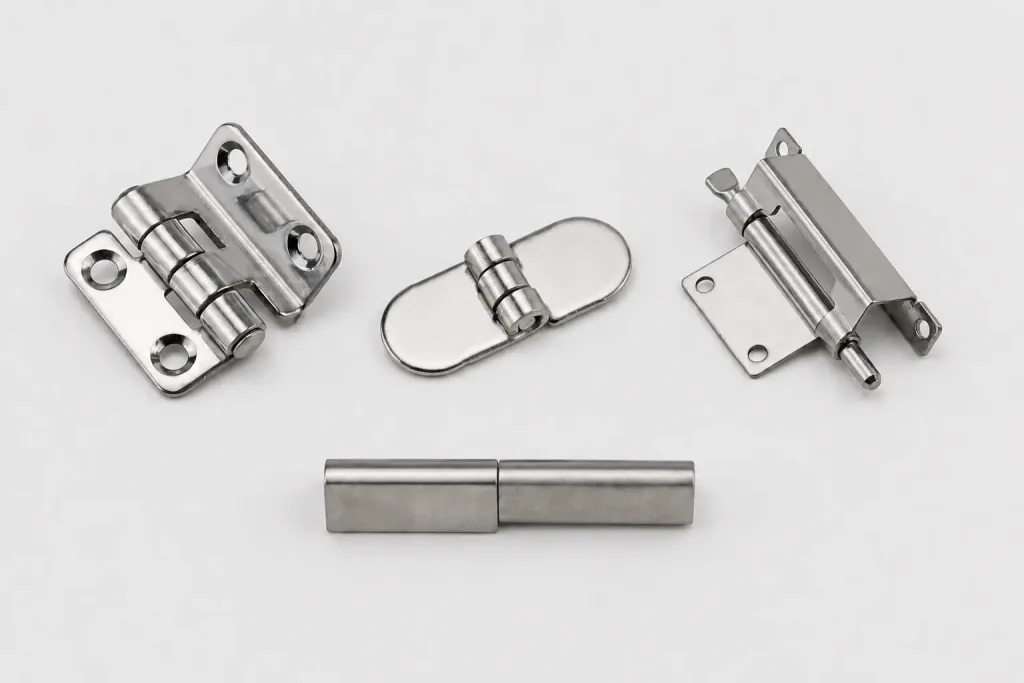
The alloy does not tell the door how to move. Stainless steel can be formed into several hinge structures, and each structure changes the mounting load, access envelope, sealing behavior, removability, and adjustment options.
Surface-Mounted and Screw-On Hinges
These are practical when the hinge must be replaceable and the panel provides enough area for the fastener pattern. The design review should include hole location, edge distance, fastener access, local panel reinforcement, and the possibility of water entering behind the leaf or through the holes.
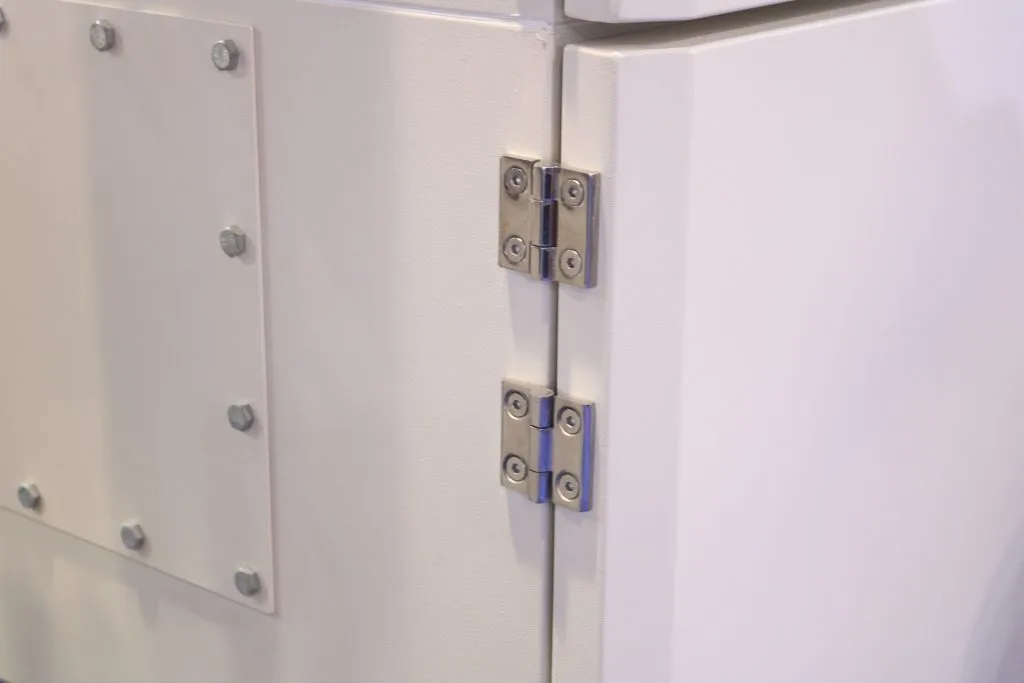
Two surface-mounted hinges installed on an equipment enclosure. Material grade, load capacity and mounting strength must be confirmed from the product drawing and enclosure design.
Weld-On Structures
A weld-on hinge removes exposed mounting screws and can create a rigid connection, but welding introduces distortion, heat tint, surface restoration requirements, and a permanent relationship between the hinge axes and the fabricated frame. The supplier and fabricator need a common datum strategy. A stainless grade callout alone cannot protect the door from weld pull or loss of alignment.
Concealed, Removable, and Adjustable Options
A concealed hinge protects the exterior profile and can support security or styling requirements, but its internal envelope may conflict with equipment, gasket space, or the door return. A removable hinge supports service access only when the removal direction, lifting clearance, handing, and door-handling method are workable. Adjustable designs can recover limited installation variation; they do not correct a flexible frame or an unsupported hinge line.
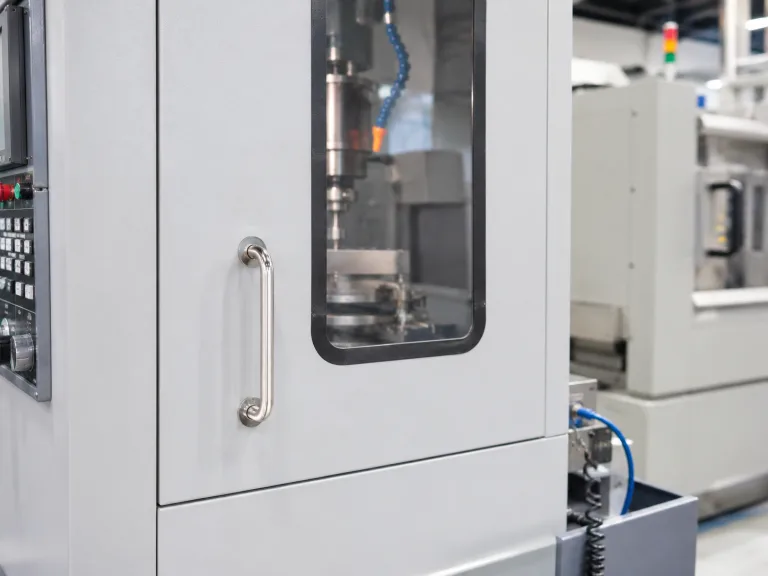
For a machine access door, continue with the stainless steel hinges for machinery guide to evaluate load distribution, cycle duty, substrate stiffness, alignment, and mounting validation.
Load and Alignment Define the Structure
Changing from 304 to 316 does not establish a hinge load rating. Capacity comes from the complete geometry and the test conditions behind the rating: leaf and knuckle dimensions, pin support, hinge quantity and spacing, fastener pattern, mounting substrate, door width, center-of-gravity offset, opening stops, and external handling loads.
A wide door can impose a larger moment on the hinge line than a narrow door of the same mass. Two hinges that are individually adequate can bind when their pin centerlines are not collinear. A thick stainless leaf can still pull a thin enclosure panel into a local dish. The drawing may fit. The panel can still sag.
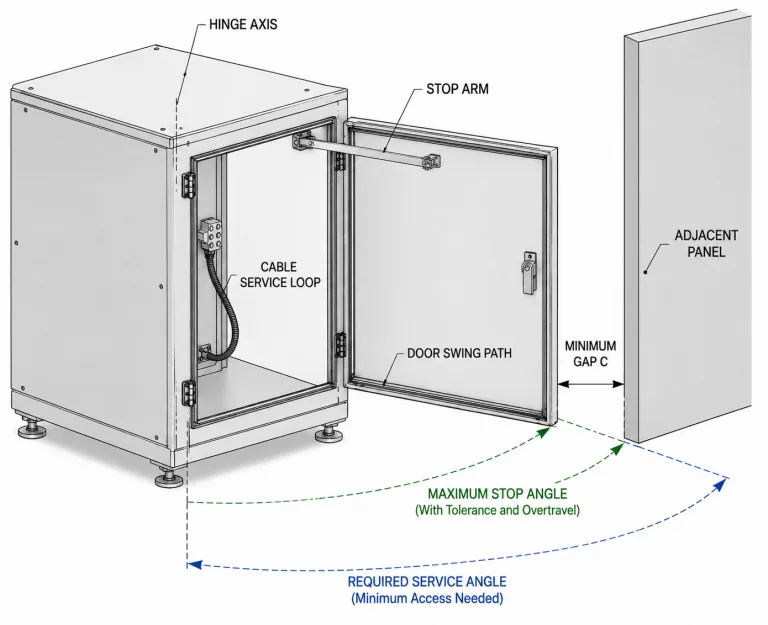
Also record opening angle, cycle pattern, stop contact, removal direction, and any hold-open or self-closing behavior. Where the pivot includes a bushing, bearing, spring, damper, or friction element, review its material, clearance, lubrication, wear behavior, contamination exposure, and temperature limit separately from the stainless housing.
Do not transfer a rating without its setup. A supplier rating is meaningful only with the hinge quantity, door dimensions, mounting structure, load direction, cycle condition, and acceptance method used to establish it.
Mounting Changes the Corrosion Path
The hinge leaf is only one surface in the wet assembly. The joint behind it can retain liquid, a mounting hole can expose base metal, and a dissimilar metallic washer can contribute to galvanic corrosion when electrical contact and an electrolyte are both present. These locations may remain wet after the visible face has dried.
- Screw-on installation: define fastener material, hole sealing, washer or isolation layer, thread engagement, and drainage from behind the leaf.
- Welded installation: control the mounting datum, fixture position, weld sequence, distortion, heat tint removal, cleaning, and final finish.
- Dissimilar substrates: review electrical contact, electrolyte exposure, coating damage, fastener area, and whether an insulating barrier is mechanically suitable.
- Water traps and contamination: remove upward-facing gaps where possible and prevent carbon-steel dust, brushes, tooling, or blasting media from contaminating the stainless surface.
Sealing also affects mechanics. A gasket or sealant layer changes stack height and local stiffness. If it compresses unevenly, the hinge axis can shift or the leaf can bend as the fasteners are tightened. The mounting detail therefore needs both a corrosion review and an alignment review.
Welded Stainless Needs Surface Restoration
Heat tint shows that the surface near a weld has changed and can reduce local corrosion performance. Define the permitted weld condition, cleaning method, heat-tint removal, final finish, and inspection. Restoration must reach the back side, root area, and tight junctions—not only the visible face. If the completed joint creates an inaccessible, water-holding crevice, revise the geometry rather than relying on cleaning instructions alone.
Surface Finish Is Functional, Not Decorative
Finish affects appearance, cleanability, friction at some interfaces, contamination risk, and how easily damage can be inspected. The purchase description should use the actual process or measurable outcome. “Satin,” “smooth,” and “food grade” are not controlled engineering definitions by themselves.
| Surface condition | What it can change | What it does not prove | Useful specification field |
|---|---|---|---|
| 2B mill finish | Provides a relatively smooth cold-rolled sheet surface before hinge fabrication | It is not the same as a directional brushed finish and does not describe post-fabrication damage | Identify whether 2B is the supplied sheet condition or the final visible finish |
| Brushed or mechanically polished | Controls visible grain direction, appearance, and potentially surface roughness | A commercial finish name alone does not define roughness, embedded contamination, or corrosion acceptance | Specify direction, appearance limit, and roughness only when the project needs them |
| Bead-blasted | Produces a uniform matte appearance and can reduce directional visual marks | It does not guarantee clean blasting media or freedom from embedded iron | Define media control, cleaning, and accepted appearance |
| Electropolished | Can smooth microscopic peaks and support cleanability or corrosion performance for suitable parts | It does not correct deep scratches, poor weld geometry, trapped liquid, or the wrong alloy | State the required process and any measurable surface acceptance |
| Passivated | Supports removal of free iron and development of a clean passive surface after appropriate preparation | It is not a coating, does not reshape the surface, and does not make every fabrication defect acceptable | Specify the process, preparation, and required evidence when passivation is necessary |
Finish should also be reviewed after forming, drilling, welding, pin installation, and final assembly. A certificate for the starting sheet does not document what happened to the surface during those operations. Visible faces, concealed crevices, cut edges, weld areas, and running surfaces may need different acceptance checks.
Use corrosion evidence for the question it can answer. A material certificate covers reported material information for the identified heat or lot; it does not prove the service life of the assembled hinge. ASTM B117 defines salt-spray apparatus and operating conditions but does not prescribe the specimen, exposure period, acceptance limit, or outdoor-life conversion for a specific hinge.
If rust, tea staining, pitting, crevice attack, or mixed-metal corrosion is already visible, continue with the corrosion-resistant hinge design guide before changing the grade.
Route the Application Before Selecting a Model
The final route starts with the dominant exposure and door task. The table below is a screening tool, not a product approval. It tells the engineer or buyer which details must be resolved before a model is shortlisted.
| Application condition | Preliminary material route | Structure question | Next decision |
|---|---|---|---|
| Dry indoor equipment with limited corrosive exposure | 304 is a common starting point; coated steel may also remain viable where stainless is not otherwise required | Does the hinge need removability, concealment, adjustment, or bearing support? | Obtain the door geometry, duty, and mounting substrate |
| Humid plant, condensation, or sheltered outdoor enclosure | Review 304 against the actual wetting, deposits, drying, and hardware compatibility | Can the mounting interface drain and remain inspectable? | Define the full component materials and sealing detail |
| Coastal, salt-bearing, or marine atmosphere | 316 is a common preliminary route, subject to the exact exposure and assembly design | Are crevices, deposits, and dissimilar-metal interfaces controlled? | Complete the outdoor/environment-specific material review |
| Repeated washdown or hygiene-sensitive equipment | 316 or another project-reviewed route may be required; cleaner chemistry and temperature govern the decision | Can every exposed area be cleaned, rinsed, drained, and inspected? | Document the cleaning schedule and review the installed assembly |
| Chemical processing or unusual temperature | Do not select from a generic 304/316 table alone | Which component, lubricant, seal, or joint is the limiting material? | Obtain chemical compatibility and temperature evidence |
| Heavy, wide, high-cycle, or vibration-loaded door | Select the environment route first; grade still does not define capacity | What load and motion evidence supports the hinge geometry and mounting? | Perform a machine-door or application-specific mechanical review |
A project can occupy more than one row. A coastal machine enclosure, for example, combines chloride exposure with load, vibration, sealing, and service-access requirements. Select the material route and the structural route separately, then test them together on the representative assembly.
Build a Purchase-Ready Hinge Specification
A useful specification lets a supplier compare the project against a real product and identify what remains open. “Stainless hinge for outdoor cabinet” does not provide enough information. The following fields keep the request centered on this material and structure decision.
- Door or panel function and equipment type
- Door mass, width, height, thickness, and center-of-gravity location
- Hinge quantity, spacing, orientation, and available envelope
- Required opening angle, removal direction, and access clearance
- Cycle pattern, speed, dwell, stop contact, and external handling loads
- Direct wetting, condensation, salt, chemicals, cleaner concentration, and temperature
- Proposed grade for the leaves, pin, bushing or washer, retainer, and fasteners
- Surface finish, appearance direction, passivation, or measurable roughness where needed
- Screw-on, weld-on, concealed, removable, or adjustable mounting requirement
- Door and frame substrate materials, coatings, reinforcement, and isolation detail
- Lubrication condition, cleanliness requirement, and maintenance accessibility
- Drawing, CAD envelope, material evidence, test evidence, and acceptance limits required
Compare the Same Assembly
Two quotations are not technically comparable when one covers 316 leaves and a specified stainless pin while the other covers only 316 leaves with unspecified internal parts. Normalize the comparison by component material, finish, mounting hardware, documentation, sample configuration, and the test basis behind any rating. Also record adapter plates, sealing, separate fasteners, or welding restoration that moves cost into the enclosure and assembly process.
The supplier response should identify the proposed model or custom concept, drawing revision, material by critical component, finish, mounting method, and the basis of any load or environmental statement. Mark unresolved fields as preliminary or supplier confirmation required. A tested sample approves only that sample and configuration; production release still depends on controlled materials, processes, and inspection.
Industrial Stainless Steel Hinges: Project Questions
Does 316 stainless steel make a hinge stronger than 304?
Not as a general selection rule. The grade change is normally driven by environmental resistance, while hinge capacity depends on geometry, material condition, pin and knuckle design, mounting, door dimensions, hinge spacing, and the test setup behind the rating. Do not increase an allowable door load merely because the proposed alloy changes from 304 to 316.
Is a 2B finish the same as a brushed finish?
No. 2B identifies a common cold-rolled mill surface condition. A brushed finish is produced by mechanical abrasion and normally has a directional appearance. State the required final surface, grain direction, roughness, appearance, and post-fabrication treatment only where those fields matter.
Must the pin and fasteners match the leaf grade?
They should be specified intentionally, not assumed. Matching grades can simplify some corrosion decisions, but the correct combination also depends on strength, wear, galling risk, retention, lubrication, mating materials, and exposure. List the leaf, pin, fastener, bushing, and washer materials separately on the controlled drawing or bill of materials.
Do salt-spray hours predict outdoor hinge life?
No direct service-life conversion should be assumed. A salt-spray test can provide comparative or project-defined evidence when specimens, duration, inspection, and acceptance criteria are controlled. Real service also includes wet/dry cycling, deposits, ultraviolet exposure, temperature changes, crevices, loads, cleaning, and maintenance that a continuous salt-spray test does not reproduce.
When is 316L relevant to a hinge?
316L becomes relevant when welding and sensitization risk are part of the material decision. It is not an automatic upgrade for every stamped, bolted, or machined hinge. The weld design, heat input, post-weld cleaning, finish restoration, and exposure still need review.
Match the Decision to a Product
Once the environment, structure, component materials, mounting interface, and evidence requirements are defined, compare the available industrial stainless steel hinges in the stainless steel hinge range. Send the door geometry, mounting layout, operating environment, required material by component, finish, and expected duty with the model inquiry. The next useful response is a controlled product recommendation or a clear list of project fields that still require engineering review.