HTAN is one of the leading manufacturers of industrial hinges, handles and latches in China.


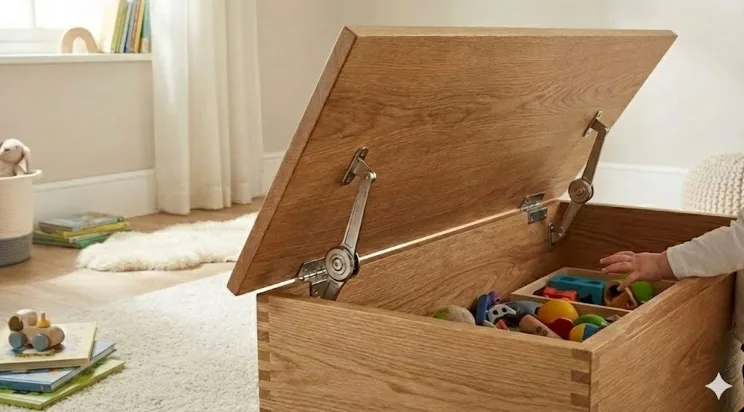
Have you ever installed a cabinet door support only to find it slowly drifts down? Or perhaps it’s so tight that you have to force the lid shut?
For furniture makers and industrial designers, selecting the right Mechanical Lid Stay (often called a Friction Stay or Toy Box Hinge) is critical. Unlike gas springs that automatically push a door open, the products you are using are designed to hold the lid in any position (Free Stop).
To get this “Free Stop” effect to work perfectly, you cannot guess. You must match the Torque Rating of the hinge to the Torque Moment of your door.
If you skip this calculation:
- The Lid Falls: The friction is too weak to hold the weight.
- The Lid Binds: The friction is too high, making operation difficult.
- Hardware Failure: Overloading the internal plastic or metal friction discs.
This guide will show you exactly how to calculate the required torque in 3 simple steps, ensuring your cabinet operates with that premium, smooth feel.
The “Seesaw” Principle (Visual Analogy)
Before we do the math, let’s understand the physics with a simple analogy.
Think of your cabinet lid as a playground Seesaw.
- The Hinge is the center pivot.
- The Door’s Weight is the person sitting on one end.
- The Lid Stay is the brake trying to stop the seesaw from moving.
If the person sits at the very end of the seesaw, they create more rotational force (Torque). If they sit near the center, they create less.
To choose the right stay, we don’t just need to know how heavy the door is; we need to know how much rotational force (Torque) that weight creates at the hinge.
Key Variables You Need to Measure
You only need two numbers to solve this puzzle.
Lid Height (L)
This is the distance from the hinge to the opening edge of the door.
- How to measure: Measure perpendicular to the hinge axis.
- Unit: Meters (m).
- Tip: If you measure in mm, divide by 1000. (e.g., 400mm = 0.4m)
Lid Weight (W)
This is the total weight of the door panel.
- Crucial: You must include the weight of the handle, glass, and any interior cladding.
- Unit: Kilograms (kg).
The Calculation (The “Fill-in-the-Blanks” Formula)
For mechanical stays, we calculate the Maximum Torque (Force Moment). This usually happens when the door is at 90 degrees (horizontal).
The Formula
$$Torque (N\cdot m) = Weight (kg) \times Lid\ Height (m) \times 0.5 \times 9.8$$
- 0.5: This assumes the door is made of uniform material, so the Center of Gravity is in the middle.
- 9.8: This uses the standard acceleration of gravity to convert Kilograms into Newtons
Step-by-Step Calculation Example
Let’s assume you are selecting a stay for the Upright Support Rod (the product on the left of your image).
Your Scenario:
- Door Height: 400 mm (0.4 m)
- Door Weight: 6 kg
Step 1: Plug in the numbers
$$Torque = 6 (kg) \times 0.4 (m) \times 0.5 \times 9.8$$
Step 2: Do the math
$$Torque = 1.2 \times 9.8$$
$$Torque = \mathbf{11.76\ N\cdot m}$$
Step 3: Select the Product
You need a stay (or a pair of stays) that supports approx. 12 N·m.
- If the product is rated 5–15 N·m: Perfect fit.
- If the product is rated 2–7 N·m: Too weak.
Quick Reference Table (No Math Needed)
Don’t want to use the calculator? Use this estimation table for standard 19mm MDF or Plywood doors.
(Values are approximate Max Torque in N·m)
| Door Height (mm) | Door Weight (kg) | Calculated Torque (N·m) | Recommended Rating |
| 300 mm | 3 kg | ~ 4.4 N·m | Look for 4-6 N·m range |
| 400 mm | 4 kg | ~ 7.8 N·m | Look for 6-10 N·m range |
| 500 mm | 6 kg | ~ 14.7 N·m | Look for 15-18 N·m range |
| 600 mm | 8 kg | ~ 23.5 N·m | Look for 20-25 N·m range |
Why Choose Mechanical Friction Stays? (Features & Benefits)
Unlike gas springs, the products shown in your image offer specific advantages for furniture and instrument housings.
The “Free Stop” Function

The defining feature of friction stays is the ability to hold the door at any angle (e.g., 30°, 60°, or 90°).
- Benefit: This is ideal for overhead cabinets or display cases where you don’t want the door to fly fully open or snap shut.
Adjustable Tension (The “Safety Net”)
Notice the hex/Allen screw joint on the Adjustable Foldable Door Stay (4th product in your image)?
- The Feature: This screw tightens the friction discs.
- The Advantage: If your calculation is slightly off (e.g., the wood was heavier than expected), you can simply tighten the screw to increase the holding force. This makes these stays very forgiving for DIYers.
Compact Profile
Folding mechanical stays collapse onto themselves. They do not have a long piston rod that sticks out into the cabinet space, making them perfect for shallow cabinets (like shoe racks or AV consoles).
Common Mistakes to Avoid with Mechanical Stays
Mixing Up Units (N·m vs. kgf·cm)
This is the #1 error.
- European Specs: Usually in N·m (Newton Meter).
- Asian Specs: Often in kgf·cm (Kilogram-force Centimeter).
- The Conversion:
1 N·m ≈ 10.2 kgf·cm. - Example: If a product says “Range: 150 kgf·cm”, that is roughly 15 N·m. Do not treat them as the same number!
Ignoring “Per Piece” vs. “Per Pair” Ratings
Always check if the torque rating is for one stay or two.
- If your door needs 12 N·m and you buy a stay rated for 6 N·m, you must install two (one on the left, one on the right).
- Pro Tip: For wide doors (>600mm), always use two stays to prevent the door from twisting (warping) at the hinges.
Over-Tightening the Adjustment Screw
On adjustable models, do not force the screw beyond its limit. Overtightening can crush the internal nylon washers, causing the “smooth” feel to become “jerky” and ruining the hardware.
Conclusion
Selecting a mechanical lid stay doesn’t have to be a guessing game. By understanding that Torque = Weight × Height × 0.5, you can ensure your cabinet door hovers perfectly exactly where you want it.
Your Action Plan:
- Measure your door height and weight.
- Calculate the Torque ($N\cdot m$).
- Check the manufacturer’s Torque Range.
- Buy an adjustable model to allow for fine-tuning during installation.
Need Help Selecting?
- Download our Free Excel Calculator: Simply enter your panel dimensions to get the required Torque value.
- Contact Engineering: Unsure about unit conversions? Send us your specs, and we will recommend the exact model for your project.