HTAN is one of the leading manufacturers of industrial hinges, handles and latches in China.


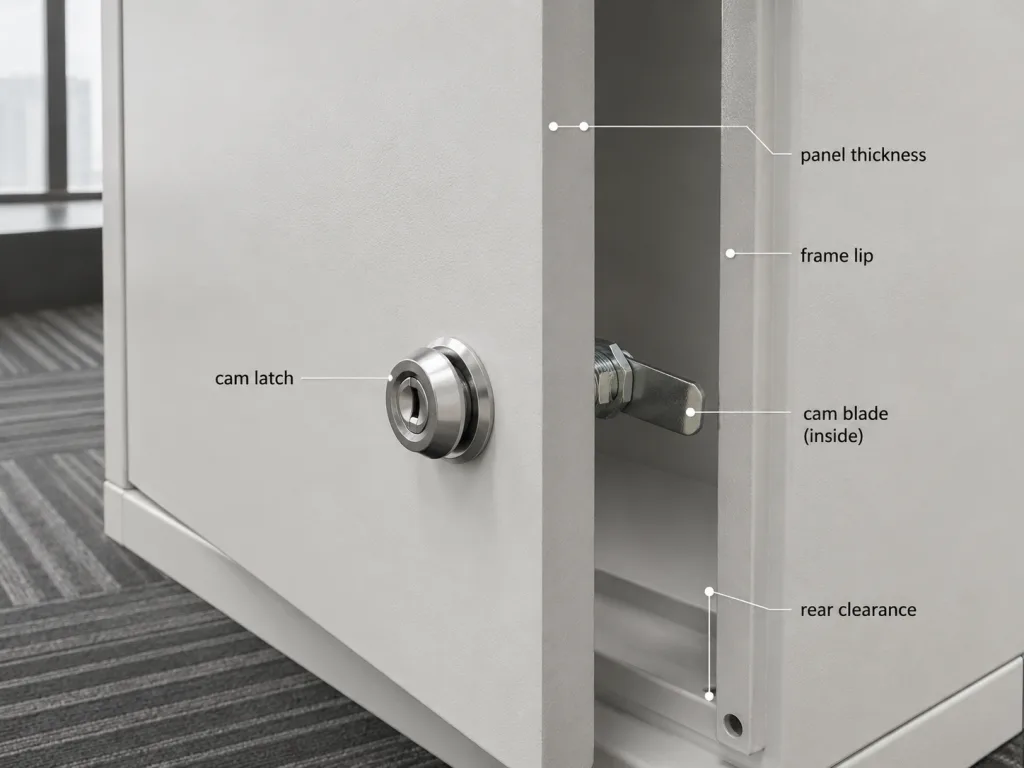
A cam latch can look correct on a product page but still fail during cabinet assembly. The door may not close, the cam may miss the frame lip, the handle may feel loose, or the cam may hit internal wiring behind the panel. In most cases, the problem is not the latch quality. It is a mismatch between panel thickness, cam length, housing depth, strike engagement, and rear clearance — the specific dimensions that determine whether a cam latch fit for an electrical cabinet is correct before production starts.
For cabinet builders, this mismatch creates real business consequences: delayed assembly, re-drilled doors, rejected samples, field service complaints, loose cabinet doors, poor sealing, and extra purchasing cost. This guide focuses on one practical decision that comes before installation and after general latch selection — how to verify cam latch fit for an electrical cabinet so the latch matches panel thickness, engages the frame correctly, and operates smoothly after installation.
Why Cam Latch Fit Fails on Electrical Cabinets
Cam latches are simple quarter-turn locking devices, but their fit is sensitive. A small difference in door thickness, frame lip depth, or cam offset can decide whether the cabinet locks correctly or needs rework. This is why cam latch fit verification should start from the cabinet drawing, not from the latch appearance.
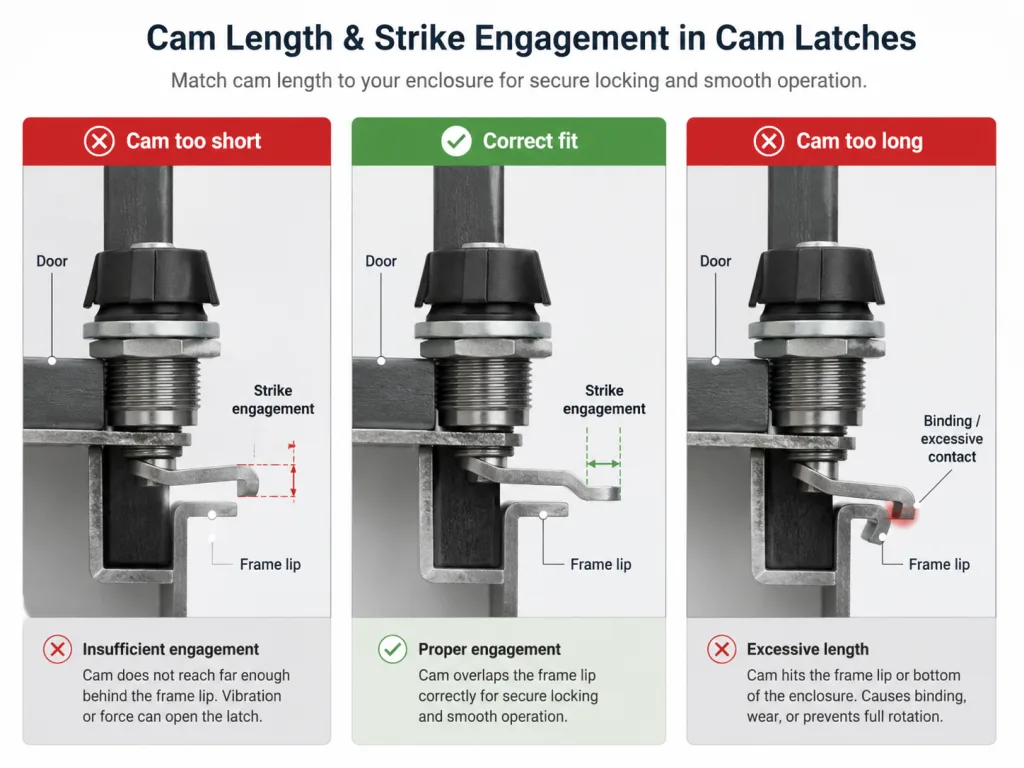
The most common failure is poor strike engagement. If the cam is too short, it turns without catching the frame. If the cam is too long, the door may bind before the handle reaches the locked position. If the rear clearance is limited, the cam may hit wiring, DIN rails, internal brackets, or insulation material behind the door.
Cam Latch Fit Guide for Electrical Cabinets: Panel Thickness, Cam Length, and Installation Checks
These problems are especially common when one latch model is used across several cabinet designs without checking panel thickness and frame geometry. A latch that works on a thin control cabinet door may not work on a thicker double-wall electrical enclosure.
Key Fit Points Before Ordering a Cam Latch
| Fit Point | What to Check | Business Risk If Ignored |
|---|---|---|
| Panel Thickness | Actual door thickness, including coating or double-wall structure | Latch housing may not clamp securely or cam may not reach the frame |
| Mounting Hole | Round, square, double-D, or anti-rotation hole size | Latch may wobble, rotate in the hole, or sit at the wrong angle |
| Housing Depth | Usable grip range of the latch body | Mounting nut may not engage fully on thick panels |
| Cam Length | Distance from latch center to the cam contact point | Cam may miss the strike or jam against the frame |
| Cam Offset | Whether the cam needs to sit closer to or farther from the door | Door may rattle or fail to close smoothly |
| Strike Engagement | How much overlap the cam has behind the frame lip | Door may open under vibration or light pulling force |
| Rear Clearance | Space behind the door for cam rotation | Cam may hit wiring, frame parts, or internal equipment |
Panel Thickness Is the First Fit Dimension
Panel thickness should be measured before checking cam latch fit for an electrical cabinet. Do not rely only on the nominal sheet metal thickness. Powder coating, insulation layers, folded edges, or double-wall door structures can change the actual grip requirement.
If the latch body is designed for a thinner panel, the mounting nut may not fully tighten on a thick door. If the panel is much thinner than the latch expects, the latch may feel loose or need washers or spacers to sit correctly. Both situations can create assembly delays and inconsistent locking performance.
For production cabinets, the safest method is to confirm the real panel thickness with a caliper, then compare it with the latch datasheet before ordering samples. This prevents batch-level mistakes where the latch fits one prototype but fails on the production door.
Cam Length and Strike Engagement
Cam length determines whether the latch can hold the door closed. The cam must reach behind the frame lip or strike plate with enough overlap to resist pulling force, but not so much that it binds during rotation.
A short cam usually causes a door that “looks locked” but opens easily because the cam barely contacts the frame. A long cam can create the opposite problem: the handle becomes hard to turn, the door cannot close fully, or the gasket is compressed unevenly.
Offset cams, stepped cams, and L-shaped cams can solve some cabinet geometry problems, but they should be tested on the actual cabinet. The correct cam is the one that engages the strike smoothly after the door, gasket, hinge alignment, and frame lip are all considered together.
| Problem During Fit Test | Likely Cause | Practical Correction |
|---|---|---|
| Cam turns but does not lock | Cam is too short or strike is too far from latch center | Use longer cam, offset cam, or adjust strike position |
| Door is hard to close | Cam is too long or contacts the frame too early | Use shorter cam or change cam offset |
| Latch body wobbles | Panel is too thin, hole is oversized, or nut is loose | Check hole size, panel grip range, and mounting hardware |
| Handle feels tight or uneven | Cam and strike are misaligned | Recheck latch position before final tightening |
| Door rattles after locking | Not enough overlap or no gasket contact | Adjust cam length, strike position, or gasket compression |
When a Cam Latch Is Not the Right Fit for the Cabinet
A cam latch is suitable when the cabinet needs simple locking, fast access, and moderate closing force. It is commonly used on indoor control cabinets, distribution boxes, automation panels, and network cabinets. However, it is not always the right fit when sealing force is the main requirement.
If the enclosure needs stable gasket compression, outdoor sealing per IEC 60529 IP ratings, washdown resistance, or stronger vibration control, a standard cam latch may not provide enough closing force. In that situation, the decision should be made against the real sealing requirement, and the comparison between cam latch vs compression latch becomes important before finalizing the cabinet hardware. For IP-rated enclosures specifically, see the engineering guide on compression latches for IP65/IP66 enclosures.
| Cabinet Requirement | Cam Latch Fit | Better Alternative If Needed |
|---|---|---|
| Fast indoor access | Good fit | Cam latch |
| Basic door retention | Good fit | Cam latch |
| Restricted access | Good with key-lock style | Key-lock cam latch |
| Strong gasket compression | Limited | Compression latch |
| Outdoor rain exposure | Only with suitable gasket and material | Compression latch or sealed latch |
| High vibration door | May need anti-rattle or locking design | Compression or positive-locking latch |
Installation Fit Checks Before Production
Before tightening a cam latch permanently or approving it for production, test the full closing action on the actual cabinet. The cam should rotate freely, catch the strike correctly, and hold the door without excessive force. If the latch binds during testing, do not solve the issue by forcing the handle. The root cause is usually cam length, strike position, mounting hole accuracy, or rear clearance.
For detailed hole preparation and step-by-step installation procedures, the dedicated cam latch installation guide should be used after the latch size and cabinet fit have been confirmed. This article stays focused on fit verification before procurement approval, not on the installation process itself.
Pre-Production Fit Checklist
- Measure actual door panel thickness with coating included.
- Confirm latch housing grip range from the datasheet.
- Check mounting hole size and anti-rotation requirement.
- Confirm cam length, cam offset, and rotation direction.
- Check strike plate or frame lip position before drilling final holes.
- Confirm rear clearance for cam rotation behind the door.
- Close the door and test the latch before final tightening.
- Check whether the gasket changes the required closing force.
- Confirm whether the cabinet needs simple locking or gasket compression.
Material and Locking Style
Material selection should match the cabinet environment. Zinc alloy or plated steel cam latches are suitable for many indoor electrical cabinets. Stainless steel should be considered for humid, outdoor, coastal, chemical, or washdown environments. Plastic or nylon cam latches may work for light-duty indoor panels where electrical insulation or corrosion-free material is more important than mechanical strength.
Locking style depends on access control. Thumb-turn cam latches are useful for service panels that need frequent access. Key-lock cam latches help restrict access to electrical components. Tool-operated cam latches can reduce casual opening in public or semi-public locations. These factors should be confirmed only after panel thickness, cam length, and rear clearance have all been verified — material and locking style cannot fix a fit problem.
| Option | Best Use | Key Check |
|---|---|---|
| Thumb-Turn Cam Latch | Frequently opened indoor service panels | Operator access and convenience |
| Key-Lock Cam Latch | Electrical cabinets requiring restricted access | Key system and security level |
| Tool-Operated Cam Latch | Panels where casual access must be limited | Drive type and maintenance access |
| Stainless Steel Cam Latch | Outdoor, humid, coastal, or corrosive environments | Material grade and fastener compatibility |
| Plastic or Nylon Cam Latch | Light-duty indoor or insulation-sensitive panels | Load, temperature, and durability limits |
Common Cam Latch Fit Mistakes
Mistake 1: Selecting by Appearance Only
A cam latch may look correct from the front, but the real fit happens behind the door. Panel thickness, cam length, strike depth, and rear clearance should all be checked before approving by handle shape or finish.
Mistake 2: Ignoring Panel Thickness
A latch that fits a thin sheet metal door may not engage correctly on a thicker panel. This can lead to weak locking, loose installation, or sample rejection at the assembly line.
Mistake 3: Using the Wrong Cam Length
If the cam is too short, the door will not hold. If the cam is too long, the latch may bind. Cam length should be selected after checking the strike location and frame geometry, not from the datasheet alone.
Mistake 4: Using a Cam Latch for a Sealing Problem
A standard cam latch provides simple locking, not strong gasket compression. If the main problem is water ingress, dust sealing, or gasket pressure, a compression latch may be the better hardware choice — and that decision belongs to the comparison stage, not the fit verification stage.
Mistake 5: Final Tightening Before Fit Testing
Final tightening should happen after the door has been closed and the cam has been tested against the strike. Otherwise, a small alignment error may remain hidden until the latch is already installed — and rework on a sealed cabinet is much more expensive than catching the issue at the fit check stage.
Cam Latch Fit Checklist for Electrical Cabinets
| Specification Item | Engineer or Buyer Should Confirm |
|---|---|
| Cabinet Type | Control cabinet, distribution box, network cabinet, enclosure door, or access panel |
| Panel Thickness | Actual door thickness including coating or double-wall structure |
| Mounting Hole | Hole shape, diameter, and anti-rotation requirement |
| Housing Depth | Latch body grip range for the cabinet panel |
| Cam Length | Enough to engage the frame without binding |
| Cam Offset | Matched to frame lip depth and strike position |
| Rotation Direction | Clockwise or counterclockwise closing direction |
| Security Level | Thumb-turn, key-lock, tool-operated, or special drive |
| Material | Zinc alloy, plated steel, stainless steel, plastic, or nylon |
| Environment | Indoor, outdoor, humid, dusty, chemical, or washdown exposure |
| Sealing Need | Whether a cam latch is enough or a compression latch is required |
| Rear Clearance | Space behind the door for cam rotation without interference |
| Fit Test | Door closes smoothly, cam catches properly, and latch does not wobble |
FAQ
Are cam latches universal for all electrical cabinet panel thicknesses?
No. Cam latches are designed for specific panel thickness ranges, housing depths, and mounting hole sizes. Always measure the actual door thickness and check the latch datasheet before ordering. The same latch model may fit a 1.5 mm control cabinet door but not engage correctly on a 3 mm double-wall enclosure.
How do I choose the correct cam length for my cabinet?
Choose cam length by measuring the distance from the latch center to the frame lip or strike surface on the actual cabinet drawing. The cam must overlap enough to hold the door closed, but not so much that it binds or prevents smooth closing. Always test the chosen cam on a sample before approving production quantities.
Why does my cam latch wobble after installation?
A cam latch may wobble if the panel is thinner than the latch grip range, if the mounting hole is oversized, if the anti-rotation feature does not match the hole shape, or if the mounting nut is not fully tightened. Recheck the panel thickness, hole size, and housing seating before replacing the latch.
What is rear clearance and why does it matter for cam latch fit?
Rear clearance is the open space behind the door where the cam needs to rotate. Many electrical cabinets have wiring, DIN rails, internal brackets, or insulation material near the door — if the cam rotation path intersects any of these, the latch will not operate correctly or may damage the internal components. Always confirm rear clearance during fit verification, not after installation.
How do I prevent batch-level fit problems when ordering cam latches in volume?
Verify fit on a real sample cabinet before approving the production order. Measure panel thickness with a caliper including any coating or insulation layer, confirm the cam length and offset against the actual frame geometry, and test full closing action with the gasket installed. A 30-minute fit check before procurement prevents thousands of re-drilled doors or rejected cabinets later.
Final Fit Verification Advice
Cam latches are a practical choice for electrical cabinets when the project needs simple locking, fast access, and a compact quarter-turn mechanism. But verifying cam latch fit for an electrical cabinet is what determines whether the latch performs in production — panel thickness, cam length, housing depth, strike engagement, rear clearance, and final fit testing are the dimensions that decide success or rework.
If your project involves control cabinets, distribution boxes, automation panels, or network enclosures, HTAN can help review panel thickness, mounting hole size, cam length, material, and locking style before sample production. Share your cabinet drawing, panel thickness, frame depth, and access requirements to receive a suitable cam latch recommendation.