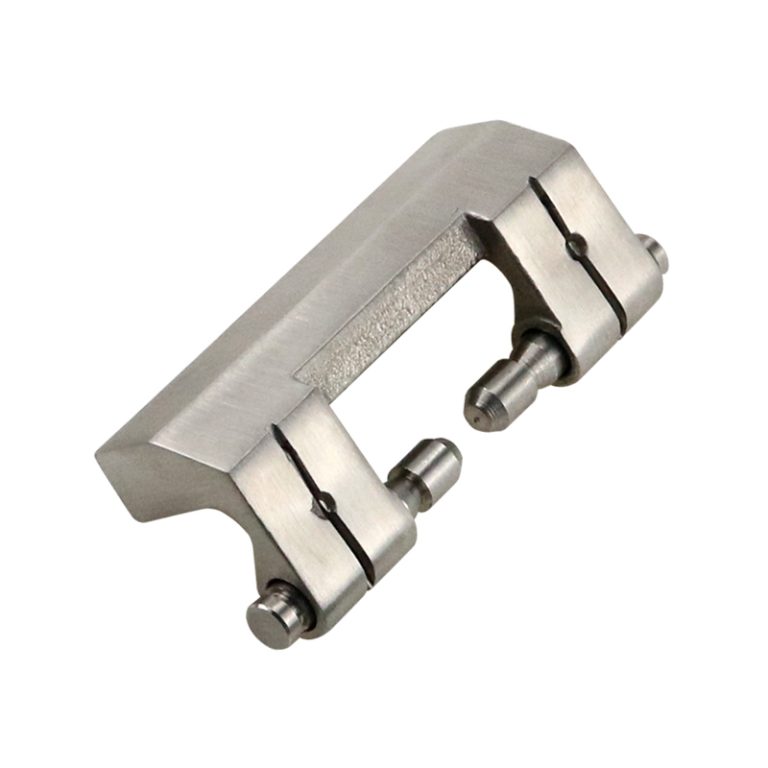
HTAN is one of the leading manufacturers of industrial hinges, handles and latches in China.


The industrial hinge market is fragmented. For most buyers, it is better understood as a set of supplier categories than as a single universal ranking — there is no one maker that leads everywhere. Instead, hundreds of manufacturers worldwide serve different slices of the market, and the “leading” ones lead in different ways. Some are large general suppliers with broad catalogs, some are specialists in one demanding niche, and some are original-equipment manufacturers who build to a customer’s drawing rather than sell from a shelf. Understanding which kind of manufacturer leads in which area is more useful for a buyer than any single ranked list, because the best manufacturer for a project depends entirely on what the project needs.
This guide explains how the industrial hinge manufacturing market is structured, the main categories of leading suppliers, and how to match a manufacturer type to your sourcing needs. Rather than naming companies, it maps the landscape by category, which is what actually helps when you are deciding where to source.
This is not a ranked list of companies. In industrial hinges, “leading” depends on the application: a supplier that leads in stock catalog hinges may not be the best fit for torque hinges, corrosion-resistant hinges, or build-to-drawing OEM work. For buyers, the more useful starting point is to identify the manufacturer category that matches the project, then evaluate suppliers inside that category — which is also why this guide maps categories rather than singling out individual companies.
How the Industrial Hinge Market Is Structured
Leading industrial hinge manufacturers fall into a few broad categories, each strong for a different kind of buyer. The table below summarizes the main types and where each one tends to lead.
| Manufacturer type | Leads on | Best fit for |
|---|---|---|
| Large general-catalog suppliers | Breadth, stock availability, distribution | Standard hinges needed fast, off the shelf |
| Niche specialists | Deep expertise in one demanding area | Extreme environments or unusual performance needs |
| OEM / custom manufacturers | Build-to-drawing, tailored specs, lower unit cost at volume | Equipment makers needing a specific hinge, not a catalog part |
| Regional manufacturers | Local lead times, language, and support | Buyers prioritizing proximity and fast turnaround |
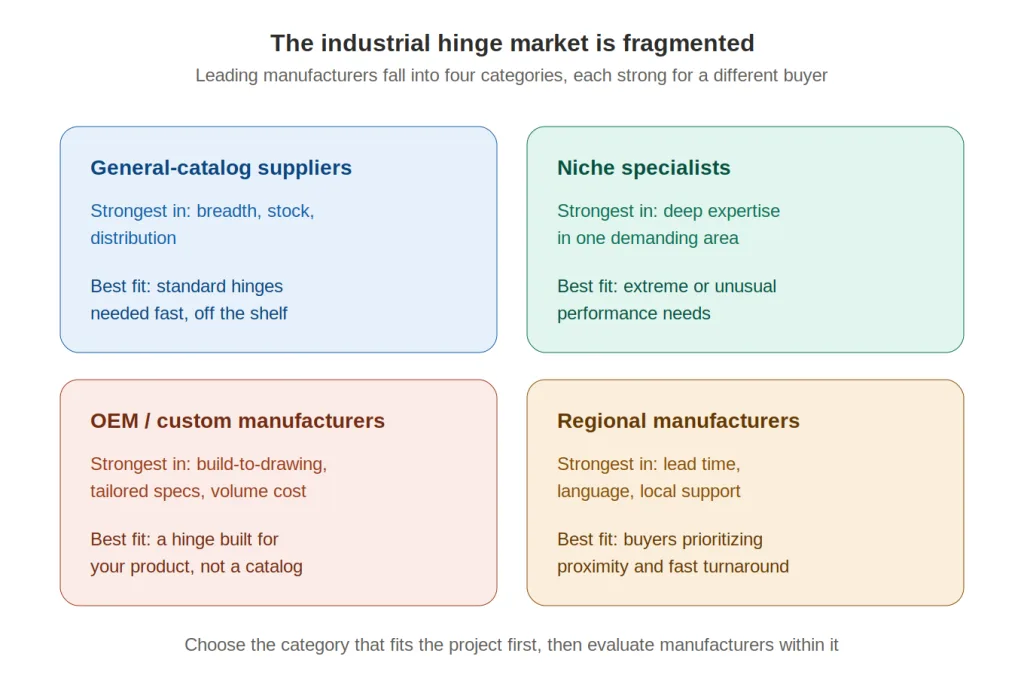
No single category is “best” in the abstract. A buyer who needs ten standard butt hinges tomorrow is best served by a general-catalog supplier, while an equipment manufacturer designing a sealed enclosure is usually better served by an OEM manufacturer who can build the hinge to the exact dimensions, torque, and finish the design requires.
The Practical Rule: Choose the Category Before the Company
A buyer should not start with a company name. The first step is to decide what the project most needs — stock availability, niche performance, custom engineering, or regional support. Once that category is clear, the shortlist of relevant manufacturers becomes much smaller and much more useful, and comparing them becomes a question of evidence rather than reputation.
This is why a single ranked list rarely helps. The manufacturer that tops a list for catalog availability may be the wrong choice for a build-to-drawing torque hinge, and the reverse is equally true. Decide the category first, and the question of “who leads” answers itself within the much narrower group that actually fits the job.
Large General-Catalog Suppliers
Large general-catalog suppliers are strongest in breadth and availability. They carry wide ranges of standard hinges in stock, supported by distribution networks that get common parts to buyers quickly. For a buyer who needs a standard hinge type in a standard size, without special requirements, this category is hard to beat on speed and convenience.
The trade-off is that catalog suppliers are built around standard parts. When a project needs a non-standard size, a specific torque value, an unusual material, or a finish outside the catalog, a general supplier often cannot help without long lead times or high minimums — which is where the other categories come in.
Niche Specialists
Niche specialists lead through depth in one demanding area. A specialist might focus entirely on torque and position-control hinges, on hinges for extreme temperatures, on hygienic stainless hinges for food and pharma, or on corrosion performance for marine and outdoor use. Within their niche, their engineering knowledge and tested performance usually exceed what a broad supplier offers.
Specialists are the right choice when the application is genuinely demanding and a generic hinge would fail. If the hinge has to hold a panel at any angle, survive salt spray for years, or work at –40 °C, a specialist in that exact problem is worth more than a wide catalog. For applications that push hinge performance, the specialist category is where the leading manufacturers tend to be.
OEM and Custom Manufacturers
OEM and custom manufacturers lead by building to the customer’s requirement rather than selling from a shelf. They work from a drawing or a specification, producing hinges with the exact dimensions, load rating, torque, material, and finish a piece of equipment needs. For equipment makers and enclosure builders, this category often delivers a better-fitting part at a lower unit cost once volume is involved, because the hinge is made for the job instead of adapted to it.
HTAN fits this category as an OEM manufacturer of industrial and torque hinges, working from customer drawings for equipment, enclosure, and machinery applications rather than as a shelf-stock catalog. Manufacturers in this group are the right fit when you need a hinge designed around your product — the trade-off is a development cycle and minimum order quantities, since each part is made to order. The capabilities to look for in this category are covered in the guide to choosing a custom hinge manufacturer.
Regional Manufacturers
Regional manufacturers are typically chosen for proximity. Sourcing closer to where the parts are used can mean shorter lead times, easier communication, simpler logistics, and support in the buyer’s own time zone and language. For buyers who value fast turnaround and close coordination over the lowest possible unit price, a strong regional manufacturer can be the most practical choice.
In practice, the regional and OEM categories often overlap: many equipment makers source custom hinges from manufacturing regions that combine engineering capability with competitive cost, then weigh that against lead time and communication. The right balance depends on volume, how custom the part is, and how time-sensitive the project is.
Matching a Manufacturer Type to Your Needs
Rather than asking “who is the single best manufacturer,” a more useful question is “which category fits this project.” Work from what the part actually requires:
| If you need… | Look to… |
|---|---|
| A standard hinge, fast, off the shelf | General-catalog supplier |
| Performance in a demanding niche | Niche specialist |
| A hinge built to your drawing | OEM / custom manufacturer |
| Short lead times and close support | Regional manufacturer |
| Custom parts at competitive volume cost | OEM manufacturer in a strong manufacturing region |
Once the category is clear, evaluating an individual manufacturer comes down to verifiable signals — quality management, material traceability, testing evidence, and engineering support. Certification is one of the clearest of these; the role it plays is covered in the guide to ISO 9001 certified hinge procurement. And before selecting a manufacturer, it helps to be clear on the hinge itself — the guide to choosing the right hinge covers type, material, and load.
FAQ
Who are the leading industrial hinge manufacturers?
The industrial hinge market is fragmented, so leadership is best understood by category rather than as a single ranked list. Large general-catalog suppliers lead on breadth and stock availability, niche specialists lead in demanding areas like torque control or corrosion resistance, OEM and custom manufacturers lead at building hinges to a customer’s drawing, and regional manufacturers lead on lead time and local support. The leading manufacturer for a given project is the one whose category matches the project’s needs.
Is there a single best industrial hinge manufacturer?
No. Because the market is fragmented and applications vary so widely, no single manufacturer is best for every project. A general-catalog supplier is best for standard parts needed quickly, a niche specialist is best for demanding performance requirements, and an OEM manufacturer is best when the hinge must be built to a specific design. The right choice depends on whether you need a standard part, specialized performance, or a custom-built hinge.
What is the difference between a catalog supplier and an OEM hinge manufacturer?
A catalog supplier sells standard hinges from stock, which is fast and convenient for common parts but limited when a project needs something non-standard. An OEM manufacturer builds hinges to a customer’s drawing or specification, producing the exact dimensions, torque, material, and finish required. Catalog suppliers lead on speed and availability; OEM manufacturers lead on fit and, at volume, on unit cost for custom parts.
How do I evaluate an industrial hinge manufacturer?
Start by identifying which category fits your project, then assess verifiable signals: a quality management system such as ISO 9001, material traceability, salt-spray and cycle-life test evidence, customization capability, and engineering support. For custom work, also look at how the manufacturer handles drawings, prototypes, minimum order quantities, and lead times. The right evidence to ask for depends on whether you are buying a standard or a custom hinge.
Are custom hinges more expensive than catalog hinges?
Per unit at low quantities, custom hinges can cost more because of tooling and setup. But when the design is stable and order volume is high enough to absorb those setup and tooling costs, an OEM-built hinge is often cheaper per part than adapting a catalog hinge, since it is made exactly for the job with no wasted material or compromise. Custom also avoids the hidden costs of a standard hinge that does not quite fit. The economics favor custom once volume, design stability, and fit are all considered.
Bottom Line
The leading industrial hinge manufacturers do not form a single ranked list, because the market is fragmented and leadership is category-specific. General-catalog suppliers lead on breadth and speed, niche specialists on deep performance, OEM manufacturers on build-to-drawing fit and volume cost, and regional manufacturers on proximity and lead time. The most useful step for a buyer is to identify which category the project calls for, then evaluate individual manufacturers within it on verifiable quality and engineering signals.
If your project needs a hinge built to a specification rather than pulled from a catalog, HTAN is an OEM manufacturer of industrial and torque hinges that works from customer drawings. Contact us with your requirements for a recommendation.