HTAN is one of the leading manufacturers of industrial hinges, handles and latches in China.


Two enclosures can carry the same level of dust and water protection and still be specified with completely different rating codes — one as NEMA Type 4, the other as IP66. For engineers and procurement teams in the U.S. market, this is a constant source of confusion: a customer asks for a NEMA rating, the hinge datasheet lists an IP rating, and nobody is certain whether the two actually match. Choosing a hinge for a sealed enclosure starts with understanding what the rating on the spec sheet actually requires.
This guide explains the two rating systems side by side and, more importantly, how enclosure ratings affect hinge selection, gasket compression, mounting style, and corrosion resistance. It is focused on how the rating shapes the hinge requirement, not the full selection process — for the complete step-by-step path (rating, corrosion, load, wind, installation), see how to choose hinges for outdoor electrical enclosures. This page answers one upstream question: what does the rating mean, and how does it shape the hinge requirement?
NEMA vs. IP at a Glance
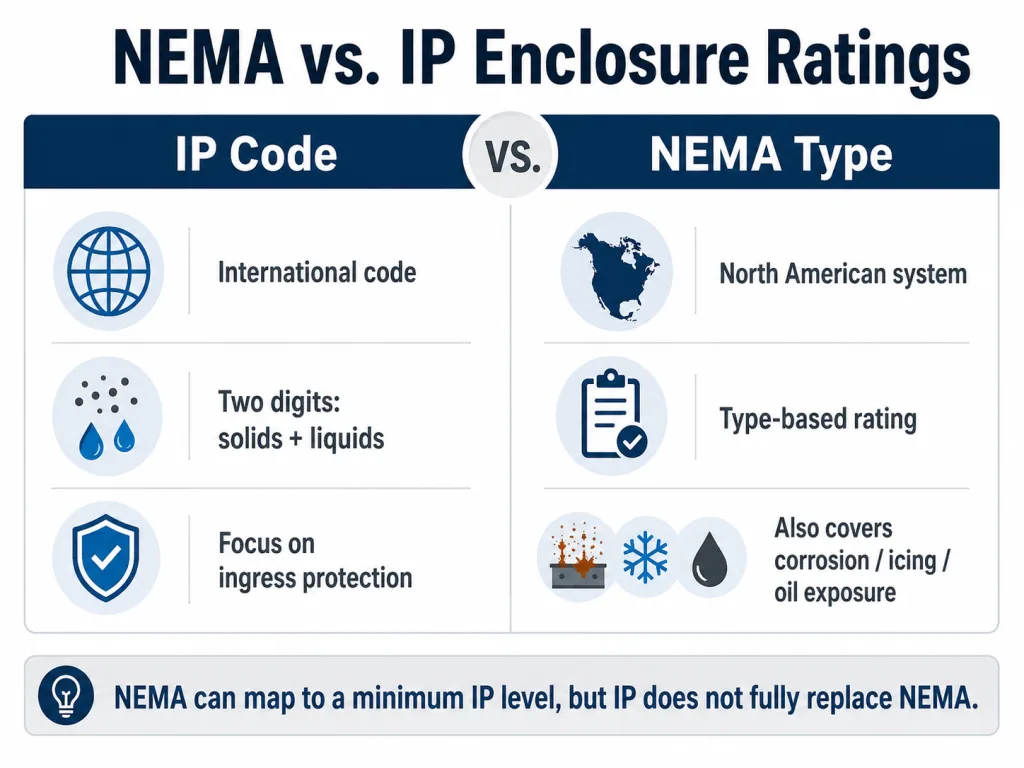
NEMA and IP are two different systems that describe how well an enclosure keeps out solids and liquids. The IP (Ingress Protection) code is international and uses two digits — the first for solids, the second for liquids. The NEMA rating is used mainly in North America and is described by a Type number; it also covers conditions IP does not, such as corrosion, icing, and oil resistance.
The two cannot be converted exactly. A NEMA rating can be mapped to a minimum IP equivalent, but not the reverse — because NEMA tests for conditions that IP does not. For hinge selection, the practical takeaway is the same in both systems: the higher the rating, the more the door must hold even, continuous gasket compression, and the more the hinge must resist sag and avoid creating leak paths.
What the IP Code Means
An IP code has two digits, defined by IEC 60529 (IP Code). The first digit (0–6) rates protection against solid objects and dust; the second digit (0–9K) rates protection against water, from dripping up to high-pressure jets. For example, IP66 means fully dust-tight (6) and protected against powerful water jets (6).
| IP Code | Solids | Liquids | Typical Use |
|---|---|---|---|
| IP54 | Dust-protected | Splashing water | General indoor/sheltered |
| IP65 | Dust-tight | Low-pressure jets | Outdoor, washdown-light |
| IP66 | Dust-tight | Powerful jets | Outdoor, heavy rain, washdown |
| IP67 | Dust-tight | Temporary immersion | Submersion risk |
The full engineering of how a hinge helps an enclosure reach IP65 or IP67 — gasket reaction force, fit tolerances, sealed studs — is covered in the deep dive on hinge selection for IP65/IP67 cabinets. Here, the point is simply what each digit requires.
What the NEMA Type Means
NEMA ratings describe enclosure protection using Type numbers, and they go beyond dust and water to include conditions common in North American industrial environments. The most common types for sealed outdoor and industrial enclosures are:
| NEMA Type | Protects Against | Typical Use |
|---|---|---|
| Type 3R | Rain, sleet, external ice formation | Outdoor, basic weather |
| Type 4 | Wind-driven dust and rain, splashing, hose-directed water | Outdoor and washdown |
| Type 4X | Same as Type 4 plus corrosion | Coastal, chemical, washdown |
| Type 12 | Dust, dripping non-corrosive liquids | Indoor industrial |
The key difference from IP is that NEMA includes corrosion resistance (the “X” in 4X), ice formation, and oil or coolant exposure as part of the rating. That is why a NEMA rating cannot be fully captured by an IP code alone — IP says nothing about corrosion or icing.
Mapping NEMA to IP (and Why It’s One-Way)
A NEMA rating can be mapped to a minimum IP equivalent, but an IP rating cannot be mapped back to a NEMA type — because NEMA types may include conditions such as corrosion resistance, external icing, hose-directed water, and oil or coolant exposure that the IP code does not fully describe. So a product can satisfy an IP equivalent without meeting the full NEMA requirement.
| NEMA Type | Approx. Minimum IP Equivalent | What IP Misses |
|---|---|---|
| Type 3R | Comparison varies by chart; confirm the actual Type 3R requirement | Ice formation |
| Type 4 | IP66 | Hose-directed test detail |
| Type 4X | IP66 | Corrosion resistance |
| Type 12 | IP52 | Oil/coolant drip detail |
For specification, the safe rule is: if the requirement is given as NEMA, confirm the NEMA type rather than assuming the IP equivalent is enough — especially for 4X, where corrosion resistance drives the hinge material choice. If the requirement is given as IP, confirm whether corrosion or icing also matters, because IP alone will not tell you.
What the Rating Means for the Hinge
Whichever system is used, the rating sets three requirements that flow directly to the hinge:
1. Even, continuous gasket compression
Higher ratings (IP66, NEMA 4/4X) require the door to compress the gasket evenly all the way around. A hinge that sags or flexes lets the gasket relax on the pivot side, so the enclosure may no longer hold its rating even though the door still closes. The higher the rating, the stiffer and better-aligned the hinge line must be.
2. No new leak paths at the mounting
Every bolt hole through the enclosure wall is a potential leak point. For dust-tight and jet-protected ratings, bolted hinges need sealed or gasketed studs, or the design should use concealed or internally mounted hinges that avoid external penetrations. A high IP or NEMA number with unsealed mounting holes is a contradiction.
3. Corrosion resistance for NEMA 4X
This is the requirement IP does not capture. A NEMA 4X enclosure must resist corrosion, which directly drives the hinge material — typically 316 stainless for coastal or chemical exposure. The 304-versus-316 decision for that requirement is covered in the guide to outdoor stainless steel hinge selection: 304 vs 316. If the spec requires NEMA 4X, confirm that the hinge material and finish are suitable for the corrosion exposure instead of assuming 304 stainless is enough.
Rating-to-Hinge Quick Reference
| Rating | Hinge Priority | Material Direction |
|---|---|---|
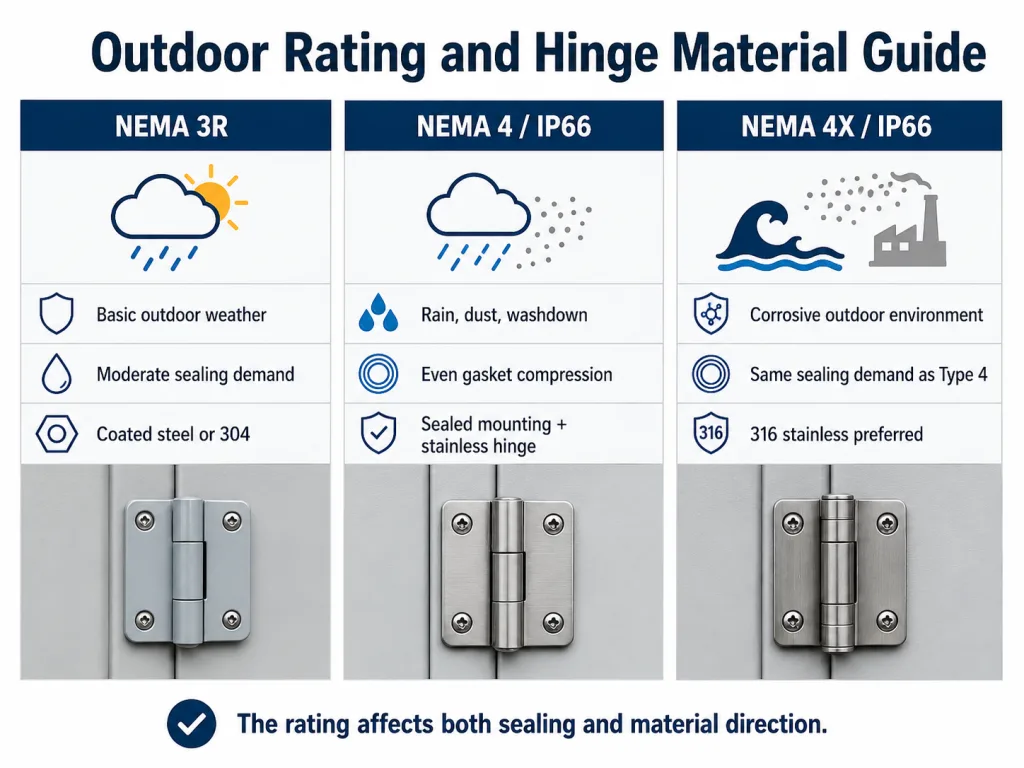
| NEMA 3R / IP24 | Basic weather protection, modest alignment | Coated steel or 304 |
| NEMA 4 / IP66 | Stiff, well-aligned hinge; even gasket compression; sealed mounting | 304 stainless |
| NEMA 4X / IP66 + corrosion | All of NEMA 4 plus corrosion resistance | 316 stainless |
| IP67 | Maximum sealing stability; no mounting leak paths | 304/316 per environment |
Once the rating tells you the sealing and material direction, the rest of the selection — door load, hinge count, wind, and installation method — follows the full outdoor enclosure hinge selection path.
FAQ
Is NEMA 4 the same as IP66?
They are close but not identical. NEMA 4 maps to roughly IP66 for dust and water, but NEMA 4 also includes tests IP does not, such as a hose-directed water test and external icing. A product can meet IP66 without fully meeting NEMA 4, so confirm the actual rating required rather than assuming they are interchangeable.
Can I convert an IP rating to a NEMA rating?
Not reliably. NEMA can be mapped to a minimum IP equivalent, but the reverse does not work because NEMA tests for corrosion, icing, and other conditions IP does not measure. An IP rating tells you nothing about corrosion resistance, so it cannot confirm a NEMA 4X requirement.
What does the X in NEMA 4X mean for hinge selection?
The X means added corrosion resistance. For hinge selection, it usually means a corrosion-resistant material such as 316 stainless steel, especially in coastal, marine, or chemical environments. A NEMA 4X enclosure fitted with a non-corrosion-resistant hinge may not maintain its rating over time.
Does a higher rating require a different hinge?
Often, yes — not because the hinge has its own rating, but because the enclosure must hold door alignment, gasket compression, and sealed mounting under the rated conditions. Higher ratings raise the requirement on hinge stiffness, alignment, and leak-free mounting, not just the gasket.
My customer specified NEMA but the hinge datasheet lists IP. What do I do?
Confirm the NEMA type first, then check that the hinge and enclosure meet at least the IP equivalent, and separately confirm corrosion resistance if the requirement is 4X. Do not treat the IP number on the datasheet as automatic proof of NEMA compliance, because IP does not test corrosion or icing.
Does the hinge itself carry an IP or NEMA rating?
The rating applies to the complete enclosure assembly, not the hinge alone. A hinge contributes to the rating by maintaining alignment and gasket compression and by not creating leak paths, but the enclosure as a whole is what is tested and rated. Choose a hinge that supports the target rating rather than expecting the hinge to carry it independently.
Bottom Line
NEMA and IP describe the same basic goal — keeping solids and liquids out — but they are not interchangeable, and NEMA adds corrosion and icing that IP does not measure. For hinge selection, read the rating as three requirements: even gasket compression, sealed mounting with no new leak paths, and corrosion resistance where the rating (4X) demands it. Confirm whether the spec is IP, NEMA, or both before choosing the hinge, and treat 4X as a material requirement, not just a sealing one.
Once the rating is clear, work the rest of the decision through the full outdoor enclosure hinge selection path. Send the required NEMA type or IP code along with the door size and environment, and HTAN can recommend a hinge that supports the rating instead of undermining it.