HTAN is one of the leading manufacturers of industrial hinges, handles and latches in China.


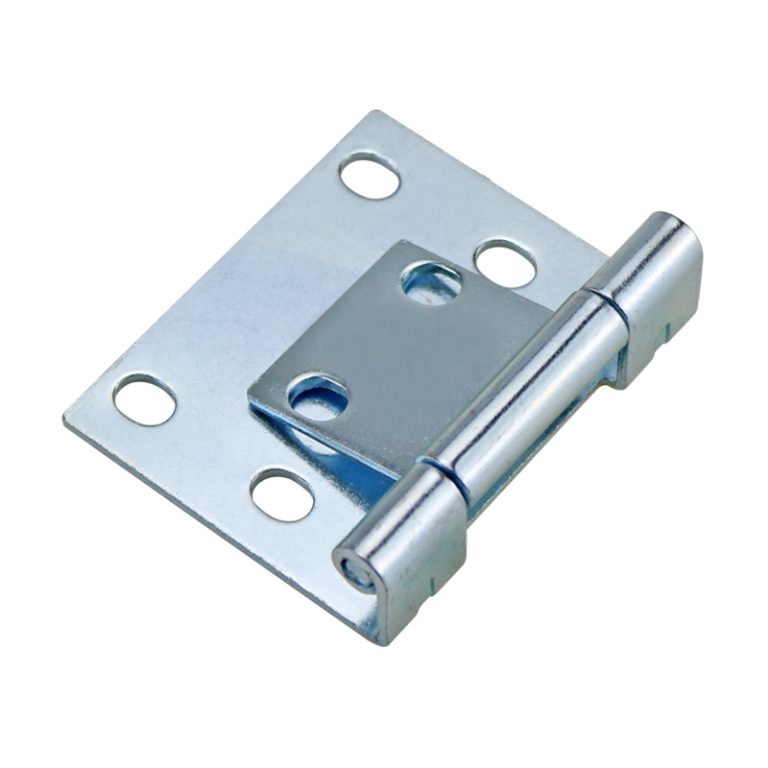
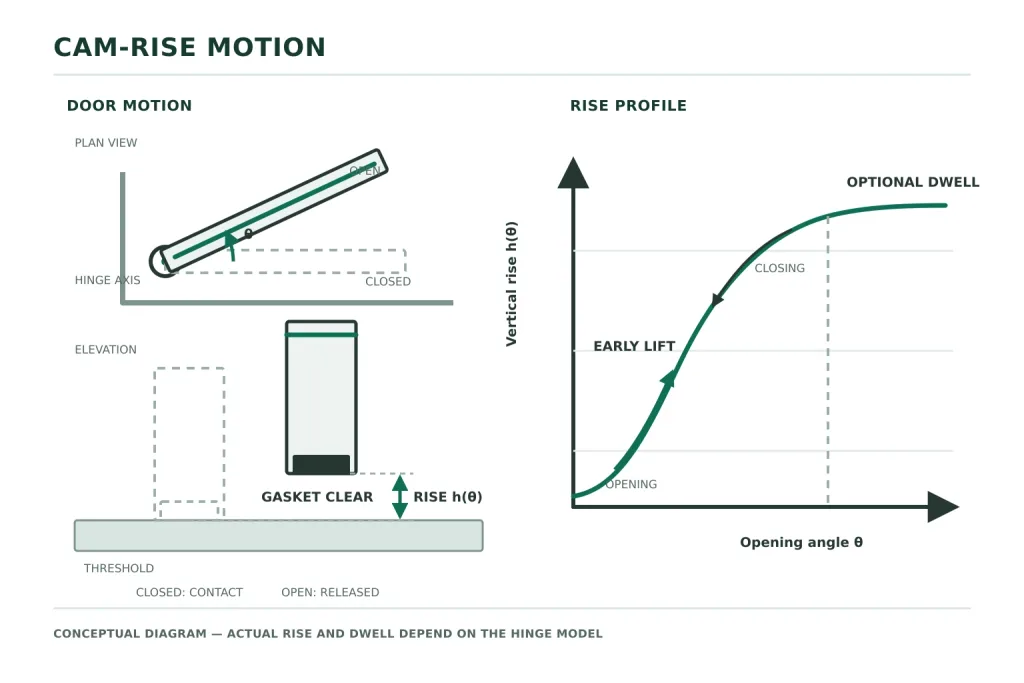
A cam rise hinge does more than rotate a door. As the door swings open, shaped cam surfaces force the hinge strap and door upward. When the door is released, its weight can drive the mechanism back down the cam toward the closed position. That rise-and-fall motion can lift a sweep gasket away from the floor, reduce dragging during the swing, and help return a gasketed door to its frame.
The name describes the motion, not a complete feature list. One cam-rise hinge may include a hold-open dwell, lift-off strap, reversible cam, or alignment adjustment. Another may have none of them. Some designs rely almost entirely on gravity for closing; others add a spring. Selecting by the words “cam rise” alone leaves too many door-system questions unanswered.
A cam-rise hinge uses a shaped cam interface to convert door rotation into controlled vertical travel. The rising path stores gravitational potential energy in the lifted door; the descending path can return that energy as closing torque.
The mechanism is a practical candidate only when the rise curve, door weight, gasket path, offset, handing, dwell behavior, paired-hinge arrangement, and operating environment work together on the complete door.
How a Cam Rise Hinge Creates Lift
A plain hinge constrains a door to rotation around a substantially fixed axis. A cam-rise hinge adds axial motion. One cam surface rotates relative to another, and the slope between them moves the supported door vertically as the opening angle changes.
Represent the vertical position of the door as h(θ), where θ is the opening angle. The useful specification is not only the total rise. It is the shape of that rise over the door’s working angle. A steep early ramp releases a bottom sweep quickly but raises opening effort sharply. A gentler ramp spreads the lift over more rotation. A flat segment creates little or no gravity-driven return and may be used as a dwell.
U(θ) = W · h(θ)
Door gravitational potential energy at angle θ
Door gravitational potential energy at angle θ
Here, W is the door’s weight force and h(θ) is its vertical rise from the closed reference position. Ignoring friction and other resistance, the gravity-derived torque magnitude associated with the cam slope is:
Tgravity(θ) = W · |dh/dθ|
Use θ in radians and h in meters for torque in N·m
Use θ in radians and h in meters for torque in N·m
This is a general energy relation, not a catalog rating or a complete sizing equation. Friction, cam contact geometry, impact, door acceleration, gasket resistance, latch forces, and mounting deformation still affect actual opening and closing behavior. The equation does show why two hinges with the same total rise can feel different: their rise may occur at different angles and with different local slopes.
Self-Closing Without Assuming a Spring
Opening the door lifts its mass. Releasing it on a descending cam allows gravity to lower the door and rotate it toward the frame. This is why a cam-rise hinge can be self-closing without an internal spring.
That statement has a limit. The door closes only where the available gravity-derived torque exceeds opposing resistance. Cam friction, misalignment, a dragging sweep, a stiff perimeter gasket, latch geometry, icing, cable drag, and a flexible mounting panel can consume the closing margin. Near a flat dwell, the cam contributes little return torque. On a floor or frame that is not level, the actual motion may also differ from the intended vertical path.
W · |dh/dθ| + Tspring(θ) > Tcam friction(θ) + Tgasket(θ) + Tlatch(θ) + Tother(θ)
Net closing condition at each required angle outside an intended dwell
Net closing condition at each required angle outside an intended dwell
For a gravity-only design, the spring term is zero. The inequality must still hold through the required closing range, not only at one catalog angle. Resistance can rise sharply as the sweep contacts the threshold, the perimeter gasket begins to compress, or the latch reaches its ramp.
A spring-assisted version adds stored spring energy to the mechanism. That may increase return capability, but it also changes opening effort, internal load, and service behavior. Projects that depend mainly on spring torque should use the dedicated spring hinge guide rather than treating every cam-rise hinge as a spring hinge.
| Feature | What creates it | What it does not guarantee |
|---|---|---|
| Vertical rise | Relative motion along the cam profile | Self-closing under every door load or resistance condition |
| Gravity-assisted closing | Door weight descending along a suitable cam slope | Final gasket compression, latch engagement, or controlled closing speed |
| Spring assistance | A separate spring stores and returns energy | Correct cam geometry, alignment, or acceptable opening effort |
| Hold-open dwell | A model-specific flat or stable region in the cam path | Rated restraint against impact, airflow, slope, or misuse |
| Lift-off removal | A separable strap, pin, or cam arrangement | That every cam-rise hinge is removable |
| Door adjustment | Slots, screws, eccentric parts, or an adjustment plate | Unlimited correction for sag, wrong offset, or structural distortion |
The Seal Releases Before the Door Sweeps
Gasketed doors create a motion conflict. The closed door needs controlled contact with the seal, but dragging that same seal across a threshold or floor during every opening cycle accelerates wear and increases operator effort. A properly matched cam rise can lift the door early enough to separate a bottom sweep from the floor before most of the swing occurs.
The benefit depends on where the gasket sits and how the door moves. A floor sweep needs vertical release. A perimeter compression gasket depends more strongly on door offset, frame contact, latch position, door sag, and how the closing path approaches the frame. Cam descent can help place the door into its closed elevation, but the hinge does not independently define seal pressure around the full perimeter.
The hinge closes. The door still leaks.
A door can descend fully on the cam while the latch pulls from the wrong position, the gasket bottoms out at one corner, or hinge-side sag leaves insufficient contact at the opposite edge. More cam rise will not correct every seal problem. The acceptance check must separate vertical door position, sweep clearance, perimeter contact, latch engagement, and frame flatness.
The broader choice among cold-room hinge types, corrosion conditions, insulated-door construction, and sealing requirements belongs in the cold storage hinge selection guide. For a cam-rise mechanism, the decisive question is whether its motion releases the sweep and returns the door without excessive effort or contact load.
Dwell Changes the End of Travel
A dwell is a region of the cam path intended to keep the door at an open angle or reduce its tendency to return. In an idealized rise curve, the dwell appears as a locally flat or stable section. Because dh/dθ approaches zero there, gravity contributes little closing torque until the door is moved out of that region.
Dwell angle is model-specific. So is the force needed to enter and leave it. Some cam-rise hinges have no dwell because the application requires continuous return toward closed. Others use a dwell beyond the normal passage angle so an operator can load equipment without holding the door. A catalog statement such as “hold open” should be translated into four questions:
- At what installed door angle does the dwell begin?
- How much travel is available before the door contacts a wall, guard, or adjacent assembly?
- What force is required to move the production door into and out of the dwell?
- What separate stop or restraint protects the hinge from overtravel and impact?
A dwell is a positioning feature, not a safety-rated door restraint. Do not use it as the only protection where an open door could move because of an uneven floor, vehicle motion, air pressure, impact, or personnel contact. The project risk assessment must define whether a separate hold-open or stop is required.
Rise Is Only One Selection Dimension
Total rise is easy to compare, but it does not describe the complete mechanism. The cam profile, useful angle range, interface materials, and installed architecture determine whether the number is useful.
| Supplier field | Engineering meaning | What to obtain or test |
|---|---|---|
| Rise versus angle | How quickly the door lifts and where gravity return is available | Curve, drawing, or measured door elevation at relevant angles |
| Closing behavior | Gravity-only, spring-assisted, or another return arrangement | Release behavior across the complete swing with production resistance |
| Dwell | Open-angle region with reduced return tendency | Engagement angle, release force, stability, and clearance to surrounding equipment |
| Handing or reversibility | Cam orientation required for left- or right-opening doors | Installed viewing convention and reversal procedure |
| Offset | Relationship between hinge axis, door face, frame, and gasket plane | Section drawing of the closed door and frame |
| Hinge-set arrangement | Whether upper and lower positions use identical or complementary parts | Approved pair, mounting elevation, and part-number location |
| Adjustment | Permitted correction of door position or gasket interface | Axes, range, locking method, tool access, and reference setting |
| Cam and bearing materials | Contact stress, friction, wear, corrosion, and temperature response | Material specification, lubrication condition, and environment limits |
| Structural rating basis | Door size and loading conditions represented by the rating | Door mass, width, center of gravity, hinge spacing, offset, and mounting substrate |
Do not combine values from unrelated models. A rise dimension from one hinge, a load rating from another, and a dwell angle from a third do not describe a valid assembly. The hinge set must be evaluated as one defined mechanism.
Door Weight Helps—and Loads the Cam
More door weight stores more gravitational energy for the same vertical rise. It also increases cam contact force, pin reactions, strap bending, fastener load, mounting-panel stress, and opening effort. Weight is therefore both the source of gravity-assisted return and a structural demand.
A light door may not develop enough gravity return to overcome gasket and mechanism resistance. A very heavy door may close positively but become difficult to raise or may exceed the hinge and mounting structure. Adding a spring can change the return margin, but it cannot repair an inadequate leaf, pin, fastener, or substrate.
Fhandle(θ) ≈ Trequired(θ) / r⊥(θ)
Preliminary opening-force relation at the specified handle point and direction
Preliminary opening-force relation at the specified handle point and direction
The handle distance and force direction must be stated. A torque measured at the hinge cannot be compared directly with a force measured at an unspecified door edge. Door width also increases the structural moment caused by a center of gravity located away from the hinge line, even though the energy needed for a given vertical rise is governed by door weight and rise. Use the hinge load-capacity guide for the separate structural calculation.
Offset, Handing, and the Hinge Pair
Offset Starts at the Closed Interface
Offset controls where the rotating and rising door sits relative to the frame. Start with a section through the closed assembly: door thickness, overlay or inset condition, gasket compression plane, frame projection, sweep position, hinge leaf seats, and required clearance. A hinge can have adequate rise and still place the door too far from the seal or too close to the frame during opening.
Handing Lives in the Cam Arrangement
A reversible housing does not prove that the installed cam is oriented correctly. Some designs are changed from left-hand to right-hand by repositioning a cam or strap. Others require a handed part number. Define the viewing side, hinge side, opening direction, and cam orientation on the assembly drawing. “Left” without a viewing convention is not enough.
The Hinge Pair Is One Mechanism
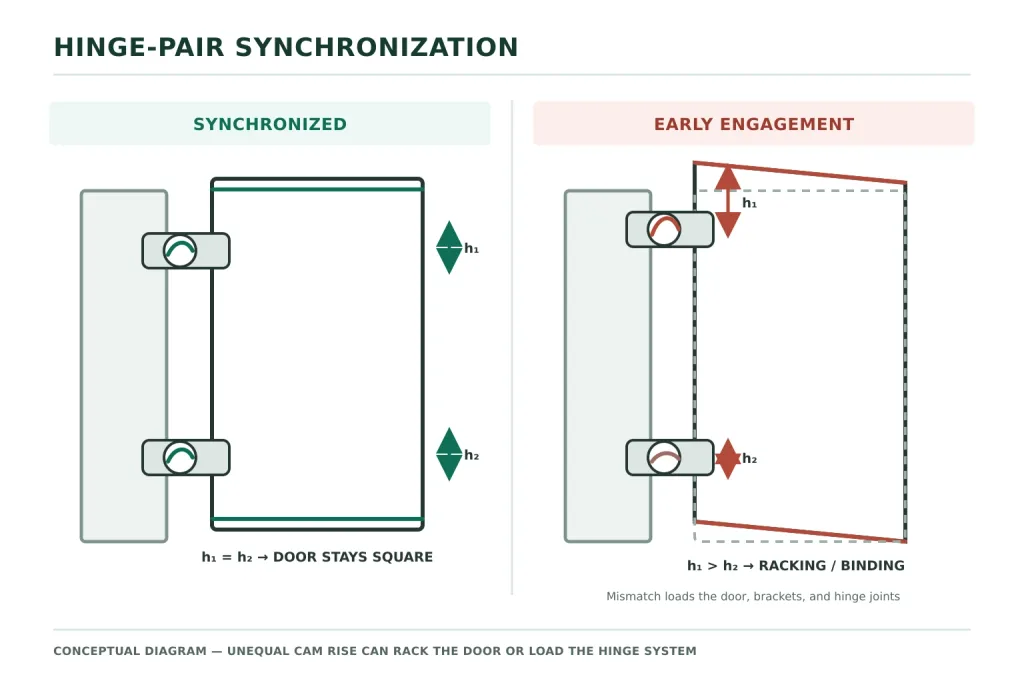
Some doors use matching rising hinges. Others use a specified upper and lower combination, or one primary cam mechanism with a complementary support hinge. The supplier’s set architecture matters. If two rising cams begin at different angular positions or sit at different elevations, one contact can carry load first while the other forces the door to twist.
The drawings fit. The cams do not share the rise.
Consider a door with two hinges that match the hole pattern and nominal offset. The upper cam begins lifting slightly before the lower cam because the parts are clocked differently or the mounting pads are not coplanar. The door opens, but the strap rocks, one cam edge polishes rapidly, and the gasket contact shifts after several operations. The problem is not insufficient catalog load. It is asynchronous motion inside a structure that can deform.
This example illustrates the mechanism; it is not based on customer or HTAN test data.
During installation, support the door independently and allow both cam interfaces to seat without using fastener tightening to pull the door into position. Observe whether the door rises evenly and whether either strap, flange, or mounting skin moves before the other cam engages.
Cold Changes the Contact Conditions
Low temperature changes the cam interface before it changes the name on the housing. Starting friction can rise as lubricant thickens, a polymer cam can respond differently under compressive load, and water or ice can obstruct the path that must carry the door upward.
The relevant material pair is the one carrying motion. A self-lubricating polymer cam sliding against a metal follower creates a different friction and wear condition from a hardened cam running on a roller. A stainless cover does not identify either interface.
- Identify the cam, follower or roller, bearing, and lubricant rather than relying on the outer finish.
- Measure breakaway force after the complete door has stabilized at its required operating temperature.
- Inspect whether the installed orientation traps water, ice, or abrasive debris on the cam path.
A room-temperature hand test cannot establish freezer-door behavior. The relevant evidence is the change in breakaway force, rise, return, and contact condition on the same installed hinge set after temperature stabilization.
When Cam-Rise Is the Wrong Mechanism
A cam rise hinge is useful only when vertical door travel is acceptable and valuable. Use this comparison while the required door path is still undecided.
| Door requirement | Cam-rise fit | Engineering direction |
|---|---|---|
| Release a floor sweep during opening and use door weight for return | Strong candidate | Match the rise-angle path to sweep clearance and acceptable opening force |
| Return a gasketed door toward closed without relying only on a spring | Possible | Prove gravity-derived torque exceeds resistance through the required closing range |
| Hold open at one defined angle | Possible with a dwell-equipped model | Specify dwell angle and release force; add a separate restraint where risk requires it |
| Hold at arbitrary angles | Poor fit by itself | Use a torque, friction, detent, stay, or separate position-control mechanism |
| Keep the door at one elevation throughout the swing | Wrong motion | Use a fixed-axis hinge or another clearance strategy |
| Provide controlled closing speed | Incomplete solution | Add a damper or closer designed for velocity control |
| Remove the door without tools | Model-dependent | Select a documented lift-off configuration; cam rise alone does not provide removal |
| Correct major frame error or ongoing sag | Wrong corrective method | Repair the mounting structure and select only the adjustment needed for normal setup |
| Operate where vertical lift creates overhead interference | Likely poor fit | Map the full swept and lifted envelope before selecting the mechanism |
Prove the Motion on the Complete Door
A loose hinge can show smooth cam action while the installed door binds. The representative assembly adds door mass, center of gravity, flexible skins, fastener compliance, gasket resistance, latch geometry, temperature, and the interaction between hinge positions.
- Map rise against angle. Record closed elevation, initial sweep release, normal passage angles, dwell entry if present, and the highest permitted opening position.
- Measure force at one handle point. Compare breakaway, mid-swing, dwell entry or release, and the final return toward the gasket and latch.
- Compare upper and lower engagement. Watch whether both cams begin rising together or one strap, flange, or mounting skin moves first.
- Separate the closing interfaces. Record sweep clearance, perimeter gasket contact, latch engagement, rebound, and final door elevation as different observations.
These four measurements are specific to the cam-rise decision. Production-intent assembly preparation, baseline control, environmental exposure, cycling, and before-and-after release criteria belong in the machine-door hinge assembly validation. There is no universal cycle count, opening-force limit, or wear allowance for every cam-rise door.
Put the Mechanism on the Drawing
“Cam-rise hinge, heavy duty” is not a usable specification. The drawing or quotation request must connect the hinge to the motion it is expected to create.
- Door mass, width, thickness, center of gravity, hinge spacing, and mounting structure
- Door-and-frame section showing offset, gasket plane, sweep, threshold, closed gaps, and available vertical clearance
- Required opening range, minimum sweep release, and the preferred rise-versus-angle behavior
- Gravity-only or spring-assisted return, dwell requirement, handing convention, and upper/lower hinge arrangement
- Operating-force measurement point and acceptable behavior at breakaway, dwell, and final closing
- Cam-interface materials, lubrication condition, temperature, moisture, ice, cleaning, and contamination exposure
The supplier response should identify the dimensional drawing, available rise or motion data, load-rating basis, cam and bearing materials, lubrication condition, handing instructions, hinge-set arrangement, adjustment method, and environmental limits. Where published data stops short of the final door, use a representative assembly instead of filling the gap with an assumed value.
Send the Door Section and Motion Requirements
For a cam-rise hinge discussion, provide the door and frame section, door mass and size, gasket and threshold geometry, opening direction, required rise or sweep release, dwell requirement, operating temperature, and available mounting space. HTAN can then compare those inputs with relevant hinge configurations and quotation requirements.
Cam-Rise Hinge FAQ
What is a cam rise hinge?
A cam rise hinge uses shaped cam surfaces to convert door rotation into vertical travel. The door rises as it opens and can descend under its own weight toward the closed position.
Is a cam lift hinge the same as a cam rise hinge?
The terms are often used for the same general mechanism: a hinge whose cam profile lifts the door during rotation. The supplier drawing still controls because rise curve, dwell, handing, lift-off construction, and adjustment vary by model.
Does every cam rise hinge self-close?
No. A suitable descending cam can use door weight to create closing torque, but the door closes only when that torque exceeds cam friction, gasket drag, latch resistance, misalignment, and other opposing loads. The cam path may also include a dwell with little return tendency.
Does a cam rise hinge need a spring?
Not necessarily. Many designs use the gravitational energy stored when the door rises. A spring-assisted model adds return force where the door and resistance require it, but also changes opening effort and internal loading.
How does a cam rise hinge reduce gasket wear?
The rising motion can lift a bottom sweep away from the floor or threshold before the door completes its swing. Perimeter gasket compression still depends on the full door system, including offset, alignment, latch position, frame condition, and gasket geometry.
What is dwell in a cam rise hinge?
Dwell is a model-specific cam region that reduces the door’s tendency to return at a defined open angle. It can provide convenient hold-open behavior, but it is not automatically a safety-rated restraint or structural stop.
Are cam rise hinges lift-off hinges?
Some are, but cam rise and lift-off describe different functions. Cam rise describes the door’s motion during rotation. Lift-off describes whether the door can be removed without fully dismantling the hinge. Verify both features separately.
What can cam rise hinge adjustment correct?
Model-specific adjustments may change vertical position, horizontal position, or gasket compression. They are intended for defined setup corrections, not for repairing a weak frame, wrong offset, incompatible cam pair, or hinge system that is structurally undersized.