






Industrial hinges, handles and latches for OEM equipment.
- +86 13720060320


Door Flex vs Latch Failure: Why Large Cabinet Doors Lose Seal
A large cabinet door can look fine from the outside and still be failing at the seal line. The gap looks small, the latch still closes, and the gasket looks intact — but the door is no longer holding enough compression to keep dust, moisture, noise, or pressure where they belong. For engineers and OEM teams, the real question is not “will the door close?” but whether the door still delivers enough seal pressure after repeated use, heat, vibration, and hardware wear.
This article focuses on one structural distinction that most leak checklists skip: when a large cabinet door loses seal pressure, is the door panel itself flexing, or is the latch and hardware failing to hold alignment? That difference decides whether you can repair the door or have to redesign it. The hands-on tests for confirming a worn gasket or a loose latch are covered in the companion diagnostic guides linked below; this page is about the door as a structure.
Why Large Doors Fail Differently
Large cabinet doors fail differently from small ones. A small door usually shows obvious latch trouble first. A large door can still latch while the frame, hinge line, or door skin moves just enough to reduce gasket compression — so the enclosure looks closed but is no longer sealed at the level the design intended.

For industrial and equipment cabinets, that matters because seal pressure is not cosmetic. It affects ingress protection, contamination control, acoustic containment, thermal management, and sometimes pressure balance. If the latch is doing all the work while the door itself flexes, the seal will degrade no matter how hard the latch pulls. The core question is simple: is the door losing seal pressure because the panel is flexing, or because the latch system is not holding alignment and compression? That distinction drives the fix.
Door Flex vs Latch Failure
Door flex means the panel itself deforms enough that the gasket line is no longer flat and consistent. It is common on larger, wider, or lighter-gauge doors because the span is longer and the panel has more room to bend. Once the door flexes, the latch may still engage, but the seal pressure is no longer uniform around the perimeter — typically weakest in the middle of the span.
Latch failure means the door structure is mostly sound, but the latch or strike is not pulling the door into the correct closed position — because it is worn, misaligned, loose, or no longer provides enough closing force. The door may sit slightly proud, leave a gap, or fail to draw the gasket fully into compression.
The practical rule: if the door bows in the middle or moves when you press on it, suspect door flex; if the door stays flat but the closing point is loose, shallow, or inconsistent, suspect latch failure. Confirming whether the latch hardware itself is loose, or whether the gasket has simply worn out, is a separate hands-on test — see the guide on telling a hinge-side leak from a latch-side leak for that triage. This article assumes you have narrowed it to the door structure.
How to Confirm Door Flex
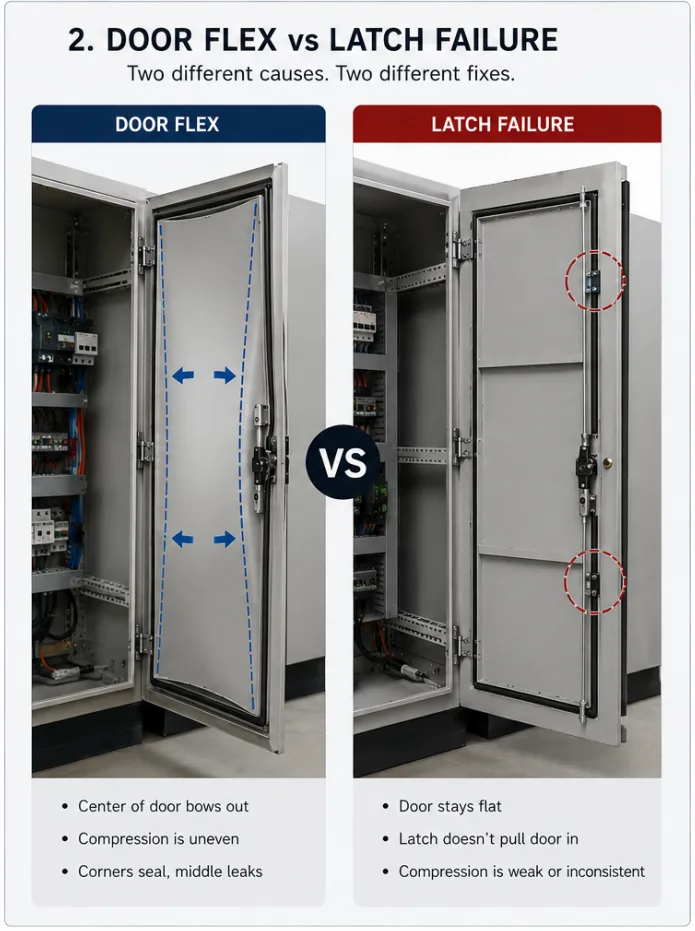
The fastest structural check is direct: with the door closed and latched, apply light pressure at the center of the panel. If the door moves enough to change the gap or shift the seal line, the panel is flexing. Large doors are especially prone to this because the center span has far less support than the hinge or latch edges. Then look at the gasket compression pattern — if the corners seal but the center shows lighter contact, that uneven pattern is the signature of flex rather than a worn gasket or a weak latch.
Flex has to be separated from two look-alikes before you act. A sagging hinge line can drop the latch side and mimic flex, so check for loose hinge fasteners and hinge-side movement; the hinge-selection root causes are covered in the guide to hinge selection errors that cause seal failure. An out-of-square frame can also prevent even gasket contact no matter how good the door is. Only once hinges and frame are ruled out should an uneven seal pattern be attributed to the panel flexing.
What Causes Door Flex
Large cabinet doors flex for predictable, structural reasons — and this is the part a hardware swap cannot fix:
- The panel span is too wide for its gauge or internal reinforcement
- The door skin lacks cross-bracing or structural ribs
- The gasket loads the door unevenly across a long perimeter
- Repeated opening and closing adds fatigue over time
- Heat or humidity changes how the panel material behaves
This is common in larger industrial enclosures because the door has to be light enough to operate comfortably but stiff enough to hold seal pressure. That is a design trade-off, not a simple hardware issue — which is exactly why a flexing door keeps defeating new latches and gaskets.
What Causes Latch Failure
Latch failure, by contrast, usually comes down to draw force, alignment, or wear: the latch does not have enough draw force for the span, the strike is misaligned, the components are worn or loose, or the geometry no longer matches the door position. It often begins as an adjustment problem and becomes a retention problem if the door or frame keeps moving. Where the latch must actively compress a gasket across a long span rather than just close a stiff door, the difference between basic closure and controlled compression is covered in the cam latch vs compression latch guide — and a long door often needs multi-point compression rather than a single latch fighting the whole span.
Failure Patterns That Point to Flex
| Field Pattern | Most Likely Cause |
|---|---|
| Center of the door bows out; corners still close | Door flex (panel span too weak) |
| Top or bottom latch-side corner won’t compress | Door twist or hinge sag |
| Seals sometimes, not others, after heat or vibration | Latch near its limit, or hinges loosening |
| Sealed at install, lost pressure after service cycles | Marginal latch force plus gradual structural shift |
| Tightening, magnets, or tweaks help only briefly | Root cause is structural, not mechanical |
The last row is the key tell: if screw-tightening, added magnets, or latch tweaks improve the door for a while but the problem keeps returning, the root cause is structural, and the door — not the hardware — is what needs to change.
Repair vs Redesign
If the cabinet is already built, the next decision is whether to repair or redesign. A repair is usually enough when the frame is square, the door panel is still stiff, and the loss of seal traces to loose or misaligned hinges or a worn, out-of-adjustment latch — all of which can be corrected with hardware.
A redesign is usually needed when the door panel visibly flexes under hand pressure, the gasket compression is inconsistent across the span, the latch is already at the limit of its adjustment range, or the problem returns after repeated service. Put simply: if the hardware is doing battle with a weak structure, the hardware will keep losing. A redesign may mean a heavier gauge, added ribs or cross-members, a stiffer door, or moving to multi-point latching so compression is shared along the span instead of concentrated at one point. For the hinge side of that upgrade, see HTAN’s heavy-duty hinges; for even, full-perimeter sealing force, see compression latches.
Specification Checklist for a New Door
If you are specifying a cabinet or enclosure door from scratch, treat it as a system — structure, hinges, latch, and seal together — so it does not pass assembly and then fail in the field.
- Door structure: width, height, thickness, skin gauge, reinforcement, and whether internal ribs or cross-members are needed for the span
- Hinge system: hinge count, size, and load rating; fastener and mounting reinforcement; field-adjustability
- Latch system: required draw force, strike alignment, and whether single-point or multi-point latching is needed to compress the gasket across a long span
- Seal system: gasket type, compression target, continuity, and the required ingress rating per IEC 60529 (IP Code)
- Service environment: indoor or outdoor, temperature cycling, vibration, washdown or contamination exposure, and service frequency
The Right Procurement Questions
For procurement and OEM teams, the useful questions are not “what hinge do we buy?” but structural ones: What seal pressure is required at the gasket line? How much door deflection is acceptable? Is the latch expected to correct flex, or only to close a stiff structure? Is multi-point latching needed on long doors? What field adjustments are realistic during maintenance? If a supplier cannot answer these clearly, the door is being specified as a loose collection of components rather than as a sealed door system.
FAQ
How do I know if the door is flexing or if the latch is failing?
Press on the closed, latched door at the center of the panel. If the panel moves enough to change the gap or seal line, door flex is likely involved. If the panel stays flat but the door does not draw in tightly at the closing point, the latch is the more likely cause. Rule out loose hinges and an out-of-square frame first, since both can mimic either symptom.
Can a stronger latch fix a large cabinet door that loses seal pressure?
Only if the real problem is latch draw force or misalignment. If the door panel is flexing, a stronger latch usually just masks the problem, because the panel still cannot hold uniform compression across the span. A flexing door needs a stiffer structure or multi-point latching, not simply more force at one point.
Why does a large door seal well at first and then get worse?
Repeated use, vibration, and thermal cycling can loosen hinges or shift latch alignment over time. A structure that is only marginally stiff at assembly can gradually drift out of uniform compression, so a door that sealed at install slowly loses pressure in service.
Should I replace the gasket first?
Not usually. A worn gasket can be a real cause, but if the door flexes or the latch is misaligned, a new gasket will not solve the root problem and the leak returns. Confirm the door structure and hardware alignment before replacing the seal.
When is redesign better than repair?
Redesign is the better path when the door panel itself flexes under hand pressure, the gasket compression is inconsistent across the span, the latch is already at the limit of its adjustment, or the same fix keeps returning after maintenance. Those are structural signals that hardware alone cannot solve.
Does a long door need multi-point latching?
Often yes. A single latch concentrates compression at one point, so a long door can seal near the latch and lose pressure toward the middle or the far corners. Multi-point latching spreads the draw force along the span and helps a large door hold uniform gasket compression.
Bottom Line
If a large cabinet door is losing seal pressure, do not assume the latch is the only problem. Press the panel, read the gasket compression pattern, and rule out hinges and frame first. If the panel flexes or the seal is uneven across the span, you are looking at a structural issue that a stronger latch or a new gasket will not durably fix. Share the door size, hinge layout, latch type, gasket target, and failure pattern, and HTAN can help evaluate the door structure, hinge system, and latch draw together — and recommend heavier hinges or multi-point compression latching where the span needs it.If you have not yet identified the primary cause, start with the [complete seal failure diagnostic guide] to work through every possibility.