HTAN is one of the leading manufacturers of industrial hinges, handles and latches in China.


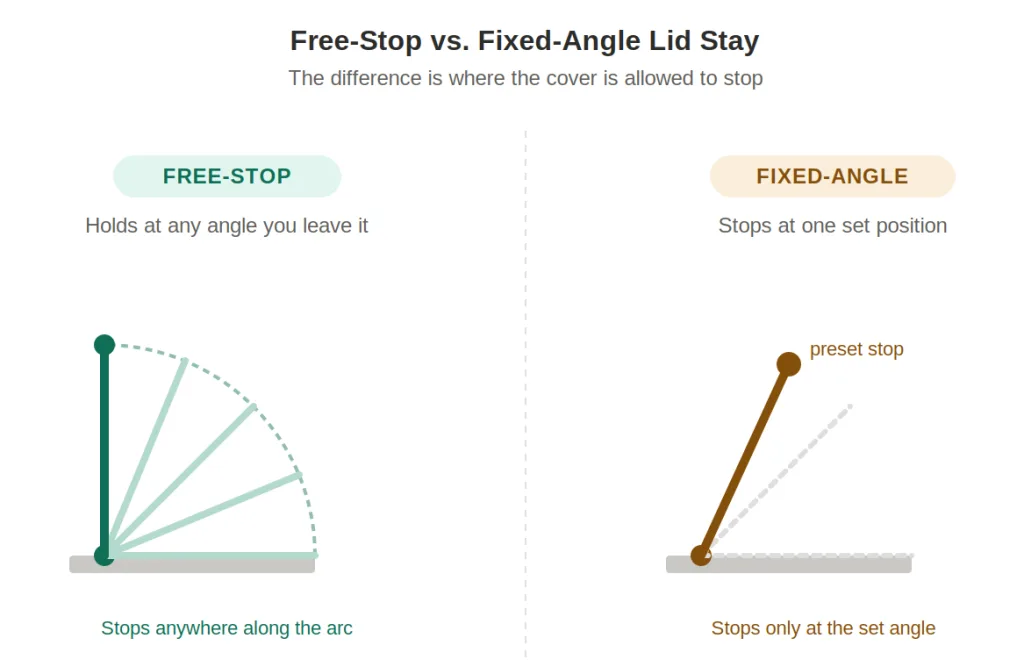
When you open an equipment cover and let go, where should it stop? That is the real difference between a free-stop and a fixed-angle lid stay. A free-stop lid stay holds the cover at any angle you leave it, anywhere along its travel. A fixed-angle lid stay holds the cover at one or more preset positions instead, stopping it at a defined opening angle every time.
Both types keep a cover from falling, but they solve different problems. Free-stop gives the operator flexibility when the working angle changes from task to task. Fixed-angle gives the equipment a repeatable open position when safety, clearance, or workflow needs the cover to stop in the same place each time.
This guide compares free-stop and fixed-angle lid stays for equipment covers across holding position, repeatability, safe clearance, operator workflow, and where each type fits best. It focuses on where the cover holds, not on what mechanism does the holding. The choice between friction, spring-damper, or other holding mechanisms is a separate decision.
Core question
Should the cover rest anywhere you leave it, or at one repeatable position?
Main difference
Free-stop = holds at any angle. Fixed-angle = holds at set positions.
Next step
Decide whether the operator needs free positioning or a repeatable open angle.
Key Takeaways
- A free-stop lid stay holds the cover at any angle along its travel, giving the operator full positioning flexibility.
- A fixed-angle lid stay holds the cover at one or more preset positions, giving a consistent, repeatable open angle.
- Choose free-stop where the cover needs to rest at varying angles during a task.
- Choose fixed-angle where a defined opening position matters for safety, clearance, or repeatable workflow.
- This decision is about where the cover holds. The holding mechanism and sizing must still be specified separately.
Quick Answer: Free-Stop or Fixed-Angle?
| If the cover… | Better choice | Why |
|---|---|---|
| Needs to rest at many different angles | Free-stop lid stay | Holds anywhere along its travel |
| Must open to the same angle every time | Fixed-angle lid stay | Stops at a defined preset position |
| Is adjusted often during a task | Free-stop lid stay | Reposition freely without a set stop |
| Needs a guaranteed safe clearance angle | Fixed-angle lid stay | Repeatable stop and predictable position |
| Is used by many operators the same way | Fixed-angle lid stay | Consistent opening every time |
A free-stop lid stay is best when the operator needs to hold the cover at different angles during a task. A fixed-angle lid stay is best when the cover must stop at a predictable open angle for safety, clearance, or repeatable workflow.
In short, free-stop lid stays win where flexibility matters. Fixed-angle lid stays win where consistency matters. How the cover is actually used — freely adjusted or opened the same way each time — usually decides it.
Selection Boundary: What This Article Does and Does Not Decide
This article helps decide the positioning type: whether the cover should hold anywhere or stop at defined angles. It does not decide the complete lid stay specification by itself. A final selection still needs the cover weight, cover size, hinge location, opening angle, mounting space, material, finish, and the holding mechanism.
This boundary matters because “free-stop” and “friction” are not the same question. Free-stop describes where the cover holds. Friction, spring-damper, or other internal mechanisms describe how the cover is held or controlled. A complete specification confirms both the position behavior and the mechanism.
Selection note: Do not choose only by the words “free-stop” or “fixed-angle.” First confirm how the cover is used, where it must stop, and whether the open position must be flexible or repeatable. Then choose the holding mechanism and size the stay to the actual cover.
What Each Type Is
Free-stop lid stay
A free-stop lid stay holds the cover wherever it is left, at any angle along its travel. There are no preset stops. The operator can place the cover at one angle for inspection, move it higher for component replacement, and leave it partly open again if the task changes.
Fixed-angle lid stay
A fixed-angle lid stay holds the cover at one or more defined positions. Instead of resting freely anywhere, the cover stops at a set opening angle. This makes the open position predictable, which is useful when the cover must clear nearby parts, avoid overtravel, or be used the same way by different operators.
Both types can be built using different holding mechanisms. The choice of friction or spring-damper is covered in the comparison of friction versus spring-damper lid stays.
The Practical Rule: Decide by Operator Behavior
The fastest way to choose between free-stop and fixed-angle is to watch how the cover is used. If the operator changes the opening angle during the task — for example to reach different components, reduce glare, route a cable, or work from different positions — a free-stop lid stay gives the needed flexibility. The cover can be placed where the task needs it, not where the hardware designer guessed it should stop.
If the cover is opened the same way every time, especially by multiple operators, a fixed-angle lid stay is usually more predictable. The cover stops at the intended angle, provides the same clearance each time, and reduces variation between users. In other words, choose free-stop when the task changes the angle, and choose fixed-angle when the process should control the angle.
Flexibility vs. Repeatability: The Core Difference
The defining trade-off is flexibility versus repeatability. A free-stop lid stay gives flexibility: the operator decides where the cover rests and can change it at will. This is ideal when the right opening angle depends on the task — reaching different components, working at different heights, or leaving just enough of an opening for airflow, inspection, or cable routing.
A fixed-angle lid stay gives repeatability: the cover opens to the same defined angle every time, no matter who opens it. This matters where a consistent position is part of safety or workflow — a known clearance angle, a predictable service position, or a stop that prevents the cover from swinging into a nearby wall, guard, cable, or moving component.
Safe Clearance and Repeatable Workflow
A fixed-angle stay is useful when the open position itself is part of the equipment design. The set angle can keep the cover away from moving parts, prevent it from blocking an operator’s view, avoid contact with nearby guards or walls, and leave a known access space for maintenance. This is not mainly about convenience; it is about making the open position predictable.
For example, a machine guard may need to stop before it reaches a moving assembly. A service cover may need to open far enough for a technician to remove a component but not so far that it hits a wall or cable tray. A fixed-angle lid stay can make that open position repeatable every time.
Free-stop designs are better when the safe working position changes with the task. A technician may need the cover partly open for inspection, higher for component replacement, and lower again when cables or test leads pass through the opening. In that case, forcing one fixed stop can make the work awkward. The safer choice is the one that matches the actual working pattern.
Single Fixed Stop vs. Multiple Fixed Positions
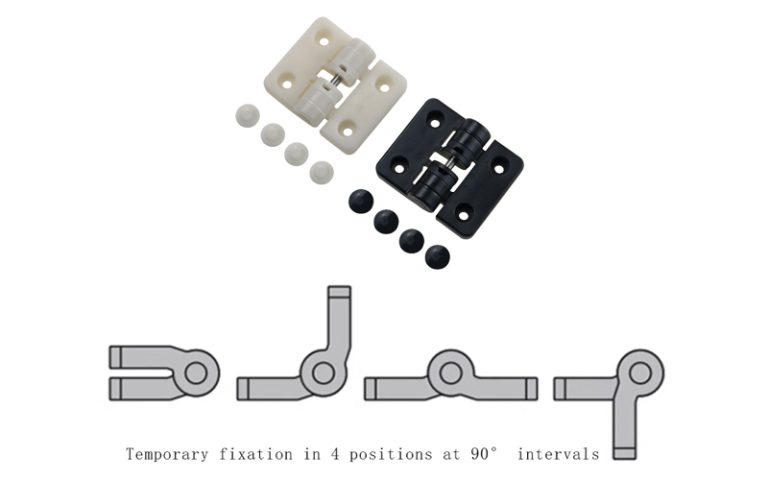
Fixed-angle does not always mean only one stop. Some lid stays are designed for one defined open position, while others offer several preset positions. A single fixed stop is best when the cover should always open to one known angle, such as a service lid that must clear a tool path or a guard that should not swing beyond a safe limit.
Multiple fixed positions are useful when the equipment needs a few known angles but not full free positioning. For example, one angle may be enough for inspection, while a wider angle may be needed for replacement work. This gives more flexibility than a single stop while still keeping each position repeatable.
The key difference is that a multi-position fixed-angle stay still stops only at defined positions. A free-stop stay, by contrast, can hold anywhere along its travel. If the operator only needs two or three known positions, multiple fixed stops may be more predictable than full free-stop behavior.
Where Each Type Fits
Free-stop lid stays suit equipment where access needs vary. On a machine cover that is opened to different angles depending on the job, or a lid that a technician repositions while working, the freedom to hold anywhere is a practical advantage. Anywhere the “right” opening angle changes from one use to the next, free-stop is the natural fit.
Fixed-angle lid stays suit equipment where a consistent open position matters. Covers that must open to a guaranteed safe clearance, enclosures used by many operators who should all open the cover the same way, or lids where a defined angle keeps the cover clear of hazards are all better served by a repeatable stop.
Whichever type fits, the stay still has to be sized to the cover weight and geometry. The broader lid stay family is explained in the comprehensive guide to lid stays, while opening-travel and folded-space choices are covered in the guide to telescopic versus two-fold lid stays.
Common Mistakes When Choosing Positioning Type
The first mistake is choosing free-stop only because it sounds more flexible. Free positioning is useful, but it also depends on the stay being sized correctly and on the operator placing the cover in a safe position. If every user should open the cover to the same clearance, a repeatable fixed stop may be safer than full flexibility.
The second mistake is choosing fixed-angle without checking the actual work task. A preset angle that looks clean on a drawing may not leave enough hand clearance, tool clearance, visibility, or component access in the real equipment. Before specifying a fixed stop, confirm the open angle against the largest component that must be reached and the space around the cover.
The third mistake is treating positioning type as the whole specification. Free-stop or fixed-angle only describes where the cover holds. The holding mechanism, load rating, opening angle, mounting points, material, and environment still have to be selected separately. A complete request should include both the desired stop behavior and the cover’s weight, size, and travel.
How to Decide
Start with how the cover is used, then weigh safety and consistency:
| Question | Points to… |
|---|---|
| Does the cover need to rest at varying angles? | Free-stop lid stay |
| Must it open to the same angle every time? | Fixed-angle lid stay |
| Is it repositioned often during a task? | Free-stop lid stay |
| Is a guaranteed clearance angle a safety need? | Fixed-angle lid stay |
| Do many operators use it the same way? | Fixed-angle lid stay |
| Does the task need only two or three known angles? | Multi-position fixed-angle stay |
| Does the task change unpredictably from use to use? | Free-stop lid stay |
The choice comes down to whether the cover benefits more from resting anywhere or from a guaranteed, repeatable position. Once that is settled, the holding mechanism and the sizing to the cover weight still need to be chosen to complete the specification.
What to Send Before Asking for a Recommendation
To choose the right positioning type, a supplier needs more than the words “free-stop” or “fixed-angle.” Send the cover weight, cover size, hinge location, desired opening angle or angles, how often the cover is opened, whether multiple operators use the equipment, and whether the cover must avoid nearby walls, guards, cables, or moving parts. A photo or drawing of the enclosure is also useful.
For a fixed-angle stay, state the required stop angle or the clearance that angle must provide. For a free-stop stay, describe the range of positions the operator needs during the task. This lets the manufacturer check both the positioning behavior and the holding capacity instead of guessing from the cover size alone.
FAQ
What is the difference between a free-stop and a fixed-angle lid stay?
A free-stop lid stay holds a cover at any angle along its travel, so the operator can leave it wherever the task requires. A fixed-angle lid stay holds the cover at one or more preset positions, stopping it at a defined opening angle every time. The core difference is free positioning versus a consistent, repeatable open angle.
When should I use a free-stop lid stay?
Use a free-stop lid stay when the cover needs to rest at varying angles depending on the task, or when it is repositioned often while someone works. Because it holds anywhere along its travel, it gives the operator control over the opening height. This flexibility suits machine covers and equipment lids where the right angle changes from one use to the next.
When is a fixed-angle lid stay the better choice?
A fixed-angle lid stay is the better choice when the cover should open to the same position every time — for a guaranteed safe clearance, to keep the cover clear of moving parts, or so that many operators all open it the same way. The repeatable stop makes the opening predictable, which supports safety and consistent workflow where a defined angle matters more than free positioning.
Is a free-stop lid stay the same as a friction lid stay?
Not exactly. Free-stop refers to where the cover holds: at any angle along its travel. Friction refers to one possible mechanism that can create that holding behavior. A free-stop lid stay is often achieved using friction, but the two terms answer different questions: free-stop is about positioning flexibility, while friction versus spring-damper is about the holding mechanism.
Can a fixed-angle lid stay hold more than one position?
Yes. A fixed-angle lid stay can be designed with one preset stop or several defined positions, depending on the application. What defines it is that the cover stops at set angles rather than resting freely anywhere. Multiple fixed positions give some choice while still keeping each position repeatable, which can suit equipment that needs a few known open angles rather than fully free positioning.
Does positioning type replace lid stay sizing?
No. Free-stop and fixed-angle describe where the cover holds, not whether the stay is strong enough for the cover. The lid stay still has to be sized to the cover weight, cover geometry, opening angle, and mounting points. A free-stop stay that is undersized may creep, and a fixed-angle stay that is poorly matched may not hold the cover safely at the intended position.
Bottom Line
Free-stop versus fixed-angle comes down to flexibility versus repeatability. Choose a free-stop lid stay when the cover needs to rest at varying angles and the operator should control where it holds. Choose a fixed-angle lid stay when the cover should open to a consistent, repeatable position for safety, clearance, or workflow. Decide by how the cover is actually used, remember that the holding mechanism and sizing are separate choices, and the right type is usually clear.
Selection note: Free-stop and fixed-angle describe where the cover holds, which is separate from the holding mechanism and from sizing. A complete specification confirms all three: the holding position type, the mechanism, and the size matched to the cover weight and travel.
If you can tell us how the cover is used, the opening angle or angles it needs, and its weight and size, HTAN can recommend a free-stop or fixed-angle lid stay to match — including free-stop positioning models and custom stop positions. As a manufacturer, we offer OEM stops, materials, and finishes, with samples for fit testing. Browse the lid stay range, or send your cover details for a recommendation.