HTAN is one of the leading manufacturers of industrial hinges, handles and latches in China.


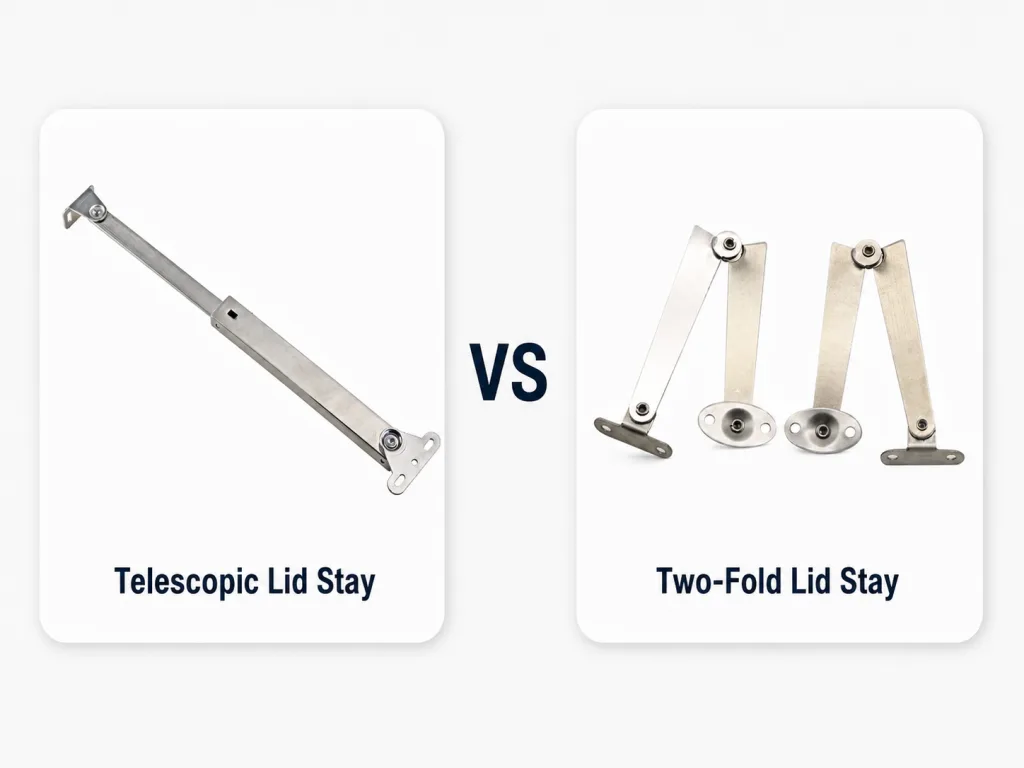
When a lid or top cover needs to be held open on an enclosure, two mechanisms handle the job in different ways. A telescopic lid stay extends and retracts along a sliding rod, giving a long, smooth opening travel that supports large or heavy covers. A two-fold lid stay is a jointed arm that folds flat when the cover is closed and unfolds to hold it open, taking very little space when packed away. Both hold a cover open safely, but they suit different covers — and the choice comes down to how far the cover opens and how much room there is for the mechanism when it is closed.
This guide compares telescopic and two-fold lid stays for enclosure covers across opening travel, folded space, cover weight, and where each fits best. It focuses on the two mechanism types, not on friction versus spring-damper or general lid stay selection, which are covered separately.
Core question
Does the cover need long opening travel, or the most compact folded size?
Main difference
Telescopic = long sliding travel. Two-fold = folds flat, compact when closed.
Next step
Check the opening angle needed and the space behind the closed cover.
Key Takeaways
- A telescopic lid stay slides along a rod for a long, smooth opening travel, suited to large or heavy top covers.
- A two-fold lid stay is a jointed arm that folds flat when closed, so it takes very little space in a shallow enclosure.
- Choose telescopic for wide opening angles and heavier covers; choose two-fold where folded space is tight or the cover is lighter.
- The deciding factors are opening travel and the space available behind the closed cover, not the cover alone.
Quick Answer: Telescopic or Two-Fold?
| If the cover… | Better choice | Why |
|---|---|---|
| Needs to open wide with long travel | Telescopic lid stay | Sliding rod gives long, smooth travel |
| Sits on a shallow enclosure with little internal space | Two-fold lid stay | Folds flat when closed |
| Is large or heavy | Telescopic lid stay | Rod supports higher load over travel |
| Is light and opens a modest amount | Two-fold lid stay | Simpler, compact, lower cost |
| Must keep a clean, compact closed profile | Two-fold lid stay | Arm folds out of the way |
In short, telescopic lid stays win on opening travel and support for larger covers, while two-fold lid stays win on compact folded size and simplicity for shallow enclosures. Opening travel and the space behind the closed cover usually decide it.
What Each Type Is
Telescopic lid stay
Uses a sliding rod that extends and retracts to guide the cover through a long opening travel. Because the rod supports the cover along that travel, it suits large or heavy top covers that open wide. It needs room for the rod to extend, but delivers smooth guided travel over a long stroke.
Two-fold lid stay
A two-fold lid stay, also called a folding support arm, is a jointed arm with a central hinge that folds flat when the cover is closed and unfolds to hold it open. Its main advantage is a very compact folded size, which suits shallow enclosures with little internal clearance. It is simple and low-cost, though its opening travel and load are more limited than a telescopic rod.
The full range of lid stay types and how they assemble is covered in the comprehensive guide to lid stays.
Opening Travel vs. Folded Space: The Core Difference
The defining trade-off is between opening travel and folded size. A telescopic lid stay is built for travel: the sliding rod carries the cover through a long, controlled stroke and supports it along the way, which is what a large top cover opening to a wide angle needs. The cost is that the rod needs space to extend, so the mechanism is less compact when closed.
A two-fold lid stay is built for compactness: the jointed arm collapses almost flat against the enclosure when the cover is shut, so it fits where there is little internal clearance. The trade is a shorter opening travel and generally a lighter load rating than a telescopic rod. So the choice is less about which is better and more about whether the priority is how far the cover opens or how little space the mechanism takes when closed.
Cover Weight, Cost, and Where Each Fits
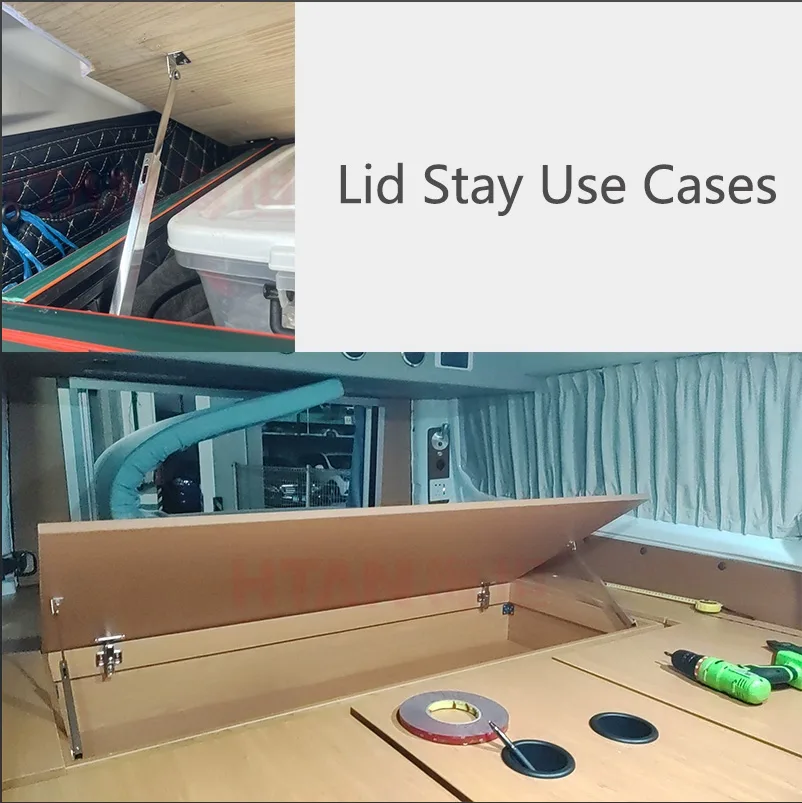
Telescopic lid stays tend to suit heavier covers and larger enclosures. The sliding rod can support more load across its travel, so a heavy steel top cover on an industrial enclosure that opens wide is a natural fit. They cost more and need clearance for the rod, but they deliver the travel and support a big cover requires.
Two-fold lid stays tend to suit lighter covers, shallow boxes, and cost-sensitive builds. The folding arm is simple, compact, and economical, which fits smaller enclosures, instrument boxes, and covers that open a modest amount. For a light cover where folded space matters more than long travel, the two-fold arm is usually the better fit. Whichever mechanism you choose, it still has to be sized to the cover — the sizing method is in the guide to calculating torque for lid stays.
How to Decide
Start with opening travel and folded space, then weigh cover weight and cost:
| Question | Points to… |
|---|---|
| Does the cover need to open wide with long travel? | Telescopic lid stay |
| Is internal space behind the closed cover very limited? | Two-fold lid stay |
| Is the cover large or heavy? | Telescopic lid stay |
| Is the cover light and cost a priority? | Two-fold lid stay |
| Must the mechanism stay compact when closed? | Two-fold lid stay |
The choice is really about whether the priority is opening travel or a compact folded size, then confirming the mechanism suits the cover’s weight. If soft-close behavior also matters, whether the stay should ease the cover shut is a separate question, covered in the comparison of friction versus spring-damper lid stays.
Common Mistakes When Choosing a Lid Stay Mechanism
Most selection problems trace back to a measurement that was skipped rather than the wrong type in principle:
| The mistake | What it risks |
|---|---|
| Choosing a telescopic stay without checking rod extension space | The rod hits internal components or the enclosure wall as the cover opens |
| Choosing a two-fold stay only because it is compact | The cover cannot open far enough, leaving too little access for service |
| Ignoring cover weight after picking the mechanism | An undersized stay does not hold; an oversized one makes the cover stiff to move |
The pattern is the same in each case: the mechanism type is only half the decision. The other half is checking the space the mechanism needs — extension room for a telescopic rod, folded clearance for a two-fold arm — and matching the size to the actual cover weight.
What to Send Before Asking for a Recommendation
A recommendation is only as good as the details behind it. To match a telescopic or two-fold lid stay to your cover, the following information lets a manufacturer size it correctly the first time:
- Cover weight, and its size and shape
- The opening angle the cover needs to reach
- The internal clearance behind the cover when it is closed
- The side-wall area available for mounting the stay
- Whether soft-close or drop protection is also needed
- A photo or drawing of the enclosure, if possible
FAQ
What is the difference between a telescopic and a two-fold lid stay?
A telescopic lid stay uses a sliding rod that extends and retracts for a long, smooth opening travel, suited to large or heavy covers. A two-fold lid stay is a jointed arm that folds flat when the cover is closed, so it takes very little space in a shallow enclosure. The core difference is long sliding travel versus a compact folded size.
When should I use a telescopic lid stay?
Use a telescopic lid stay when the cover needs to open wide with a long travel, or when it is large or heavy. The sliding rod supports the cover through its stroke and controls a long opening motion, which suits heavy steel top covers on industrial enclosures. It needs clearance for the rod to extend, so confirm there is room for it behind the cover.
When is a two-fold lid stay the better choice?
A two-fold lid stay is the better choice for shallow enclosures with little internal space, lighter covers, and cost-sensitive builds. Its jointed arm folds nearly flat when the cover is closed, so it fits where a telescopic rod would not have room to extend. The trade is a shorter opening travel and generally a lighter load rating.
Which lid stay supports a heavier cover?
A telescopic lid stay generally supports a heavier cover, because the sliding rod carries load along its full travel and is built for larger top covers. A two-fold arm can handle lighter to moderate covers but has a more limited load and travel. For a heavy steel cover that opens wide, a telescopic stay is usually the more reliable choice, sized to the actual cover weight.
Does a two-fold lid stay take less space than a telescopic one?
Yes. A two-fold lid stay folds nearly flat when the cover is closed, so it takes much less internal space than a telescopic rod, which needs room to extend and retract. This compact folded size is the main reason to choose a two-fold arm for a shallow enclosure. If space behind the closed cover is limited, the two-fold arm is usually the more practical fit.
Bottom Line
Telescopic versus two-fold comes down to opening travel versus folded space. Choose a telescopic lid stay when the cover is large or heavy and needs to open wide with a long, supported travel, and you have room for the rod to extend. Choose a two-fold lid stay when the enclosure is shallow, the cover is lighter, or a compact folded size and lower cost matter most. Match the mechanism to the opening travel and the space behind the closed cover, then size it to the cover weight — and the choice is clear.
Selection note: Confirm both the opening angle the cover needs and the internal clearance when it is closed before choosing. The same cover can call for a different mechanism depending on how far it opens and how much room sits behind it, so measure both rather than assuming a type alone.
If you can tell us the cover weight, size, opening angle, and the space behind the closed cover, HTAN can recommend a telescopic or two-fold lid stay to match — including the TX-series telescopic and flip-down two-fold models. As a manufacturer, we offer OEM stroke, material, and finish, with samples for fit testing. Browse the lid stay range, or send your cover details for a recommendation.