HTAN is one of the leading manufacturers of industrial hinges, handles and latches in China.


A battery energy storage system may include several access doors within the same cabinet or enclosure. A battery compartment door, power-electronics door, control-service panel, and cooling-access door can differ in weight, opening frequency, sealing requirement, and door-mounted hardware.
For that reason, BESS cabinet door hinges should not be specified from the words “battery storage cabinet” alone. Each moving door assembly must be reviewed using its complete mass, center-of-gravity position, opening geometry, service task, mounting structure, and required closed-position repeatability.
This guide focuses on the door-level decisions that distinguish a battery energy storage enclosure from a general outdoor cabinet specification. It does not assume that battery modules are mounted on the door or that every BESS cabinet is opened at the same frequency.
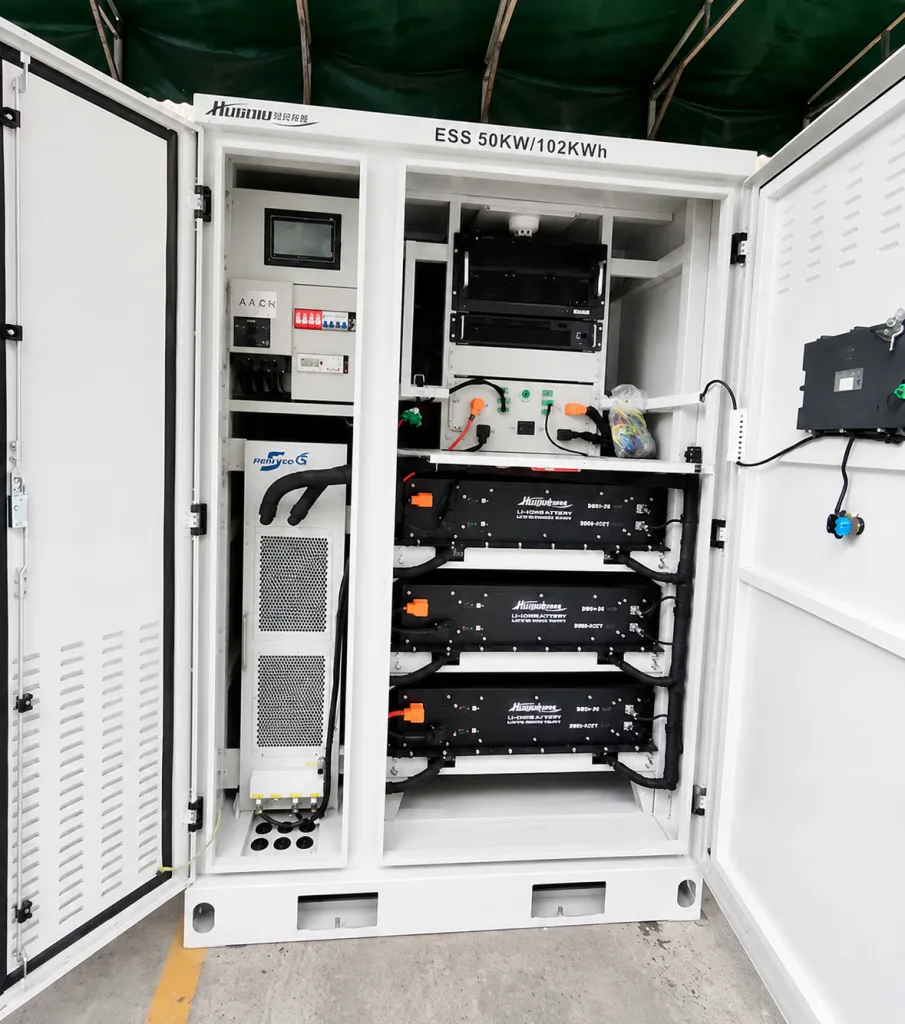
An open BESS cabinet showing separate equipment compartments, service doors, hinge positions, latches, and door-mounted components.
Quick Answer
A BESS cabinet hinge should be specified from three connected inputs:
- Complete moving-door load: The mass, center of gravity, dimensions, and accessories of the assembled door
- Door-specific access profile: The actual commissioning, inspection, cooling-service, fault-response, and component-access tasks
- Closed-position repeatability: The ability of the hinge, mounting structure, latch, and gasket arrangement to return the door to the required position after use, transport, and installation
Do not select the hinge from door size, outdoor exposure, or a catalog load number alone.
Scope boundary: This page assumes the general outdoor-enclosure requirements have already been defined. For the broader sequence covering protection rating, corrosion environment, door loading, vibration, installation, and access method, use the outdoor enclosure hinge selection path.
What Makes BESS Door Requirements Different?
A BESS cabinet does not automatically require one special hinge category. The difference is that one system may contain several doors with different functions, and those functions affect the hinge specification.
The table below shows possible door roles. It is not a universal BESS architecture; the actual equipment drawing remains the controlling reference.
| Possible door function | What may change the hinge requirement | What to confirm |
|---|---|---|
| Battery-compartment access | Large door dimensions, reinforcement, interlocks, internal barriers, or restricted service procedures | Complete door assembly, permitted opening angle, access procedure, and latch arrangement |
| Power-electronics or control access | HMI panels, switches, wiring, indicators, or equipment mounted to the door | Door-mounted accessory mass, cable movement, bonding strap, and operating clearance |
| Cooling or filter-service access | Fans, filters, louvers, insulation, or cooling-service hardware | Service interval, rear clearance, airflow components, and repeated alignment |
| Inspection or fault-response panel | Different access frequency from the main cabinet door | Expected service profile, tool access, removal needs, and closing repeatability |
The hinge should therefore follow the individual door rather than a single cabinet-wide assumption. Two doors on the same BESS enclosure may legitimately require different hinge sizes, mounting methods, or support arrangements.
Define the Complete Moving Door Assembly
The bare sheet-metal panel is not the complete design load. The hinge review should use every component that moves with the door.
Include These Items in the Door Assembly Record
- Door panel, frame, reinforcement, and insulation
- Locks, latches, rods, handles, and internal linkage
- Windows, HMI panels, switches, indicators, or warning panels
- Fans, filters, louvers, vents, or cooling-service components
- Fire-detection, monitoring, or other equipment actually mounted to the door
- Bonding straps, moving cable bundles, and cable retainers
- Fasteners, inserts, hinge leaves, and mounting brackets
- Any project-specific component shown on the moving-door drawing
Battery module mass should be included only when the project drawing actually mounts a module or another heavy battery component to the moving door. It should not be added as a general assumption for all BESS cabinets.
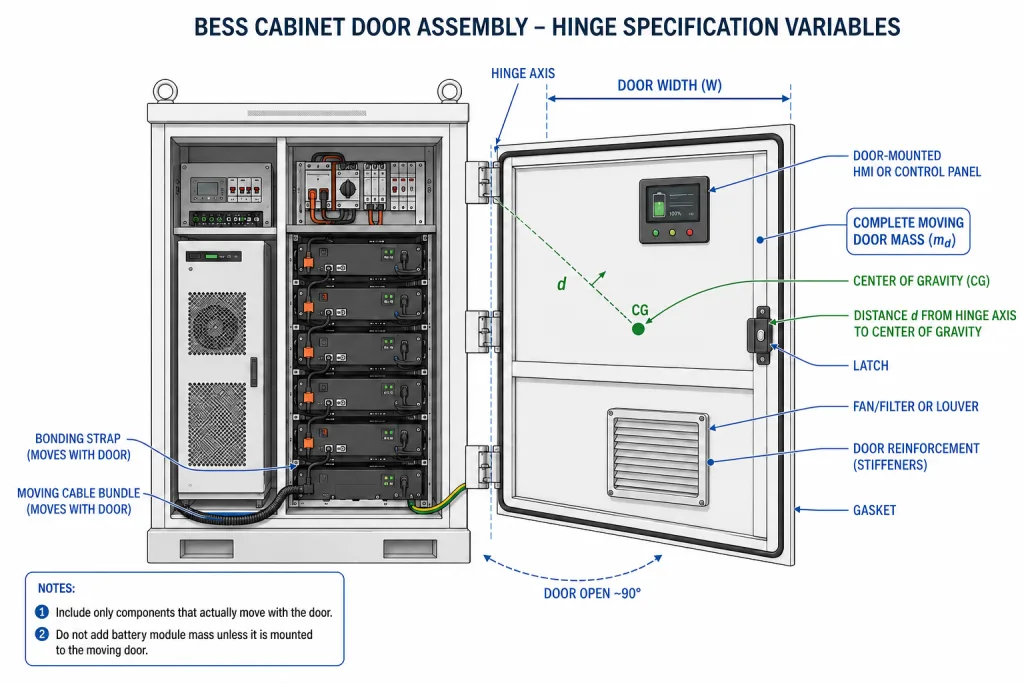
BESS cabinet door assembly showing the hinge axis, complete moving-door mass, center of gravity, door-mounted accessories, gasket, latch, bonding strap and moving cable bundle.
Use Door Mass and Center of Gravity Together
Door mass alone does not describe the hinge demand. The distance between the hinge axis and the door assembly’s center of gravity determines the turning effect produced by that mass.
A narrow, dense door and a wide door of the same weight can impose different demands on the hinge and mounting structure. The review should record:
- Complete moving-door mass
- Door width and height
- Center-of-gravity distance from the hinge axis
- Number and spacing of hinges
- Mounting-hole position and surrounding reinforcement
- Required opening angle and any external stop
Use the complete geometry to calculate door moment from mass and center of gravity. This BESS page does not repeat the general load formulas or safety-factor method covered in that guide.
Engineering check: If the door must be lifted, pushed sideways, or forced toward the frame before the latch engages, the problem should not be accepted as normal operating behavior. Recheck hinge capacity, mounting stiffness, alignment, and door deflection.
Define the Real Access Profile for Each Door
There is no universal opening frequency for every BESS cabinet. Some doors may remain closed during normal operation, while others may be opened more often during commissioning, filter replacement, cooling-system service, fault response, or component work.
Instead of labeling the system as “frequent access” or “low maintenance,” define the expected tasks for each door.
| Access task | What to record | Why it matters |
|---|---|---|
| Factory assembly and commissioning | Expected opening cycles before final handover | Commissioning may create a different short-term duty profile from normal operation |
| Routine inspection | Planned monthly or annual access by door | Defines the expected operational cycling requirement |
| Filter or fan service | Service interval and access duration | Cooling-access doors may cycle more often than sealed electrical compartments |
| Coolant-system access | Inspection or maintenance procedure where applicable | Liquid-cooled designs may have different service doors and interference risks |
| Fault response | Emergency or corrective-maintenance access assumptions | Access must remain practical after transport, outdoor exposure, and long closed periods |
| Component replacement | Required opening angle, tool clearance, and temporary door support | Major service tasks may require more clearance than normal inspection |
The cycle requirement should come from the OEM’s project specification and service plan. It should not be copied from another cabinet type or estimated from the BESS label alone.
Screen the Hinge Architecture Against the Door Function
The following table is a preliminary screening tool, not a substitute for load calculation, drawings, and prototype verification.
| Door condition | Architecture to evaluate | Main review point |
|---|---|---|
| Compact, moderate-load access door with strong local reinforcement | Multiple butt or surface-mounted hinges | Local mounting stress, hinge spacing, alignment, and fastener access |
| Tall or wide door where maintaining the hinge-side gap is difficult | Continuous or distributed-support hinge | Load distribution, installation straightness, corrosion path, and full-length mounting |
| Panel that must be removed during planned service | Lift-off or removable hinge arrangement | Safe removal direction, wiring and bonding disconnection, lifting procedure, and reinstallation alignment |
| Door with limited exterior clearance | Concealed, offset, or low-projection arrangement | Opening geometry, gasket path, internal interference, and service accessibility |
A continuous hinge is not automatically the correct choice for every BESS cabinet. Consider it when door width, local mounting stress, hinge-side gap control, or distributed support justifies the additional length and installation requirements.
Check Seal and Alignment Repeatability
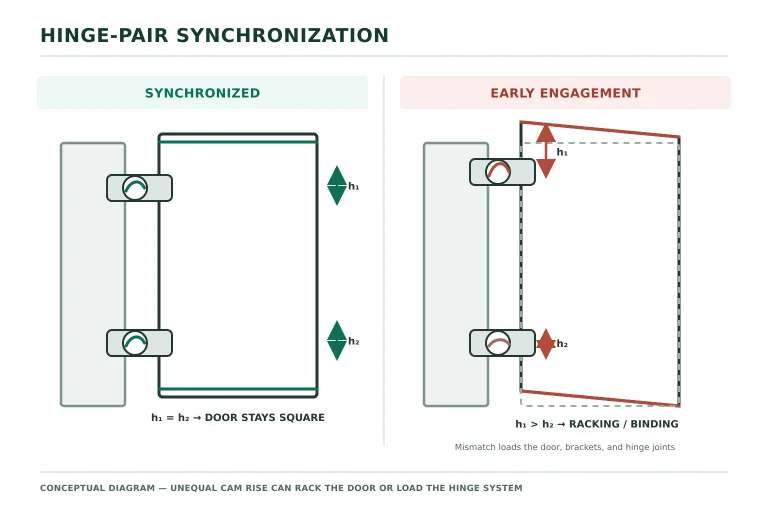
An enclosure seal depends on the complete door assembly returning to the intended closed position. The hinge does not create the protection rating by itself, but hinge play, mounting movement, door sag, or frame distortion can change how the gasket contacts the door.
Before and after the required cycling, record:
- Hinge-side, latch-side, top, and bottom door gaps
- Whether the latch engages without lifting or forcing the door
- Visible change in gasket contact or compression pattern
- Local over-compression or loss of contact near the hinge side
- Fastener movement, insert pullout, or deformation around mounting holes
- Radial or axial play that was not present before testing
Where the project specifies an enclosure protection target, use the separate guide to translate the enclosure rating into door and seal requirements. Do not describe an individual hinge as providing the complete cabinet’s IP or NEMA rating.
Recheck the Door After Transport and Installation
A door that aligns correctly at the factory may change after the cabinet is transported, lifted, anchored, or installed on an uneven support structure. Large cabinets and enclosure assemblies should therefore include door-function checks at more than one stage.
| Inspection stage | What to check |
|---|---|
| Factory assembly | Door gaps, hinge fasteners, latch engagement, opening angle, gasket contact, and accessory clearance |
| After transport | Door sag, frame movement, loosened fasteners, latch alignment, and damaged stops |
| After lifting or site placement | Changes caused by cabinet twist, lifting points, temporary supports, or foundation condition |
| After final anchoring | Final door position, operating force, gasket contact, and full-range cable or bonding clearance |
If the door position changes after anchoring, do not correct the symptom only by forcing the latch or adding gasket compression. First determine whether the cabinet frame, mounting surface, hinge position, or door reinforcement has moved.
Verify Bonding Strap and Cable Clearance
Do not assume that a moving hinge automatically provides the intended electrical bonding path unless that function has been specifically designed and verified.
Where a dedicated bonding strap or moving cable bundle is used, verify that it:
- Remains clear of the hinge leaves, pin, and fasteners
- Does not become trapped between the door and gasket
- Has sufficient length through the full opening angle
- Does not rub against sharp panel edges or moving linkage
- Does not pull the door away from its intended closed position
- Remains inspectable after the enclosure is installed
System-Level Boundary
A hinge does not carry the BESS system certification or enclosure protection rating by itself. The door, frame, hinge, fasteners, latch, gasket, mounting penetrations, cooling interfaces, cables, and enclosure structure must be reviewed as the complete assembly.
Any change to the hinge model, mounting location, fastener, door reinforcement, gasket, or opening geometry should follow the OEM’s engineering-change and validation process.
How This Differs From a Solar Inverter Cabinet
Solar inverter cabinets and BESS cabinets can share outdoor exposure, thermal cycling, corrosion, and sealing requirements. The difference is not that one category always uses a stronger hinge. The difference is that BESS projects may contain several door functions with different access and equipment interfaces inside one enclosure system.
For an inverter cabinet primarily driven by UV exposure, temperature cycling, wind, and long unattended outdoor service, use the separate guide to solar inverter cabinet hinge requirements. This BESS guide remains focused on door-by-door assembly data, access tasks, transport checks, and closed-position repeatability.
BESS Door Hinge Specification Mistakes
| Specification gap | What may appear later | Corrective action |
|---|---|---|
| Using bare panel weight instead of the complete moving-door assembly | Unexpected sag, mounting stress, or difficult latch engagement | Record all components that move with the door |
| Adding battery module weight without checking the actual drawing | Oversized or poorly matched hinge specification | Include only components mounted to the moving door |
| Assuming every BESS door has the same access frequency | Some hinges are over-specified while service doors are under-specified | Define the service profile for each door |
| Selecting a continuous hinge only because the equipment is a BESS cabinet | Unnecessary cost, installation complexity, or poor fit | Base the architecture on door width, load, alignment, and mounting stress |
| Treating the hinge as the source of the IP or NEMA rating | Incomplete system verification | Evaluate hinge, door, latch, gasket, frame, and penetrations together |
| Checking alignment only before shipment | Door or latch problems appear after lifting and anchoring | Repeat the inspection after transport and final installation |
| Ignoring the bonding strap or moving cables | Pinching, abrasion, limited opening, or altered door position | Verify clearance through the complete opening range |
Do Not Release the Hinge From a Catalog Rating Alone
A catalog load value does not confirm the door’s center of gravity, mounting stiffness, fastener condition, gasket interaction, latch alignment, transport shift, or cable clearance. The complete door assembly must still be verified.
BESS Door Data Sheet
Complete one data sheet for each door rather than one generic form for the entire cabinet.
| Parameter | Project input |
|---|---|
| Door function | Battery, electrical, control, cooling, inspection, or other access |
| Complete moving-door mass | Include all door-mounted hardware and accessories |
| Door dimensions | Width, height, thickness, and reinforcement |
| Center of gravity | Distance from the hinge axis |
| Opening requirement | Minimum angle, maximum angle, and any door stop |
| Hinge mounting | Surface, concealed, weld-on, bolted, continuous, removable, or open to review |
| Fasteners and structure | Material, thickness, inserts, reinforcement, and hole pattern |
| Access profile | Commissioning, routine inspection, cooling service, fault response, and replacement tasks |
| Outdoor environment | General outdoor, coastal, humid, industrial, or project-specific exposure |
| Protection target | Specified enclosure-level IP or NEMA requirement |
| Latch and gasket | Latch location, closing direction, gasket type, and contact arrangement |
| Door-mounted services | Cables, bonding strap, HMI, fan, filter, sensor, or other components |
| Transport and installation check | Required inspection points after shipment, lifting, placement, and anchoring |
| Acceptance criteria | Door gap, hinge play, operating force, latch engagement, and mounting condition |
Frequently Asked Questions
Are BESS cabinet door hinges a separate hinge category?
Not necessarily. A BESS cabinet may use butt, continuous, concealed, removable, or other industrial hinge arrangements. The correct architecture depends on the individual door assembly, load, center of gravity, service task, mounting structure, and sealing requirement.
Should battery module weight be included in the hinge load?
Only when the project drawing actually mounts a battery module or another heavy battery component to the moving door. Otherwise, calculate the load from the complete door panel, reinforcement, latches, HMI, cooling hardware, cables, bonding strap, and other components that move with the door.
Is a continuous hinge always better for a BESS cabinet?
No. A continuous hinge may help distribute load or control the hinge-side gap on a tall or wide door, but it also changes installation, corrosion, alignment, and service requirements. The decision should be based on the complete door geometry and mounting structure, not the BESS application name alone.
Can a hinge guarantee the cabinet’s IP or NEMA rating?
No. The protection rating applies to the evaluated enclosure assembly. Door position, hinge mounting, latch engagement, gasket contact, fasteners, penetrations, and frame structure all affect the result.
How should the hinge cycle requirement be defined?
Define the cycle requirement from the expected tasks for each door, including factory assembly, commissioning, routine inspection, filter or cooling service, fault response, and component replacement. Do not apply one assumed opening frequency to every BESS door.
BESS Door Specification Handoff
A BESS hinge request is ready for supplier review only after the moving-door assembly has been defined. The handoff should identify the complete door mass, center-of-gravity position, opening range, door-mounted accessories, access profile, target enclosure requirement, latch and gasket arrangement, mounting structure, and post-installation inspection points.
Do not release the hinge part number from a catalog load value alone. The completed door should return to its specified closed position without manual lifting, abnormal latch force, unacceptable hinge-side gap growth, mounting movement, or interference with the bonding strap and moving cables.
If those conditions have not been recorded and checked, the hinge may have been selected, but the BESS door assembly has not yet been fully verified.
Submit a BESS Door Assembly for Review
Send HTAN the assembled-door drawing, complete moving mass, center-of-gravity position, opening requirement, access profile, mounting structure, latch and gasket arrangement, and required inspection criteria.